
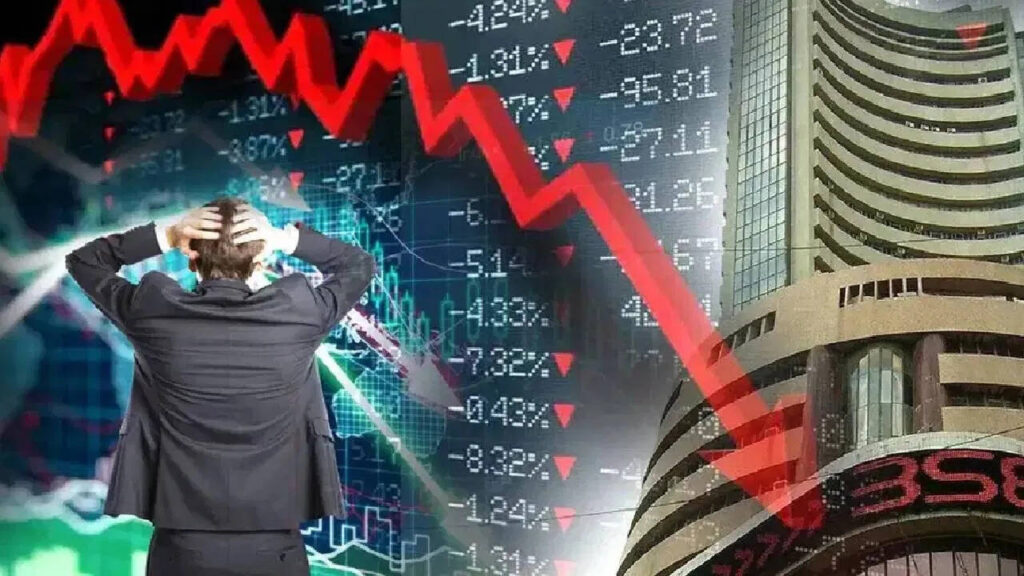
The Indian stock market continues to decline. On the third trading day of the week, on Wednesday, both the Sensex of the Bombay Stock Exchange (BSE) and the National Stock Exchange (NSE) Nifty opened on the red mark. The Sensex dropped more than 300 points, while the Nifty recorded a decline of 90 points. In early trade, automobile stocks also saw a huge decline, including major stocks such as Tata Motors and Ashok Leyland. There are many major reasons behind this instability of the market, mainly the policies of former US President Donald Trump and weakness of Indian rupee.
Sensex-Nifty’s poor start
As soon as the market opened, the Sensex opened from its previous closed level 82,102.10 to 81,917 and slipped more than 382 points in a few minutes to 81,720.29. Similarly, the Nifty also fell from the previous closed level of 25,169.50 to 25,108.75 and soon broke over 100 points to 25,053. This is the decline of the third consecutive day which is increasing the concerns of investors. However, some companies also saw a slight jump in shares. Shares of 994 companies were in decline in early trade, while shares of 1204 companies opened in a slight increase.
Most falling shares
In early trade, 24 out of 30 shares of Sensex were in decline. The most affected shares included Tech Mahindra (1.71%), Tata Motors (1.70%) and Bharti Airtel (1%). The Midcap segment also saw a sharp decline in KEI shares (2.50%) and Ashok Leyland (2.30%). IIL stock (7.86%) and Bajaj Consumers (4.20%) were the most broken among smallcap companies. These figures indicate extensive selling in the market, as investors are keeping distance from risky shares.
Three major reasons for market fall
There are three major factors behind this fall in the Indian stock market:
Trump’s tariff: Former US President Donald Trump had talked about imposing 50% high tariffs, which is still visible on the Indian market. This tariff policy can affect global trade relations and negatively impact India’s exports, weakening the morale of investors.
H1B visa fee increase: Another policy of Trump, an increase in H1B visa fee has also spoiled the market sentiment. This step can especially affect Indian IT companies, whose income comes from American projects. Fearing this policy, many IT shares were seen to decline.
Weakness in rupee: The continuous decline in Indian rupee is also a major concern for the market. The rupee has reached its lowest level so far, making imports expensive and the investment of foreign investors may be reduced. A weak rupee may be beneficial for companies earning in foreign currency, but it pose a threat to overall economic stability.