
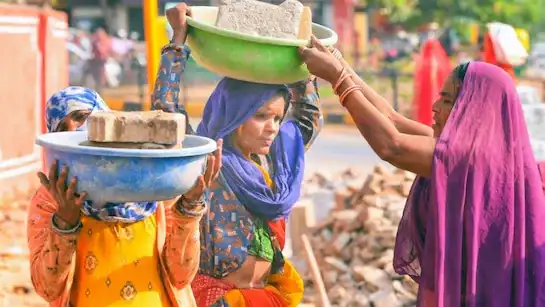
Preparations are underway to abolish MNREGA and bring a new law. The central government is planning to bring a new law named VB-G RAM G to replace the Mahatma Gandhi National Rural Employment Guarantee Act (MNREGA). VB-G RAM G stands for Vikas Bharat Guarantee for Employment and Livelihood Mission (Rural). The ‘VB-G RAM G Bill’ for this new law is expected to be introduced in the winter session of Parliament. This new law will replace the Mahatma Gandhi National Rural Employment Guarantee Act, 2005. The number of days of guaranteed employment will increase, and both the central and state governments will have to share funding. The new law may also include a provision for a break period. This means that in a financial year, there will be a break during the agricultural seasons from sowing to harvesting, during which no work will be given.
Gujarat Congress alleged MNREGA scam and protested outside the assembly.
1. New law will guarantee more days of work
Under MNREGA, every family is guaranteed 100 days of employment, but the new law will increase the number of days. The VB-GRAM G Bill increases the days of guaranteed employment from 100 to 125 days. There is a provision for ‘minimum 100 days’ work in MNREGA, but the software is designed in such a way that this has become the maximum period. Basically, the software requires a request from the state or union territory for work beyond 100 days. This can provide additional 50 days of employment. These 50 additional days can be given to Scheduled Tribe families living in forest areas. However, the family should not own any personal property other than land rights acquired under the Forest Rights Act, 2016. Similarly, in areas declared drought affected or affected by any natural disaster by the Home Ministry, the government can provide work for more than 100 days.
2. Under the new system, payments will be made weekly
The VB-G RAM G Bill also includes provisions for changes in wage payments. Under MNREGA, there is a 15-day limit for payments, but the new law may allow weekly payments. According to reports, daily wages will be paid on a weekly basis or, in any case, within fifteen days of completion of the work. The provision for compensation in case of delayed payment has also been kept in the new law. MNREGA provides for compensation at the rate of 0.05% for every day there is a delay in wage payment beyond 15 days – but there is no mention of any change in the wage amount.
3. Now, state governments will also have to contribute to the funding
A major change in the VB-G Ram-ji bill is related to funding. While under MNREGA, the central government bears the entire cost of wages for unskilled workers, the new law will mandate that state governments also have to share the burden of wage payments. However, this will not be applicable to all states. For example, in Union Territories without legislature, the Central Government will bear the entire cost of the scheme. A very small portion of the funding has been allocated to some states. For north-eastern states, hill states and union territories, the funding ratio between the central and state governments will be 90:10. For the remaining states and union territories with assemblies, the ratio will be 60:40.
4. If the expenditure exceeds the allotted amount, the state government will have to bear the cost.
In the VB-G Ram-ji Bill, the central government will fix a specific amount for each state in every financial year, based on pre-decided standards. Now, if a state spends more than its standard allocation, the state government will have to bear the additional cost.
5. Employment guarantee will be suspended during the farming season
A major difference between MNREGA and VB-G Ram-ji Bill is the break period. To ensure that work in the fields does not stop, a provision is being made to suspend the employment guarantee for some time during the farming season. According to the report, no work will be done under this Act during the peak farming season. According to the report, state governments will have to announce in advance a total period of 60 days in every financial year, which will include the sowing and harvesting season. The special thing is that this notification should not be the same in the entire state. This may vary from area to area – even for each district, block or village panchayat.