
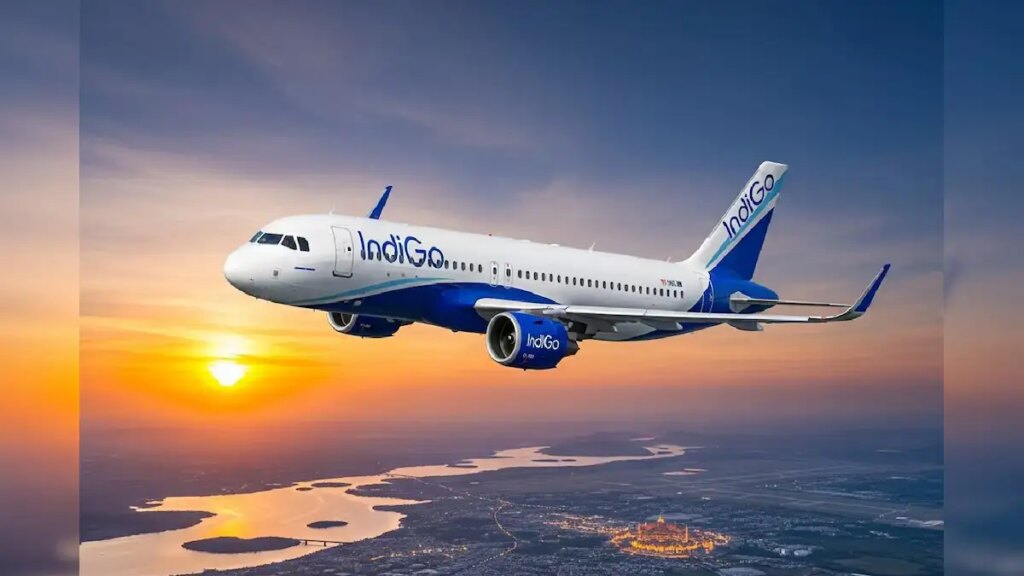
Citing the ongoing crisis in the Middle East, IndiGo has announced an increase in fuel surcharge for both domestic and international flights. The impact of the huge increase in the prices of ATF—i.e. Air Turbine Fuel—is now falling directly on the pockets of air passengers. Amidst the pressure of rising fuel expenses, the country’s largest airline, IndiGo has once again changed its fuel charges. The new rates will now be applicable to all new bookings made on or after April 2, whether the travel is domestic or international. Earlier, a flat fuel charge of ₹425 was applicable on all domestic routes; Now it has been decided again on the basis of distance.
For journeys up to 500 kilometres, the charge is ₹275.
For distances between 500 to 1,000 kilometres, it is ₹400.
For distances between 1,000 to 1,500 kilometres, it is ₹600.
For distances between 1,500 to 2,000 kilometres, it is ₹800.
For flights above 2,000 kilometres, a fuel charge of ₹950 will be applicable.
While commuters on short routes have certainly got some relief, the cost for those traveling long distances has increased. The fuel charge was first introduced on 14 March; However, due to ongoing tensions in the Middle East and rising fuel prices, the airline had to change it once again. This is the second change made in just three weeks. The fuel charge was first introduced on March 14, but the current tensions in West Asia and rising fuel costs forced the airline to change it again.
The government has intervened in the matter of domestic flights, which has provided some relief to the passengers. The Petroleum Ministry and the Civil Aviation Ministry have allowed airlines to pass on only a partial increase—limited to 25 percent—to passengers, so that there is no sudden and drastic increase in ticket prices. The situation is completely different for international flights; In this region, the government has not imposed any such limit, resulting in a huge surge in fuel charges. Huge increase on international routes in just three weeks
On March 14, fuel surcharges were set at around ₹900 for the Middle East, ₹1,800 for South Asia and China, and ₹2,300 for Europe. However, from April 2, travelers will now have to pay ₹3,000 to ₹5,000 to the Middle East; ₹3,500 to ₹5,000 for South Asia and China; ₹7,500 for Türkiye and Greece; And for European routes, fuel charges will be up to ₹10,000. In just three weeks, fuel charges for international travel have increased three to four times.
Fuel charge will affect ticket prices
This increase in fuel charge will have a direct impact on the total price of the airline ticket. Passengers—especially those traveling on international and long-haul flights—will now have to pay much more than before. Airlines say they have not passed the entire burden on passengers; However, if Aviation Turbine Fuel (ATF) prices continue to rise at this pace, air fares may increase further in the future. According to the IATA Jet Fuel Monitor, fuel prices in the sector have increased by more than 130 percent in the past month alone. Especially on international routes, ATF prices have more than doubled in a single month.
All this has happened at a time when the Petroleum Ministry and the Civil Aviation Ministry have jointly decided that only a small increase—limited to 25 percent—will be allowed to airlines for domestic flights. That’s why IndiGo has avoided passing the entire burden on to passengers, and has instead decided to create a tiered fuel surcharge structure based on flight distance.