
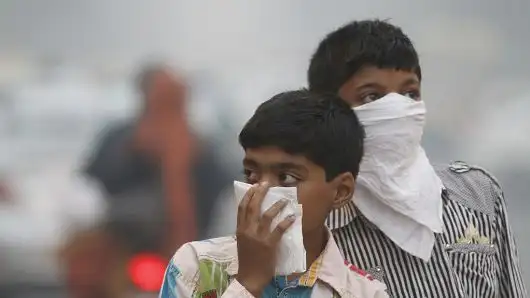
Air pollution in Delhi has become very bad in the last few years. A new report by Chintan Environmental Research and Action Group shows that increasing air pollution in Delhi-NCR is having a deep impact on children’s health, mental health, education and everyday life. The study was based on interviews with 1,257 children aged 6 to 15 years between December 2025 and January 2026, when pollution was at its peak. Of these, 86 percent believed that polluted air was directly harming their health. After October 2025, about 44 percent of children had to visit a doctor, and many had to be treated more than once for problems like breathing difficulties, cough, headache and fatigue.
What does the report say?
The report titled “A Generation Under Siege” said that 77 percent of children said that toxic air makes them feel restless, irritable, scared or stressed. About 46.6 percent children said that if given a chance, they would like to leave Delhi-NCR. The report also revealed that the impact of pollution is not limited to children only; Their parents, siblings and grandparents are also falling ill. About 55 percent of the children admitted that they had to leave school due to health problems related to pollution, which affected their studies.
children try to save themselves
When the air becomes poisonous, children definitely try to protect themselves. About 85 percent of the children adopted some form of protection. Of these, 39 percent used N95 masks or air purifiers, while 37 percent preferred to stay indoors or reduce outdoor activities. Despite this, 85 percent reported feeling symptoms like eye irritation, cough, headache and fatigue. This clearly shows that even after taking precautions, they do not feel completely safe.
It says that many children are forced to go to school, play or do other activities even in times of high pollution. This shows the need to create policies that focus on children’s health and their experiences. According to the report, just averaging cities is not enough; Instead, it is important to understand the quality of air children are breathing at home, at school and during their daily commute.