
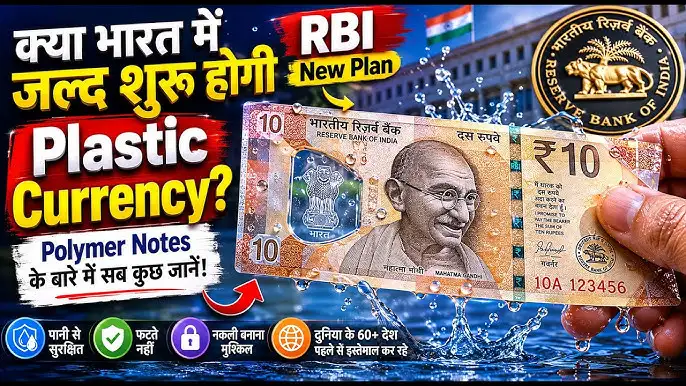
The Reserve Bank of India (RBI) is seriously considering introducing polymer notes in the country. If this proposal is approved, it can bring a big change in the history of Indian currency. This initiative can prove to be the biggest change after demonetization. Polymer notes are made of a special type of plastic material which is much stronger and more durable than ordinary paper notes. They do not tear easily, do not get spoiled by water and moisture has less effect on them. This can increase the average age of these notes by two to four times, which will reduce the need for repeated printing and save billions of rupees.
What are plastic notes?
Unlike paper currency, polymer or plastic notes are much more durable.
The effect of dirt and moisture is less on them.
These things are very important considering the climate and usage conditions of India.
Due to their longer age, the need for frequent printing reduces.
As a result, even though initial production costs may be higher, overall costs may decrease over time.
cost of printing currency notes
The cost of printing currency notes in India remains high, albeit with some fluctuations from year to year. Latest RBI data shows that the cost of printing currency notes had reached an all-time high of ₹6,372 crore in the 2024-25 financial year. After this it reduced to ₹4,875 crore in the 2025-26 financial year. Earlier, the cost had increased to ₹7,965 crore in the 2016-17 financial year – the difference was due to demonetisation and issuance of new currency notes.
The biggest problem with paper currency notes
However, printing money is only part of the problem. A major challenge arises from the huge quantity of damaged and soiled notes that have to be constantly replaced. RBI data on disposal of notes highlights the high circulation value cycle. According to the latest data, most of the notes removed from circulation in the 2025-26 financial year were ₹500 notes (5.983 billion notes) and ₹100 notes (5.811 billion notes).
**Countries using plastic notes**
This change is already happening around the world; Currently more than 60 countries use plastic notes. Australia was the first country to start these. Other countries using polymer currency include Canada, Singapore, Malaysia, Thailand, Indonesia and Romania. Countries such as Australia, Canada and the UK have fully adopted polymer currency, while many others have partially adopted it. However, a large part of the world – including India – still relies primarily on paper currency.
**India tested polymer notes in 2012**
India previously tested polymer notes in 2012, but the initiative did not go beyond the pilot stage. Now, RBI is again actively considering this proposal. The data continue to reveal cost and sustainability challenges, which strengthen the argument in favor of adopting polymer currencies. For India, the issue is no longer just about printing more currency; Rather, the focus has now shifted to increasing the lifespan of notes and reducing maintenance costs.