
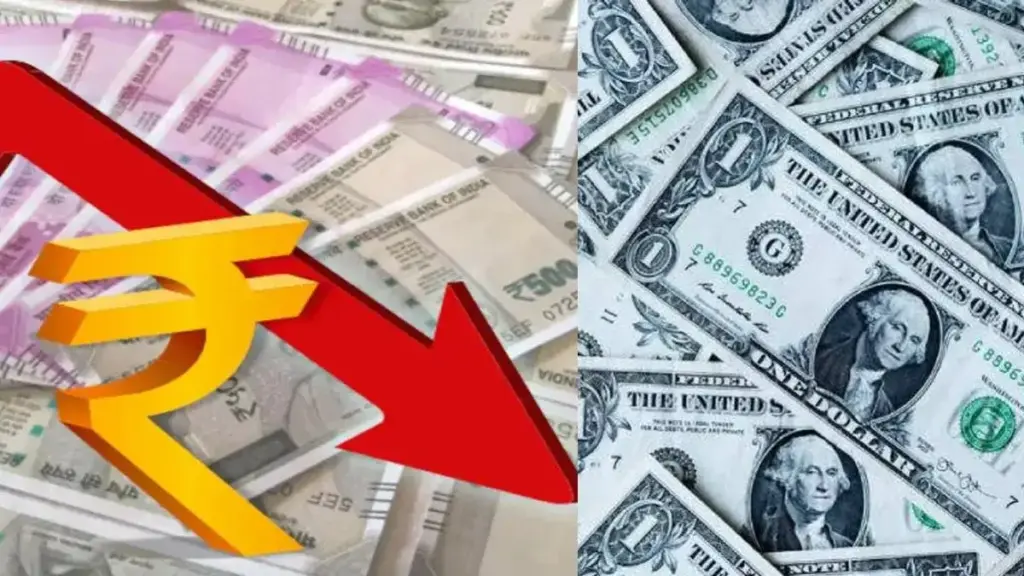
Amidst the global turmoil caused by US tariffs, the country’s biggest concern is the continued weakening of the Indian currency against the dollar. Fall in rupee has a bad impact on every sector. This year there has been a sharp decline in the Indian currency. Amid uncertainties in the international market, the rupee fell 98 paise to close at 89.66 on Friday, November 21. This is the biggest fall in a single day in the last three years. Earlier, on February 24, 2022, the rupee had fallen by 99 paise in a day. This begs the question: What is causing this decline? Which factors are responsible for this? And despite the efforts of RBI, why is the rupee not becoming stable against the dollar?
Due to fall in rupee
Dr Aastha Ahuja, associate professor in the Department of Economics at Artbhat College, says the rupee first reached an all-time low of 88.80 in September, when the RBI intervened. There was a feeling in the market that RBI will not allow the rupee to fall below 88.80. Because of this, many people sold dollars, they were confident that this level would remain stable.
But as soon as the rupee crossed 89 and broke this “protective line”, traders initiated stop-loss orders. A stop-loss order is an order that automatically sells a security if it falls below a predetermined price. For example, if you bought a security at ₹100 and set a stop-loss of ₹90, it would be sold once the price reaches ₹90. The same thing happened in the rupee-dollar market—as prices fell, traders increased their buying of dollars to hedge their positions, thereby strengthening the dollar further.
Stop-loss is also a big factor
When short sellers buy dollars to hedge their positions, the value of the dollar increases rapidly. Many market participants believed that RBI should have intervened at this level. However, RBI intervened during limited trading at 88.80. The second reason is that due to the high tariffs imposed by the US on India, import demand has increased, while the supply of dollars for exporters has reduced. RBI Governor recently said that the rupee crossed 89 the very next day after the announcement of India-US trade deal.
Will the decline continue?
Dr. Aastha Ahuja says that there is still a lot of uncertainty in the Indian market. The decline may continue until a trade deal is finalized. India’s trade deficit is also continuously increasing. This is affecting not only the market but also the consumers. This has had a direct impact on students studying abroad—they have to send more money to their families than before. The rupee is likely to reach 87 or 86 after the trade deal is finalized. The second reason is that whenever uncertainty increases at the international level, it has a direct impact on imports and exports. From Ukraine War to Tariff War, many global events have impacted the Indian Rupee.