
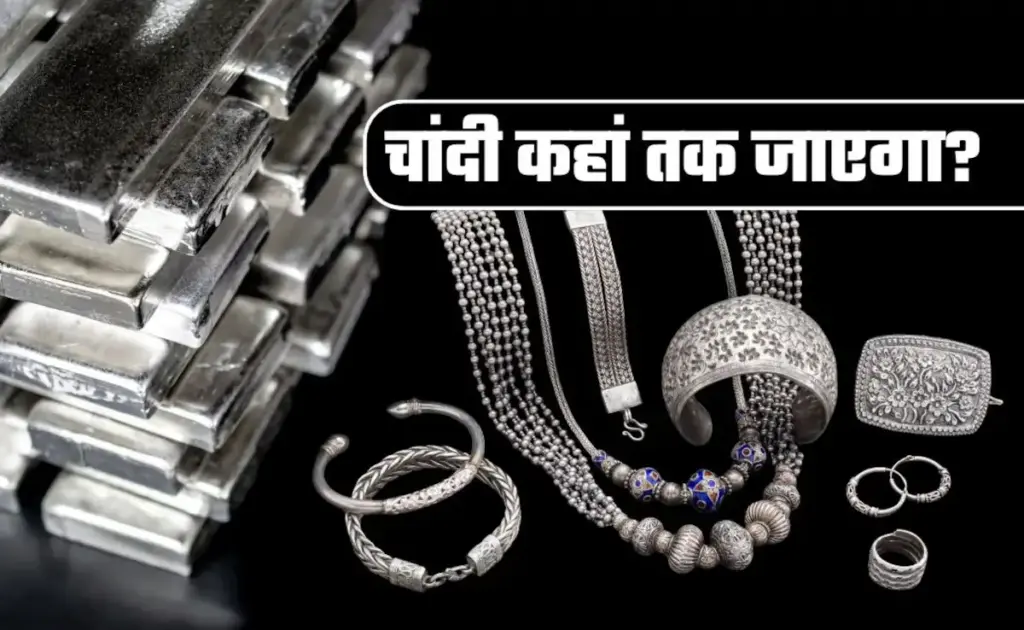
On December 29, the price of silver was ₹2.50 lakh per kg. On the 16th of the same month, an increase of 30% was seen in silver in a month. Just a day earlier, it had suddenly surged by ₹15,000, taking its price to nearly ₹3 lakh. Now, just two weeks later, on Thursday (January 29, 2026), the price of silver has reached a record high of ₹4 lakh. It has increased by 60% in January this year and by about 280% in the last one year.
The previous day, on Wednesday (January 28), silver opened 2.4% higher at ₹3,64,821 per kg on MCX and hit a record high of ₹3,83,100 per kg. This means it witnessed a record increase of ₹18,279 in a single day. This was a record. There has been a tremendous increase in the prices of silver in the last few months. The effect of this increase was visible once again on Thursday, when it increased by more than 10% in a single day. Its price reached ₹4.27 lakh per kg on the Multi Commodity Exchange (MCX).
Why are silver prices increasing?
Its immediate causes are economic uncertainty, rising US debt and rising geopolitical tensions. Central banks of different countries are buying gold. The US Federal Reserve has made no changes in interest rates, and a weak dollar has also affected its price. The most important thing is that there is a decrease in supply while the demand is increasing, so according to the laws of supply and demand in economics, this surge is natural. Due to rising prices, demand for silver is also increasing.
However, experts say that the reason for the long time is that today silver is not used only for investment or jewellery, but its use has increased in many industries. Its consumption is increasing in smartphones, solar panels, electronics, electric vehicles and other modern technologies, due to which demand is continuously exceeding supply.
In India, the traditional use of silver in jewelery is deeply rooted in history. Silver ornaments and coins have been popular during weddings, festivals and other important occasions. Although a major share of silver consumption in India is still in the jewelery sector, especially during festivals, the share of industrial demand is also continuously increasing. Let’s take a look at the industries where increased consumption of silver has impacted its price.
solar panel
According to The Silver Institute, a US-based non-profit international organization, the fastest growing use of silver today is in solar panels. According to The Silver Institute report, in 2024, demand for photovoltaic silver (PV silver) will account for 29% of total silver consumption worldwide, up from just 11% previously. Silver is mainly used in the form of silver paste in silicon cells of solar panels, which helps to bind electrons and conduct electricity efficiently. An average solar PV panel uses about 15-20 grams of silver. According to the 2025-26 report of the International Energy Agency (IEA) and International Renewable Energy Agency (IRENA), solar energy consumption is continuously increasing.
In India, only 2.6 GW of solar power was produced in 2014, which increased to 35 GW in 2020. This more than doubled over the next four years, reaching 85 GW in 2024. It is expected that by 2026 it will exceed 100 GW. Therefore, as solar energy production increases in India, it is having a structural impact on silver consumption. That is, as the consumption of solar energy is increasing, the total consumption of silver is also increasing at the same pace.
Silver is also used to create conductive paths for contacts in printed circuit boards (PCBs), RFID antennae and circuit connections, sensor switches and connectors, and many other electronic devices. This is due to its very low resistivity and long-lasting durability. Today, silver is found in almost every modern electronic device. Be it mobile phones, computers, TVs, or any smart devices, their production is increasing on a large scale every year, and the consumption of silver is also increasing in the same proportion.
Electric Vehicles (EVs) and Automobiles
When it comes to electric vehicles (EVs), silver is used in many areas. It is used in battery management systems, power electronics and inverters, wiring and high-conductivity switches, charging infrastructure, sensors and electrical contacts.
The Silver Institute said in its 2021 report that silver consumption in automobiles will further increase with the advent of electric vehicles. According to the report, a typical internal combustion engine vehicle uses 15 to 28 grams of silver, while hybrid vehicles may use 18-34 grams and EVs may use 25-50 grams of silver. This means that electric vehicles use approximately 67% to 79% more silver than conventional ICE (Internal Combustion Engine) vehicles.
Rising price of silver and increasing industrial demand
Silver price to rise from ₹80,000–₹85,000 per kg to ₹400,000 per kg in 2025. Experts believe that the industrial share of silver now accounts for about 60% of total demand, which is more than that of gold and other precious metals.
India itself is not a big producer of silver. A large part of its silver consumption depends on imports. According to The Economic Times report, India will import silver worth about $9.2 billion (over ₹75,000 crore) in 2025, which is 44% more than last year (2024). In this way, India has become a big importer of silver.
According to World Integrated Trade Solution, in 2023, India imported maximum silver from China, United Kingdom, UAE, Hong Kong and Russia. There is a big processing center in China from where the finished goods reach India. Under the India-UAE Comprehensive Economic Partnership Agreement, India gets goods from the UAE at lower tariffs.