
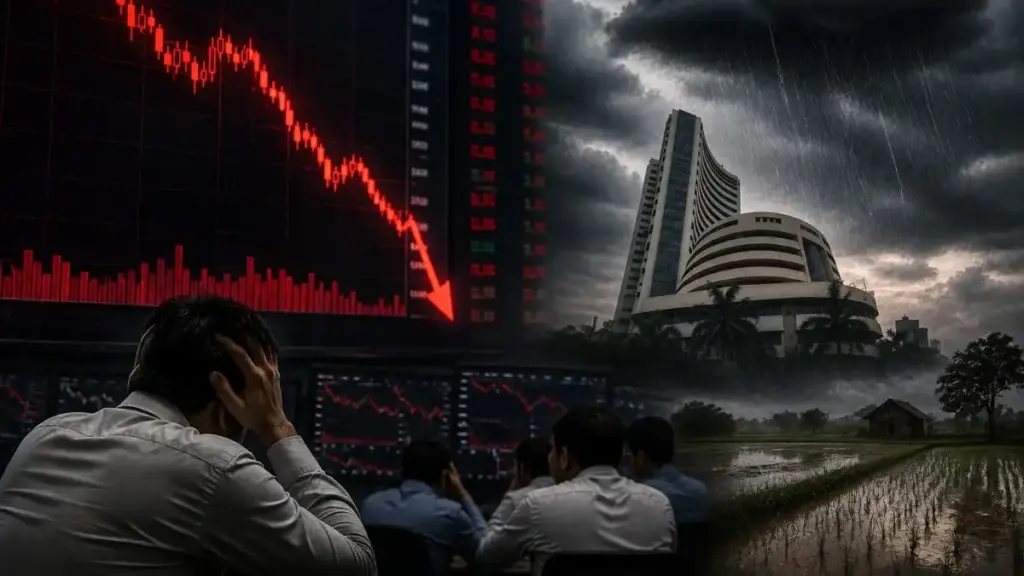
On Friday – the last trading day of the week – the market suddenly took a big U-turn. After opening higher, the stock market fell sharply by afternoon, with the Sensex closing 1,092 points lower. At around 3:00 pm on Friday, Sensex closed at 74,776 (down by 1,092 points), Nifty at 23,548 (down by 359 points) and Bank Nifty at 54,239 (down by 615 points). The market, which was trading cautiously throughout the day, came to a complete halt by the evening. Due to this sudden turmoil in the market, investors lost more than ₹ 5 lakh crore in the last hour of trading. The total market capitalization of BSE listed companies declined by ₹5 lakh crore to ₹466 lakh crore.
Why did the Indian stock market suddenly fall?
On Friday, May 29, the stock market opened with modest gains. BSE Sensex opened with a gain of 352.22 points at 76,220.02. NSE Nifty 50 opened at 24,002.80; However, by 1:00 pm, the market began to slow down. By 3:00 pm, there was chaos in the market. Sensex fell 1,092 points to close at 74,776, while Nifty fell 359 points to 23,548.
How did the market open at lower levels?
The first reason: Investors were already worried due to the ongoing uncertainty over a possible deal between the United States and Iran. A 60-day ceasefire agreement has been agreed, but US President Donald Trump is yet to give it formal approval – a factor that is clearly weighing on investor sentiment.
Second reason: Another major reason behind this decline was the forecast issued by the India Meteorological Department (IMD). The India Meteorological Department (IMD) has reduced its rainfall forecast compared to its previous estimates. For the Indian economy, monsoon is not just rain, but the livelihood of millions of farmers and a strong pillar of the national economy. The livelihood of millions of people depends on this rain. As soon as the weather department predicted a weak monsoon, investors’ reaction was immediate and obvious; Selling pressure became dominant in the market. According to IMD, the heat wave is likely to continue during June and July; This time the temperature is expected to be 3 degrees more than normal. Furthermore, the department had indicated that the country is expected to receive an average of 78 cm of rainfall this year – which is about 10% below normal levels. Based on data from 1971 to 2020, the average rainfall for the country is considered to be 87 centimeters. The possibility of a weak monsoon has cooled the market environment. Inflation is expected to increase due to lack of rain, which is directly related to the interest rate policies of the Reserve Bank. These collective fears have distorted the market environment, creating tremendous selling pressure.
Third factor: MSCI India index gave the last blow. On Friday, the MSCI India Index, one of the world’s largest global indices, announced changes to its composition. Following these indexing adjustments, many funds managing millions of dollars of assets rebalanced their portfolios; This activity caused a wave of heavy selling in the market during the last hours of trading. Shares of Power Grid, Bajaj Auto, Max Health, IndiGo, Eicher Motors and ONGC were among the worst performers.