
Be it the war between Russia and Ukraine, the Israel-Palestine conflict, US-Iran tensions, or the globally-stirring “Trump Tariffs”—the past few years have seen many global challenges emerge; Nevertheless, the momentum of the Indian economy remains strong. The world has recognized India’s potential—and rightly so—because while the rest of the world grappled with risks ranging from trade disruptions to inflation, the Modi government delivered one spectacular success after another. This is evident from the fact that in the last six years, India has signed free trade agreements (FTAs) with nine countries—agreements that have proven to be an effective countermeasure against US tariffs. The most recent of these agreements is with New Zealand.
The FTAs being continuously entered into by the government with various countries are not only opening up new and bigger markets for Indian exports but also reducing the country’s dependence on imports. Moreover, these agreements have paved the way for increasing foreign investment in India and are also playing an important role in creating more employment opportunities.
FTAs from UK to EU
Even before these recent initiatives, India had signed free trade agreements with several other countries. These include FTAs with partners ranging from Mauritius and the United Kingdom to the European Union (EU).
**No. 1:** The Modi government signed an agreement with Mauritius (India-Mauritius FTA)—the first FTA by India with an African country.
**No. 2:** In 2022, a free trade agreement was signed between India and the United Arab Emirates (UAE). As per the targets set under this FTA, bilateral trade between the two countries is estimated to reach $100 billion by fiscal year 2025.
**No. 3:** Also in 2022, India sealed another agreement. On this occasion, a free trade agreement between India and Australia was agreed upon—and signed. This was India’s first FTA in which tariffs on 100 percent of its exports were completely eliminated (made to zero). No. 4: A Trade and Economic Partnership Agreement (TEPA) was signed between India and the EFTA countries (Switzerland, Norway, Iceland and Liechtenstein) on March 10, 2024. This agreement came into force on October 1, 2025. Its objective was to attract investments of $100 billion into India over a period of 15 years.
No. 5: In 2025, an agreement is reached between India and the United Kingdom. In July, the two countries signed a historic free trade agreement (FTA). Under this FTA, 99% of the goods exported from India got duty-free access to the UK market. Furthermore, the deal aims to increase bilateral trade between India and the UK to $120 billion by 2030.
No. 6: In late 2025—specifically in December—the Modi government successfully closed another deal. Amid global concerns over “Trump tariffs”, a Comprehensive Economic Partnership Agreement (India-Oman CEPA) was signed between India and Oman. Under this agreement, Oman will provide duty-free access to India on 98.08% of its tariff lines. This includes 99.38% of goods exported from India to Oman. In contrast, India has given duty concessions on 77.79% of its total tariff lines, which includes 94.81% of goods imported from Oman.
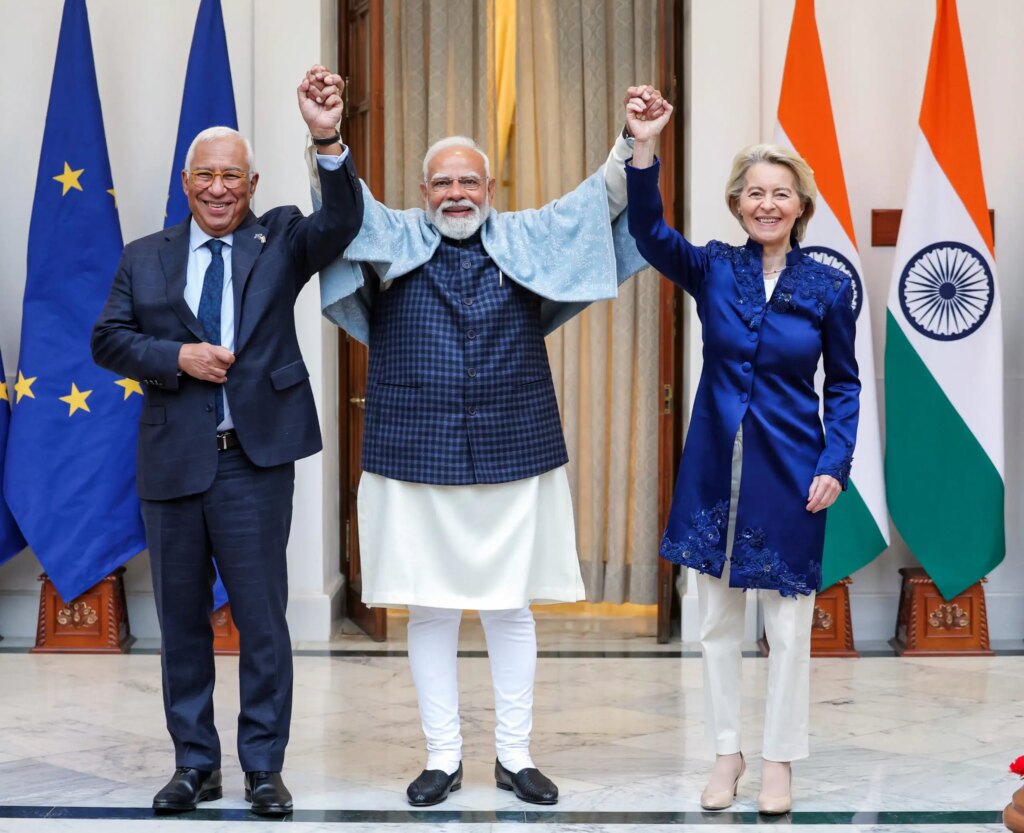
No. 7: In early 2026—in January—India struck a historic deal with the EU. India-EU FTA was called “Mother of All Deals”. Under this agreement, Indian exporters got access to export to EU countries at zero-duty. The deal is particularly beneficial for the textile and apparel sector, as the EU is the largest market for Indian exports in this sector—second only to the United States—with a market size of over ₹22 lakh crore. Furthermore, under the terms of this agreement, both countries have agreed to open their markets to each other; As a result, an announcement was made regarding the reduction or complete elimination of tariffs on up to 90 percent of their products.
No. 8: In February 2026—a period when there were concerns around the world about tariffs—a consensus was reached on the framework for an interim trade agreement between the United States and India. Both the countries have expressed their mutual agreement on many issues. The United States has lifted an additional 25 percent tariff previously imposed in response to India buying Russian oil; Additionally, it has reduced the retaliatory tariff from 25 percent to 18 percent, effective February 7.
No. 9: India’s latest free trade agreement (FTA) is with New Zealand, and the agreement was signed on April 27. The India-New Zealand FTA was signed by Union Commerce Minister Piyush Goyal and New Zealand Trade Minister Todd McClay. A special feature of this agreement is that it was completed in just nine months. It is expected that this free trade agreement will be implemented by the end of this year. Under this FTA, New Zealand will give India duty-free access to its market, ensuring that approximately 95% of India’s exports will reach there either duty-free or at reduced tariffs. The objective of this agreement is to double the mutual trade between the two countries, with the aim of reaching a total of $5 billion. Additionally, New Zealand has pledged to invest $20 billion in India over the next 15 years.