
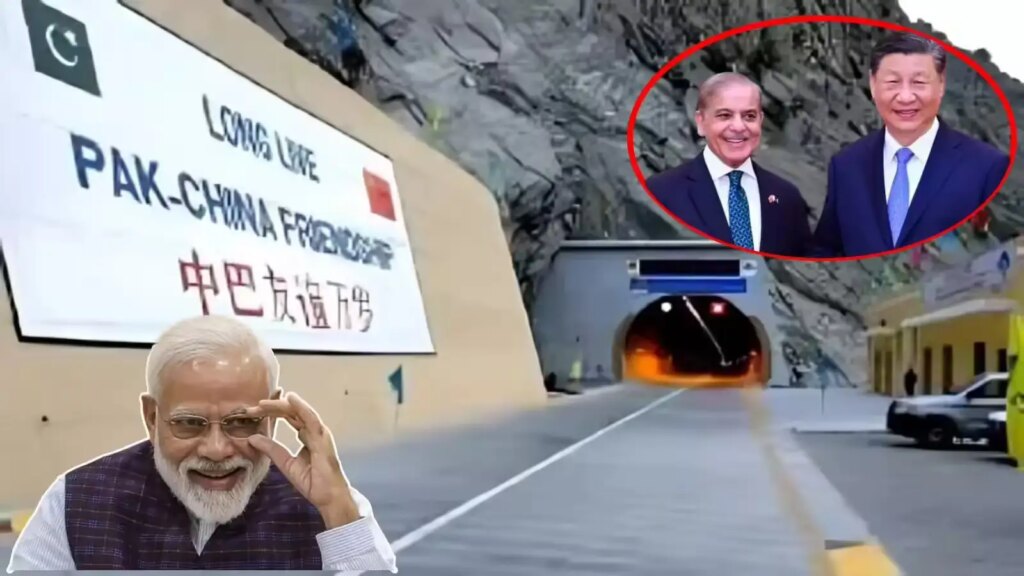
Pakistan’s own economist has now confirmed what the whole world was suspecting. Earlier it was being said that China-Pakistan Economic Corridor (CPEC) will change the fortunes of Pakistan. But, while disclosing this, well-known Pakistani economist Dr. Qaiser Bengali said that no significant investment has come under this project. Gwadar Port, which was once called the “heart” of the plan, is also not yielding any economic benefits.
CPEC failed to become a game changer
In a podcast conversation with a Pakistani journalist, he also said that Pakistan’s economy is sinking day by day. Qaiser Bengali says, “First, CPEC was being called a game-changer. Then SIFC, Green Initiative, Udaan Pakistan, and now Minerals. These are all just words. They have no real results.
Billions of dollars have been spent on construction
CPEC was launched in 2013 with an initial investment plan of $46.5 billion. Later, as more projects were added over time, the plan was increased to $62 billion. However, now economists claim that no major investment has actually come. “Apart from Lahore’s Orange Train, I don’t see anything concrete under CPEC,” he said. When asked whether the billions of dollars promised under CPEC were loans or investments, he said, “It was a mix of both, but nothing actually came. Many MOUs were signed, but an MOU is not an agreement—it is just a statement of intent, not a contract.”
What is CPEC?
It is worth noting that the China-Pakistan Economic Corridor (CPEC), launched from China’s Xinjiang, reaches Gwadar Port in Balochistan via the Khunjerab Pass in northern Pakistan. Its objective was to strengthen the transportation network between the two countries, increase investment opportunities in Pakistan, strengthen infrastructure, accelerate economic development and reduce the energy crisis. However, nothing concrete happened. Dr. Bengali has even called it a “ghost path.”
What is the problem in Gwadar?
Qaiser Bengali said Gwadar Port still has only four berths, and no ships arrived last year. He said that while he was in Balochistan, he visited Gwadar, where the port gate was locked with a lock the size of a small suitcase, and the guard had gone to his village.
Bengali, a former advisor to the Sindh chief minister, said Gwadar cannot become a transit or trade hub as its economic zone is more than 1,000 kilometers away. “In 2008, we imported three ships of wheat just to prove that Gwadar was alive,” he told the truth. There was no need for this in Gwadar. Then, wheat was brought to Karachi from Gwadar, and transportation alone cost Rs 2 billion. If the goods were landed directly in Karachi, Rs 2 billion would have been saved.”
The Economist said that Gwadar is not economically viable, and the port could only be profitable if it was linked to Lokandi and Helmand in Afghanistan and a dedicated Afghan transit corridor was created. Until then, Gwadar may not be economically profitable. However, considering the current situation in Afghanistan, the country no longer wants to import anything through Pakistan. Afghanistan now prefers Chabahar, and the railway link between Chabahar and Afghanistan has been completed.