
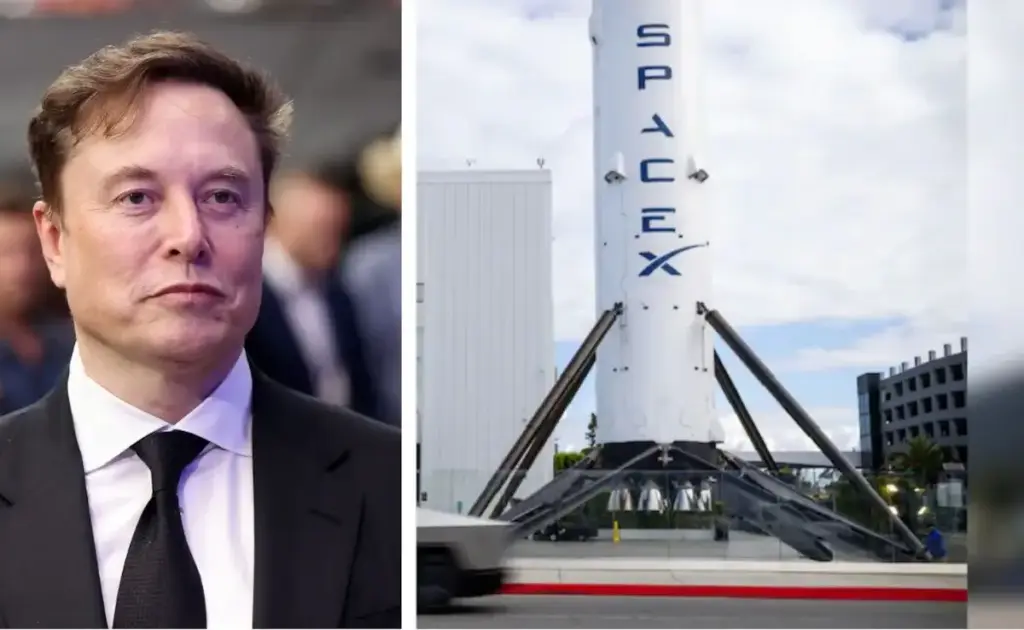
This happened about 25 years ago. Elon Musk’s college roommate, Adio Raci, told him, “Dude! Do whatever you want, but this dream of building rockets is stupid.” Adio gathered space experts at a California hotel to explain to Musk that investing in private spaceflight is like throwing money into a well. But Musk was not one to back down. Today, when you look at Elon Musk on his way to becoming the world’s first ‘trillionaire’ (with a net worth of more than $10 trillion), do you think it was an easy journey? That day in the hotel room – surrounded by his roommates and several space experts – he listened to their advice, but ultimately followed his instincts. Today, the result of the same ‘obsession’ and ‘madness’ is SpaceX, which is valued at $2.2 trillion (approximately ₹187 lakh crore).
**Musk himself was only expecting 10%!**
At SpaceX’s historic milestone event in Texas, Musk, 54, admitted that he himself had only 10% hope that the company would succeed. Musk said, “I told people clearly that this idea might fail, but we just had to try it.”
**An attempt to buy scrap in Russia was rejected**
The beginning was very simple. According to a *New York Times* report, Musk and his friends initially wanted to send a small greenhouse to Mars so that people could see green leaves growing there, in the hope that this would increase the US government’s space budget. To do this, Musk went to Russia to purchase older, cheaper intercontinental ballistic missiles. However, the Russians completely refused them.
Musk had neither the experience nor the budget to build a rocket from scratch; That’s why he went to Russia. Their objective there was not to purchase new or modern rockets; Rather, he wanted to buy old, obsolete Intercontinental Ballistic Missiles (ICBMs) from Russia at a low price so that he could convert them for his purposes. In common parlance, efforts to purchase such old or retired military or government equipment are often referred to as purchasing “junk” or “scrap”.
When Musk went to the Russians to buy old missiles, officials there did not see him as a serious businessman. They sent him back empty handed and insulted. To the Russians, the deal was nothing more than selling scrap or useless hardware—something they didn’t want to sell to a young newcomer. On the return flight, Musk told his teammates, “If no one gives us missiles, we’ll make them ourselves.”
Three consecutive failures and the last bet
The early days of SpaceX were very difficult. The company’s first small rocket was the Falcon 1. Its first two launches from an island in the Pacific Ocean failed miserably. The company was running out of money.
In a *New York Times* report, Musk’s old friend Robert Zubrin recalls that the third launch was also a failure. At that time, Musk only had money left for one last attempt. If the fourth launch had also failed, it would have meant the end of SpaceX forever. However, the fourth attempt in September 2008 made history – Falcon 1 successfully reached orbit.
NASA’s support and the story of Starlink
After this success, the American space agency NASA trusted SpaceX and gave it a big contract to deliver goods to the International Space Station. From there, Musk hasn’t looked back. In 2010, the giant Falcon 9 rocket arrived, ushering in the mission to send humans into space. Musk was now moving really fast. Musk greatly reduced the cost of space launches, allowing his rockets to launch satellites around the world. Using this cheap transportation, Musk launched Starlink in 2019. Today, this company – which provides high-speed satellite internet to every corner of the world – is SpaceX’s biggest source of income.
Musk’s dream: a colony on Mars
Musk’s vision now extends beyond just cargo transport; Their aim is to establish a new colony of humans. For this, Starship – the world’s largest rocket – is being built now. Although a Mars mission before 2025 seems impossible – NASA estimates that humans will not reach Mars until the mid-2030s – Musk is not convinced. Recently, the 12th test flight of this vehicle was largely successful. Space experts believe that Musk has created a ‘highway’ to space – a path on which a completely new global economy is going to be built. What was once dismissed as a joke has now become a very real fact.