
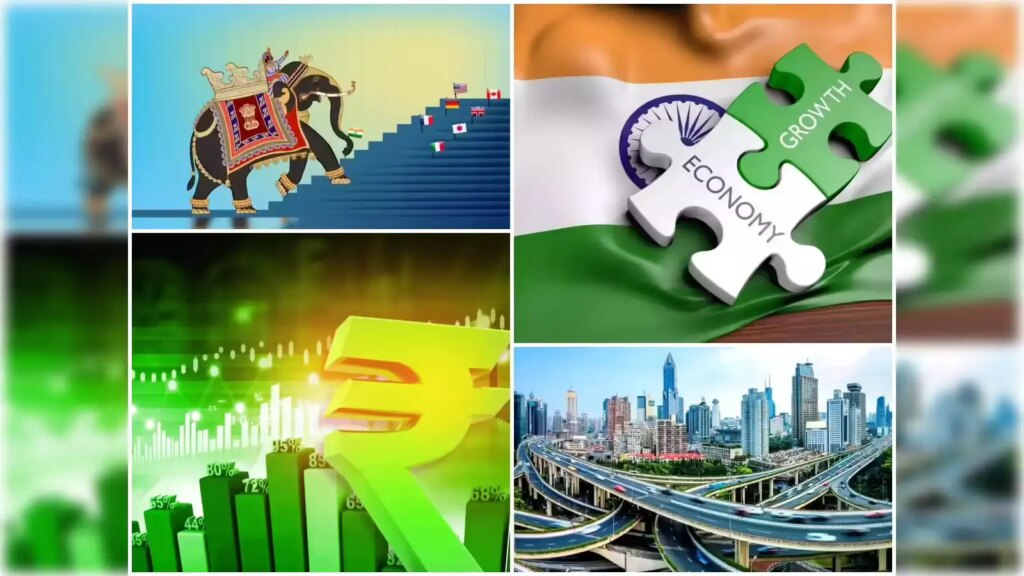
India’s economy is growing rapidly. In May this year, NITI Aayog CEO BVR Subramanian had said that India has become the world’s fourth largest economy. The size of India’s economy is 4 trillion dollars, which is more than many countries like Japan, Britain, France and Italy.
Growth will continue next year also
Recently, the International Monetary Fund (IMF), using Datamapper, has estimated that the same pace of growth will continue in 2026 as in 2025 and India will remain the world’s fourth largest economy after the US, China and Germany with a value of $4.5 trillion. Its next goal is to become the world’s third largest economy, leaving Germany behind, which will give a tough competition to China. Investment firm Morgan Stanley said in a report in July that India will overtake Japan to become the world’s third largest economy by 2028. Meanwhile, India’s economy is projected to more than double to $10.6 trillion by 2035.
Global rating agency Moody’s has also projected the Indian economy to grow at 6.4 percent next year. The rating agency said it expects India to emerge as the fastest growing economy among the G-20 countries. Its real GDP growth is projected to be 7 percent in 2025, up from 6.7 percent in 2024. Moody’s estimates India’s GDP to grow at 6.4 percent in 2026 and 6.5 percent in 2027.
Understand the country’s economy in three points
Famous economist and professor Alok Puranik said that to understand this, first of all we have to understand the structure of the economy.
In this country of 1.4 billion people, 5 percent of the people are the “America” of India, who have a lot of money.
Whereas 35-40 crore people fall in the category of middle class, which is the “Malaysia” of India.
The remaining 80 crore people are the “Ugandans” of India, who are provided all facilities by the government.
It will take time for this 80 crore Uganda to become India’s Malaysia, but it is not impossible. It is clear from this that employment inequality is very high in the country. One class has a lot of money, while the other class is suffering from deprivation. In a developed country, employment equity is a major factor that helps in increasing per capita gross domestic product (GDP) growth, which in turn drives the economy.
Population is no longer a “curse” but a “boon”
He further adds, “India’s growing population is now becoming its strength because the more people there are, the bigger the market.” Buying and selling of goods will also increase accordingly, which will boost the market. This is the reason why many big companies of the world are coming to India and starting their business. Companies like Apple are setting up their manufacturing plants in India.
He further adds, “Today no global company can ignore India as they can make profits from a big market like India to sell their products. In this sense, India can definitely become the third largest economy in the world within two-three years, but it may take a lot of time to reach the level of China and then the US. However, it is not certain that India will join the ranks of highly advanced or developed countries in a few years; this is also due to its population. Increase in Gross Domestic Product (GDP) will undoubtedly increase per capita income, but since our country is so large, we cannot claim to be highly developed on the basis of per capita GDP.
It is important to pay attention to many other areas also
To boost the country’s economy, the government is continuously working to strengthen the manufacturing sector, but there are many other sectors that can contribute significantly to the growth of the economy. “Apart from manufacturing, the country’s tourism sector, medical sector and education sector can also contribute to the growth of the economy,” Professor Puranik said. These have immense potential, so more work needs to be done in these areas.”
He further said, “India’s services sector and software sector are already very big. India’s entertainment industry is also very big; this can also be focused on. We should explore opportunities in all these sectors.” This means that the day is not far when India will rank third among the countries with the largest economies in the world, but to make it further advanced, the country needs to work deeper on its hidden capabilities.