
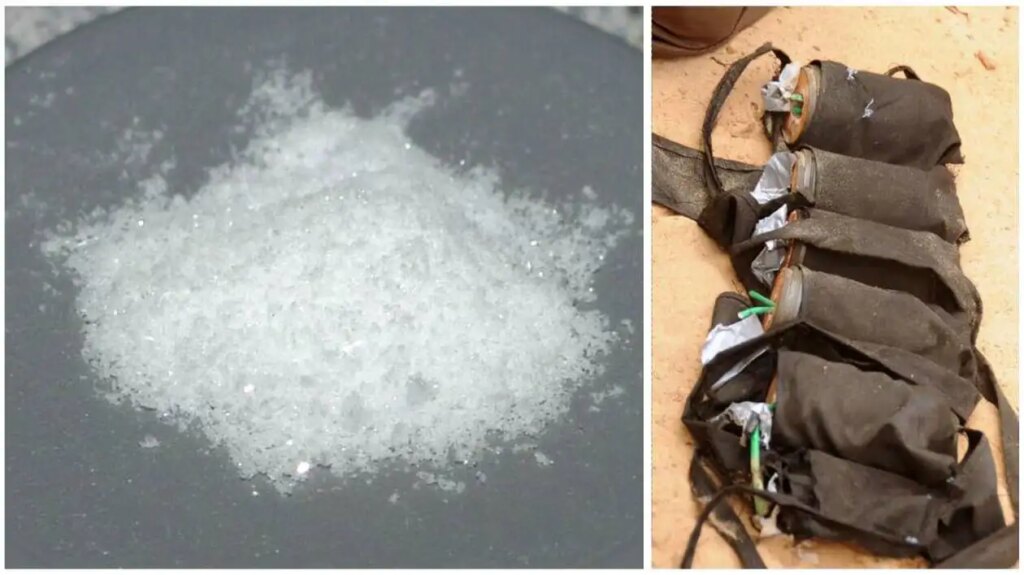
Security agencies have found an important clue in the investigation of the Red Fort explosion. Jaish-e-Mohammed terrorist Omar Mohammed may be the “shoe bomb attacker”. Explosive material was found in a shoe in his car, which is likely to cause an explosion. TATP, a dangerous explosive, was used in terrorist attacks around the world.
What is TATP? The mystery of the “Devil’s Mother”
TATP (triacetone triperoxide) is a household explosive that is extremely volatile and dangerous. It is called the “Devil’s Mother” because it can produce powerful explosions from even slight heat, friction or static electricity. Its chemicals are easily available, making it a favorite of lone terrorists or sleeper cells.
TATP has been linked to several attacks in London, Paris and the Middle East. Its explosive power is very high, but it leaves very little trace after the explosion, making investigation difficult. Groups like Jaish use it for major attacks. The question is, how much destruction can an explosion of just 10 grams of TATP cause? According to experts, this is a very small explosion, but can prove fatal for anyone standing nearby.
Why is TATP so dangerous?
The explosive speed of TATP is about 5300 meters per second, which is slightly less than that of TNT. The efficiency of TATP is estimated to be 55% to 70% of that of TNT. This means that the effect of 10 grams of TATP is equivalent to 6 to 7 grams of TNT. This quantity seems small, but terrorists use it by hiding it in shoes or bags.
Impact of a 10 gram TATP explosion: How far will it reach?
Calculations using scientific formulas show that a 10 gram TATP explosion affects only a very limited area. If it explodes in the air or on any surface…
Lethal radius (15 psi pressure – lung injury, death): Only 0.22 metres. This means that a person up to 22 centimeters away from the explosion center can suffer serious injuries. Anyone holding it in their hands or hiding it in their shoes could die instantly. The lungs may burst and internal bleeding may occur.
Radius of injury (5 psi pressure – ear burst, minor injury): 0.45 m. This means that a person standing 45 cm away may suffer ear injury, headache or mild irritation. Glass or small objects may fly.
Radius of damage (1 psi pressure – window breaks): 0.91 m. This means that windows or light doors up to about 1 meter away can be broken. But there will be no major damage to the building.
This calculation is based on Hopkins’ scaling law, which is used for smaller explosions. In explosions in the gram range (1–10 grams), the blast wave weakens rapidly. Beyond 1 meter, it becomes like a normal air wave.
How much destruction? Examples and comparisons
The explosion of 10 grams of TATP is approximately the size of a small firecracker or grenade fragment. However, if there are projectiles (metal fragments) involved, the damage may be more extensive.
On humans: Death is certain on direct contact. 1-2 people standing nearby may get seriously injured. However, in a crowd, if the sphere is present, it may affect 5-10 people. Richard Reid, the 2001 shoe bomber, filled his shoes with about 100 grams of TATP, but the explosion was incomplete. If it had burst completely, 10-20 people on board the plane could have died.
On stuff: Windows in a small room will break and furniture can go flying. However, there will not be much damage to cars or buildings. In the Red Fort explosion, a small amount of impact was felt only on nearby objects.
Comparison with TNT: The lethality of 10 grams of TNT is 0.26 meters, while that of TATP is 0.22 meters. However, TATP is more sensitive, so the risk of an accident is higher.
Experts say TATP is best suited for small attacks as it is easy to hide, but hundreds of grams are required to cause major devastation.
Evidence found from car, shoes and explosives
Security agencies investigated the blast site. A shoe was recovered under the driver’s seat of Omar Mohammed’s I-20 car, near the right front tyre. A metal-like substance was found in this shoe, which could cause an explosion. Investigation found traces of TATP at the blast site, tires and shoes. It was also confirmed that Jaish terrorists had collected large quantities of TATP to plan a major blast. TATP explosives along with ammonium nitrate were used in the Red Fort blast. Evidence of explosives was also found under the back seat of the car. This evidence shows how well planned the conspiracy was.