
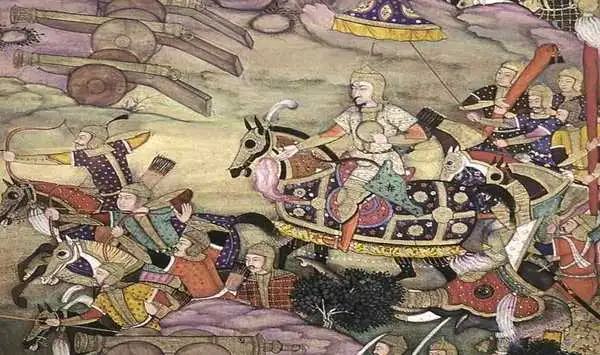
Exactly 469 years ago, on November 5, 1556, Panipat was a decisive battle in Indian history. This was the Second Battle of Panipat, in which the 13-year-old Mughal emperor Akbar and his guardian Bairam Khan faced the Hindu warrior Hemchandra Vikramaditya, known as Hemu. Just a few weeks earlier, Hemu had captured Delhi and Agra and declared himself Vikramaditya. But in this battle, an arrow changed everything and Akbar beheaded Hemu, giving him the title of Ghazi.
Hemu became the emperor after the death of Sher Shah Suri.
Hemu’s story is an example of becoming extraordinary from the ordinary. This Hindu warrior, resident of Rewari, was a long-time associate of Sher Shah Suri. Sher Shah’s death threw the Suri empire into disarray. After the death of Islam Shah Suri in 1554, a struggle for the throne began and many territories were separated. Humayun took advantage of this opportunity and recaptured Delhi and Agra on July 23, 1555. However, Humayun died on January 27, 1556.
Emperor Hemchandra Vikramaditya’s mistakes proved costly
At that time Hemu was in Bengal. Hemu immediately marched towards Delhi and expelled the Mughals from areas like Bayana, Etawah, Bharthana, Bidhuna, Lakhna, Sambhal, Kalpi and Narnaul. The ruler of Agra fled without fighting. He then defeated Tardi Beg Khan, the Mughal ruler of Delhi, in the Battle of Tughlaqabad, captured Delhi on October 7, 1556, and declared himself Vikramaditya at Purana Qila.
Just one arrow changed the history of India
Hearing the news of Tughlaqabad’s defeat, 13-year-old Akbar and Bairam Khan headed towards Delhi. On the way, Ali Quli Khan Shaibani looted a large part of Hemu’s artillery. This was a big shock for Hemu. On November 5, 1556, both the armies faced each other in Panipat. Akbar and Bairam Khan lagged behind by about 12-14 kilometers. The Mughal army was led by Ali Quli Khan Shaibani, who had about 10,000 horsemen. Sikandar Khan Uzbak was on the right and Abdullah Khan Uzbak was on the left. Hussain Quli Beg and Shah Quli Maharam were in the front line.
On the other hand, Hemu’s army was larger in numbers. He had 30,000 Afghan cavalry and 500 elephants. Each elephant was armored and manned by archers. Hemu himself was riding on an elephant named Hawaii. His left wing was commanded by his nephew Ramya, and the right wing was commanded by Shadi Khan Kakar. Hemu had the experience of 22 wars, but this time he did not have cannons. Hemu started the war by attacking with elephants. The Mughal army was initially scattered due to the attack of the elephants, but the Mughal cavalry was fast and was showering arrows on Hemu’s cavalry.
Moving forward, the Mughal army stopped near a deep ditch. Hemu’s elephants and horses were not able to cross the ditch. The Mughal cavalry attacked from the rear, cutting off the legs of the elephants and killing the riders. Hemu pulled back the elephants, but Ali Quli Khan immediately sent his horsemen to attack Hemu’s army from the rear. Hemu counterattacked, but Shadi Khan Kakar and Bhagwan Das were killed. Hemu was close to victory, but an arrow hit him in the eye, rendering him unconscious.
Only two mistakes turned Hemu’s victory into defeat
Hemu’s biggest mistake was to poorly protect his artillery, which was easily plundered by Ali Quli Khan. The lack of cannons proved fatal in the war. The second mistake was to fight from the front. If he had remained in command, he would not have had to face arrows nor would his army have run away in fear. Due to his unconsciousness, panic spread throughout the army and the army fled. More than 5,000 of Hemu’s soldiers were killed in the war.
A few hours after the battle ended, Hemu was captured unconscious and brought to the Mughal camp. Bairam Khan asked 13 year old Akbar to behead Hemu. Akbar’s courtier Abul Fazal says that Akbar refused, saying, “I will not draw a sword on a dead man.” However, according to the contemporary writer Muhammad Arif Kandhari’s Tarikh-e-Akbari, Akbar himself beheaded Hemu and assumed the title of Ghazi. It is believed that the story of Hemu’s refusal to behead was fabricated by later courtiers.
The head was sent to Kabul, the torso was hanged in Delhi.
Hemu’s head was sent to Kabul and hung at the Delhi Gate, while his torso was hung at the Purana Qila Gate. Many of Hemu’s close associates were also hanged and a tower was built, a picture of which is also found in the Akbarnama. The Mughals recovered 120 of Hemu’s elephants, which later became an important part of their army. The Second Battle of Panipat proved how even a small strategic mistake can change the course of history. The defeat of a brave warrior like Hemu teaches us the importance of strategy, safety and restraint.