
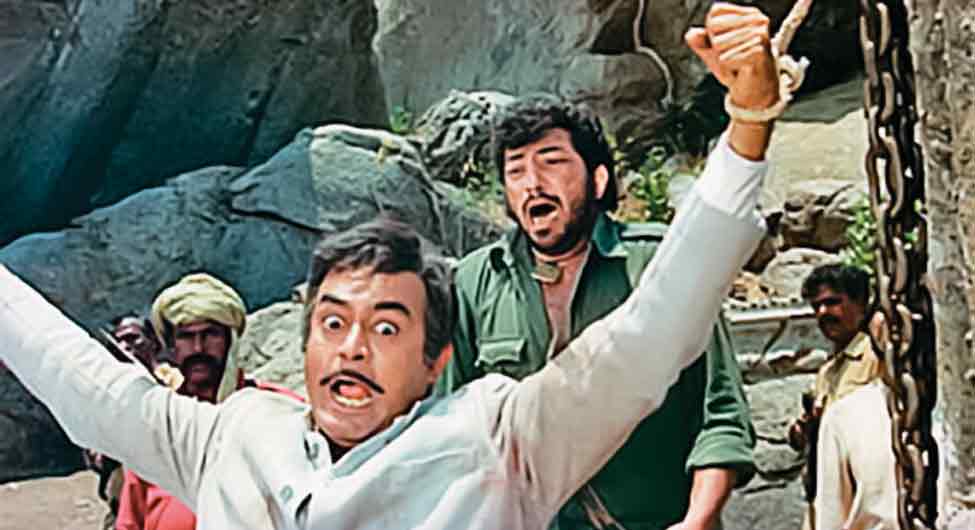
The culmination of hypnosis calms the logic and intellect and the people tied in his fascination reach Mayalok. Such Mayalok is not only a part of the folk tradition of the whole world, whose story continues to reach generation from generation to generation. These are the same stories, who have come to know about our grandchildren, heating the bonfire on the cold nights or taking pleasure of the cool winds on the roofs of the houses in the summer. Where the stories start and where they end, it does not matter, but the life they keep tied, it is his life.
Today, as soon as the child is born, he starts smiling while looking at the mobile camera, his first ‘smile pick’ is drawn as soon as he opens and he enters Google’s world, not in the world of stories. Soon his fingers decide in which world he will go and he reaches the world of animation. It is a different matter that animated world villains are more cruel than Gabbar. They want to create fear not only to the village or 50 kos, but all over the world; That too on the condition of ending the world. In such a situation, Sholay’s Gabbar is not even able to become his pawn. Despite this, Gabbar’s tilism or say Sholay’s Tilism is still intact even after half a century and four generations are tied in his hypnosis.
In this half a century, many stories were said, but they are not seen anywhere in comparison to it. Even today its magic is in such a way that start watching this film from anywhere, it runs for you till the end.
This story was written by Salim-Javed’s pair i.e. Salim Khan and Javed Akhtar. In the language of the story, in the language of cinema, its story-script and dialogue writer was Salim-Javed. But Javed Akhtar alone did the backbone of this story i.e. dialogue writing. These are the dialogues that have been attended by idioms in our language today.
The language of the dialogues of Javed Akhtar presents the best example of folk language, or the language of colloquial language. The dialogues bring the story to the audience in this way, as if the sea wave, which is felt even when standing on the shore. The rhythm of the language not only dissolves the juice in the ears with its sweetness, but also makes the mind-brain peep. The dialogue of the film makes a picture and its indelible impression is maintained forever.
“Hey O Sambha” or “How many men were there?”, How many dialogues are being used like a forest liner and will continue to be done. There is a story of just some similar pictures, Sholay. While looking at Sholay, the family background of its writers must be noticed. This is easily available in the era of social media.
While looking at Sholay, his story does not know how many perspectives. Like Thakur, Thakur, there should be a society of India. His honesty is his arms, morality-chews are his feet. When he uses the strength of the arms, Gabbar Singh, a symbol of the evils of the society, looks in his arms. When evil leaves from his arms, the end of evil only encourages him.
Jai-Viru is a part of the same society that is stuck in his morality. Sometimes free, sometimes selfish, sometimes philanthropist. Jai and Veeru are symbols of society’s will and confidence. The heroine of the story is the Basanti symbol, the unmatched thirst of our desires. See this in such a way that wealth is very important in all the desires of the society and the traveler of this floor is a symbol of Basanti’s journey, which is being done by his mare to reach the floor. Radha is the mirage of the society, incomplete thirst, which the society could not bring in the mainstream despite its will and confidence. Also consider that Maulvi Saheb is Nabina, such as our evils and our fanaticity, due to which we cannot see evil. Maulvi Saheb’s son is a symbol of our gentleness. The evils have always been killing her and her body keeps on putting it on a horse of cowardice. This dialogue challenged our conscience on it, as if our courage, “Why is it so silent brother?” Ramgarh, the village of the film, keeps reminding us of our roots.
Surma Bhopali is a symbol of those people who are ripping all the opinions and harmony of the society. It is noteworthy that Surma is the owner of Bhopali wooden back and like today’s leaders, they are clapping with long-dings. The two characters of the film are Sambha and Kalia symbols of high-low and casteism, who are still playing the command of the owner lowering their eyes. Consider the jailer of the British era, then the matter will be completely clear. He is still surrounded by smoothies like Hariram Barber, is the admirer of his life and he is doing what he can do with his average intellect. Believing them, they are burning their hands and saying, “We are the jailers of the British era.” We have changed so much but we have not changed. ”They are making it clear that we are still carrying the tradition of the British, which is a reflection of our bureaucracy.
Sholay was released during the Emergency. Its story was the era of thinking and thinking when the country was going through the duality of morality and immorality. Thakur’s release from that duality and the feeling of emergency was exactly like the hands of the society. Another mention between the countless stories and stories of Sholay, his bandit is the first bandit of Hindi cinema, who wore a soldier’s uniform, which is a symbol of the devil in the form of a sadhu. The suggestion of this uniform was GP Sippy. Hardly anyone could believe in this era that Gabbar’s popularity was that after that the bandits started wearing uniforms. The tradition of Gabbar Singh will be clearly visible on the Internet, looking at the pictures of Malkhan Singh, Ramesh Sikarwar, Dasyu Sundari Phoolan Devi.
This is not only a film, but a result of life. Every character of this tells a different story of life. There is a philosophy behind every character, which states that life goes around this.
Till three weeks after the release of Sholay, the jumla of ‘Sholay Ke Nikla Gaye Chole’ continued to echo in the film industry. There is an incident that Ramesh Sippy went to meet Sanjeev Kumar, who was dubbing Sunil Dutt. The work of a successful director’s film was going on there. Ramesh was returning to Sippy after meeting Sanjeev Kumar. At that time there was tension on his face, beard increased and there were slippers in the legs. The successful director told his assistant, “If you ever get a chance in life, do not direct a film like Sholay, otherwise this is the case.” The story also happens. “A woman astrology of Bangalore, who used to predict something strangely, said that the film will last for 5 years. Sholay proved this prediction as false. We are still talking on Sholay after 50 years.
Half a century passed with Sholay. The end of the film was changed by the censor due to the Emergency. In the end, a former police officer does not kill Thakur, Gabbar, handed over to the police. The end reminds us of such a period, which forced our independent thinking to walk accordingly. However, there is a discussion that Gabbar Singh has been killed by Thakur in re -release. It is a matter of analysis we call it a ladder up or down a ladder.
A big popular song is, ‘Yahoo … whether someone calls me wild….’ Few people know that Yahoo’s voice with Rafi Saheb was given by an unknown artist named Prayagraj. But Rafi continued to get credit. Many Prayagrajas made Sholay ‘Sholay’. Cameraman Dwarka Dwivecha placed the paintings of paintings on the scene-by-century screen.
Sholay is a story composed in the 19th century, which made an indirect presence everywhere in advertisements, speeches, idioms as well as society. Interestingly, Gabbar Singh i.e. Amjad Khan did not work again in any story of Salim-Javed. This was better, because Gabbar’s work is a milestone and the rest of his works are not able to reach around it.
Sometimes someone had asked, why the name of the film is Sholay? Just see the names of the literary works of Javed Akhtar, Tarkash and Lava. It will be understood in gestures.
(Arvind Mandloi Javed Akhtar’s biography is the author of Jadunama)