
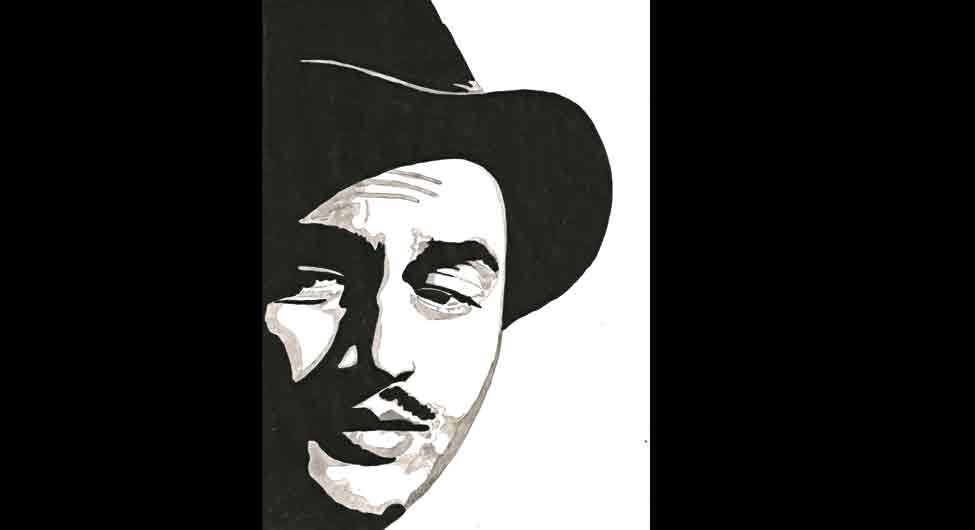
While working on my book Guru Dutt: An Unfinished Story, I came across aspects of his life and thinking which were as interesting and surprising as his films. What surprised me the most was that the filmmakers who made classic films like Pyaasa, Kaagaz Ke Phool, Saheb Bibi and Ghulam were very private about their lives.
Was suffering from a period of turmoil and fragile mental state. That period of his was very restless and his mind was unstable, but his creative talent was at its peak. One of his unique and most distinctive features was his inquisitive nature and indecisiveness. These characteristics of his remained constant in the midst of brilliant successes, especially indecisiveness. Amidst the resounding successes like Baaji, Pyaasa or Saheb Bibi Aur Ghulam, there were films which were shot with great gusto, some even at exorbitant amounts of money, but later remained incomplete and were abandoned.
Projects like Gauri (Guru Dutt-Geeta Dutt), Raaz (Sunil Dutt-Waheeda Rehman), Moti Ki Mausi (Salim Khan-Tanuja), Kaneez (Guru Dutt-Simi Garewal), Picnic (Guru Dutt-Sadhana), the Bengali film Ek Tuku Chhoa (Vishwajit-Nanda) and a few others fell victim to his deep restlessness and wavering mental state.
His completed films also suffered from indecision and costly overshooting. People close to Guru Dutt have said many times that he did not believe in shooting any film according to a fixed script or shooting schedule. He was fond of ‘moving forward’ the film as it took shape on the set. Usually he used to make major changes in the script and dialogues in between shooting. Abrar Alvi had said that Guru Dutt did not shoot films in any particular order but haphazardly and usually he could complete three films with the resources used in one film. Senior lyricist and filmmaker Amit Khanna, who worked closely with Dev Anand, told me, “There were other people like Raj Kapoor, Ramesh Sippy and Manoj Kumar, who used to cancel some scenes after shooting, but Guru Dutt was made of a different material. He used to cancel the films shot for months. He was always a victim of indecision or presented with completely new situations.
By the time Guru Dutt made Pyaasa, his indecision or new curiosities had increased manifold. He used to shoot continuously and was not completely sure about what he wanted in a particular scene or his thinking changed in between. For the famous climax scene of Pyaasa, he even took 104 takes with himself! They kept forgetting dialogue because it was such a long shot, but they wanted to get it exactly right. When something did not go right, Guru Dutt would start screaming and lose his temper. Before Pyaasa, he used to shoot just one or two shots of the film instead of the entire scene. But after Pyaasa, the process of deleting and re-shooting scenes increased considerably. People close to him also felt uneasy with this change. When his magnum opus Pyaasa was released in 1957, everyone was shocked. That was kind of a revelation. No one had expected such a dense and serious film from Guru Dutt, who till then had only made romantic comedies and thrillers like Baaji, Aar-Paar and Mr & Mrs 55. It is important to say that like any poetic work, the lyricism or flow of Pyaasa seems to flow in a stream different from Guru Dutt’s indecision or irregular shooting style. The film is equally powerful and relevant even today.
Encouraged by the success of Pyaasa, Guru Dutt started work on his very ambitious Hindi-Bengali project Gauri. The aim was to launch his wife Geeta as the lead actress and make it the country’s first CinemaScope film. But the film was abruptly abandoned after the first schedule was shot in Calcutta, further souring their already fragile family relationship. The next film was Kaagaz Ke Phool, which was half autobiography and half fantasy. Many colleagues and close friends have publicly stated that even during the shooting of the film, their thinking was not in sync. The situation at home was unstable and his mood would change from time to time. His state of indecision was at its peak. Dutt also overextended the film’s schedule, shooting long scenes and abandoning them due to uncertainty, wasting a lot of money and resources.
He asked his assistant Niranjan to direct the suspense thriller film Raaz, based on Wilkie Collins’ novel The Woman in White. Waheeda Rehman was cast in a dual role (playing two sisters), while Sunil Dutt was signed in the lead role of a military doctor. Raaj’s poster featured only Waheeda Rehman, with ‘Fast Forward’ written on the right corner. The shooting of Raaj began in snow covered Shimla. But soon Sunil Dutt walked out of the film. They were very upset because no reason was given for their removal. Then came the news that Guru Dutt himself would play the lead role. Shooting resumed in Shimla and a lot of money was spent on the schedule and set-up of the military hospital. Two songs were also composed by composer R.D. Burman, who was starting his innings as a music composer with this film.
When Guru Dutt returned to Bombay and edited the scenes shot in Shimla, he did not like them. So, true to her style, she canceled it and despite spending so much time and money, Raj was released. His close friend, actor Dev Anand, said, “He always looked sad and was restless. He had a great sense of cinematography and rhythm, but he would shoot continuously, wasting a lot of footage. Whatever he thought was right at one time, he started having doubts the next moment and he became eager to shoot new scenes.
Screenwriter Abrar Alvi has written, “He was the Hamlet of films… He used to lose enthusiasm as soon as he felt that the film was not going well.” After losing enthusiasm, no amount of advice or fear of financial loss could stop him from abandoning the project… Hardly anyone could care so little about money. I have seen him squandering lakhs of rupees, not for personal luxuries, but for his art. How many artists were signed and paid but never used, how many stories were bought that never came to screen, how many films were shot and never completed.
But there are also such occasions when Guru Dutt used to take absolutely firm and firm decisions about something. According to writer Bimal Mitra, on whose novel Saheb Bibi Aur Ghulam (1962) was based, audience reaction was initially mixed, with some scenes being disliked. Guru Dutt, who was extremely sensitive to the audience’s opinion, quietly and anonymously attended the first show of Bombay’s Minerva Theater to gauge their reactions. He noted that some scenes were expressed in displeasure, for example, the beautiful climax in which the younger daughter-in-law (Meena Kumari) rests her head in the lap of Bhoothnath (Guru Dutt) while traveling in a carriage. People took this as a ‘relationship’ or ‘physical lust’ between the younger daughter-in-law and Bhootnath. There was also objection to another scene, when the younger daughter-in-law demands the last drop of liquor. Guru Dutt also felt that the last song ‘Sahil Ki Tarf’ weakens the narrative.
Victim of indecision, Guru Dutt directly approached Mughal-e-Azam director K. Went to Asif for advice. At that time Guru Dutt was playing the lead role in his next film Love and God. Asif’s advice was clear, lighten the atmosphere. He said, “Listen, finally tell me that the younger daughter-in-law has stopped drinking alcohol. Now he is fine. Everything is fine between husband and wife and they live happily ever after.
Guru Dutt came out of his house and immediately called his team. Abrar Alvi and Bimal Mitra were asked to write a new climax. Meena Kumari was requested to shoot for one day. He began writing the new scene, but the next evening a very restless Guru Dutt appeared. Now with concrete intentions. He said, “No, Bimal Babu, I have thought a lot. I won’t change the ending of the film.” Everyone was shocked. Guru Dutt said, “I don’t care if no one watches my film, even if I lose lakhs. I don’t care. But I won’t change the climax. This film, its climax, it can’t really be changed. This is a different kind of story. If people don’t understand this then it is their loss, not mine. Of. Whatever Asif says, I am also a filmmaker, I have my own mind and understanding. I will not change the ending at any cost, never.”
However, ultimately they decided to remove the scene in which the younger daughter-in-law was keeping her head in Bhoothnath’s lap and also the climax song. In place of the song, the dialogues between the younger daughter-in-law and Bhootnath in that vehicle were kept. New scenes were inserted into every print running in theatres.
Guru Dutt could not sleep the night before the reviews and reports were published in the newspapers. He called close associates of the team early in the morning. When he reached there, there were piles of newspapers all around him, English, Hindi, Gujarati, Marathi. Every newspaper. The Times of India called it a ‘screen classic’. A slight sparkle appeared in Dutt’s eyes. Then every member of the team started reading other newspapers out loud. Guru Dutt was smiling, silently listening to the praise. He praised director Abrar Alvi for making a great film. Everyone saw how happy Guru Dutt was that day. Praise was coming from everywhere. Such recognition always meant a lot to him. Guru Dutt was such a unique creator.
(Yasir Usman is the author of the book Guru Dutt: An Unfinished Story)