The Navratnas of the generation that came after singer Kundanlal Sehgal in Hindustani film music were Lata Mangeshkar, Asha Bhosle, Geeta Dutt, Hemant Kumar, Talat Mehmood, Mohammed Rafi, Mukesh, Kishore Kumar, Manna Dey. The singing style of none of them was similar to that of the other. Everyone had their own style. Among them, Rafi Saheb alone had such range and modulation ability that he could sing and play songs of any mood with ease. Rafi could sing all range of songs easily. Rafi’s specialty was that he could pick up the rhythm very quickly. Musicians would play songs for him and Rafi Saheb would immediately sense the mood of the song. It didn’t take much time for him to even record. Filmmakers love this quality. This saves time and saving time is saving money.
Rafi’s specialty was that he could sing in different styles for different actors. No two actors had the same singing style. If you listen to the songs sung for Dilip Kumar, you will find them completely different from the songs sung for Shammi Kapoor. This was the magic of Rafi Sahab. Whether Rafi sang for the lead actor of the film or for the character actor, his dedication was 100 percent. Whether you listen to songs filmed on Dharmendra or Johnny Walker, you will see his proficiency in both the songs. This quality of Rafi Sahab was very useful for him to remain meaningful in Hindi film music for a long time.
Talat Mahmood’s popularity was at its peak in the early years of the fifties. Mukesh also remained in the news till the end of that decade. In this decade, Rafi continued to showcase his talent, but the entire decade of the sixties was in the name of Mohammad Rafi. Rafi Sahab’s shine diminished a bit in the seventies. There were many reasons for this. The first was that Kishore Kumar had completely ventured into playback singing. There was freshness in his voice, a youthful feeling. This is the reason why actor Dev Anand started getting Kishore Kumar to sing his songs. Dev Anand was the choice of youth. To enhance his youthful image, he took the help of Kishore. In the same period, Hindi cinema got its first superstar in the form of Rajesh Khanna. The pairing of Rajesh Khanna and Kishore Kumar became a hit with the film Aradhana. After that, Kishore remained paired with Rajesh Khanna as long as he gave hit films. Rafi also sang songs for Rajesh Khanna, but many times Rajesh Khanna clearly said that he did not want the voice of any singer other than Kishore Kumar. Another specialty of Kishore was that he was an actor. While singing, he used to incorporate the style of acting into his voice, hence he used to present even simple words with great style.
Despite this, Rafi survived into the seventies. He did not get very good songs in that period because the first demand of actors was Kishore Kumar. There were some musicians who chose Rafi even during that period. For example, actor Rishi Kapoor was advocating Kishore Kumar for the songs of the film Laila Majnu, but composer Madan Mohan believed that Rafi would be better musically. Rafi Saheb sang the songs of Laila Majnu.
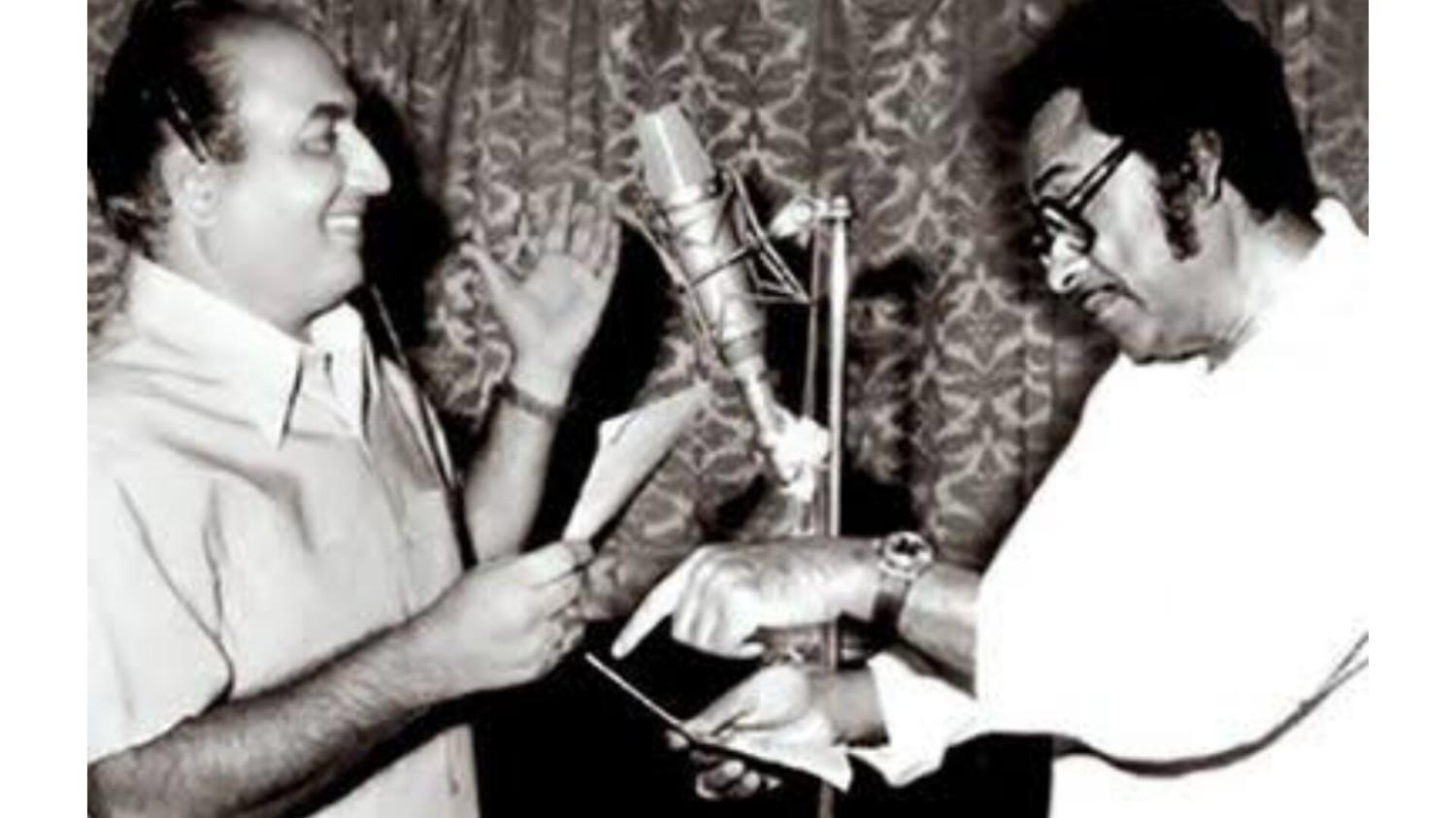
But it is also worth noting that Rafi Saheb and Kishore had a very deep friendship. Both respected each other. Once someone told Kishore that he had left Mohammed Rafi behind. Kishore found the speaker’s style so insulting that he became enraged. People who know say that the teenager had slapped the man.
There is another such interesting story. Musician R.D. Burman’s main assistant was Basudev Chakraborty. He was a resident of North Kolkata. There was a shop called “Malone Cho” where delicious fish was prepared. The fish was filled with spices etc. from the shop, packed in an ice box and sent by air to Mumbai. Basudev Chakraborty or R.D. in Mumbai. When the fish reached Burman’s house, Kishore Kumar was informed that the fish had come from “Malone Chou” of Kolkata. On hearing this, Kishore Kumar would immediately leave with Rafi Saheb. There was such friendship, such closeness between Kishore and Rafi. Not only this, Kishore’s son Amit Kumar used to do live programs then. Kishore often took Rafi Saheb with him to Amit’s programs.
To understand the deep friendship between Mohammed Rafi and Kishore Kumar, it is necessary to mention one more incident. Once Kishore Kumar had gone to South Africa in connection with a program. During that time black people were discriminated against in Africa. When Kishore reached the program, a Muslim organization there objected to his presentation. Kishore Kumar became very angry. He opposed this discrimination in the name of religion. Giving the example of Mohammed Rafi from the stage, Kishore Kumar said that when the temple was being constructed in Juhu, Mumbai, Mohammed Rafi had done a charity show for the temple. This is the character of our Muslims in India. What kind of Muslims are these who are creating a wall between Hindus and Muslims in music?
Kishore Kumar was deeply shocked by Rafi Saheb’s demise. He could not believe that Mohammad Rafi had left this world. He kept distance from singing for some time. After some time, when Kishore went to sing, he took a small photograph of Rafi with him. He started the program with Mohammed Rafi’s song “Man Re, Tu Kahe Na Dheer Dhare”.
Everyone talks about Rafi’s kindness and humanity. Many times he helped many people from the film world. There is an incident related to the film Balika Vadhu, which director Tarun Majumdar told me. One song in the film was based on the Swadeshi movement. The lyrics of the song were “These bangles are not….” Mohammad Rafi was to sing this song. After the recording, Tarun Majumdar told him that this song was written by Bengali poet Mukund Das for the freedom movement. Rafi Saheb became very emotional after hearing this. He returned the payment for the song taken from Majumdar. Tarun insisted on taking the money from him but he said, how can he take the fees for singing the song of Swadeshi movement. This shows that he was not only a singer but also a person who thought for the society. One thing needs to be mentioned here that Rafi Saheb was an admirer of the heroes of the freedom movement and especially Mahatma Gandhi and Pandit Nehru. His voice and sentiments reflect the deep sensitivities of the era of independence and beyond. Indeed, that period was wonderful, when many talents emerged in the film industry, Rafi Saheb and Kishore Kumar have those images in abundance.