
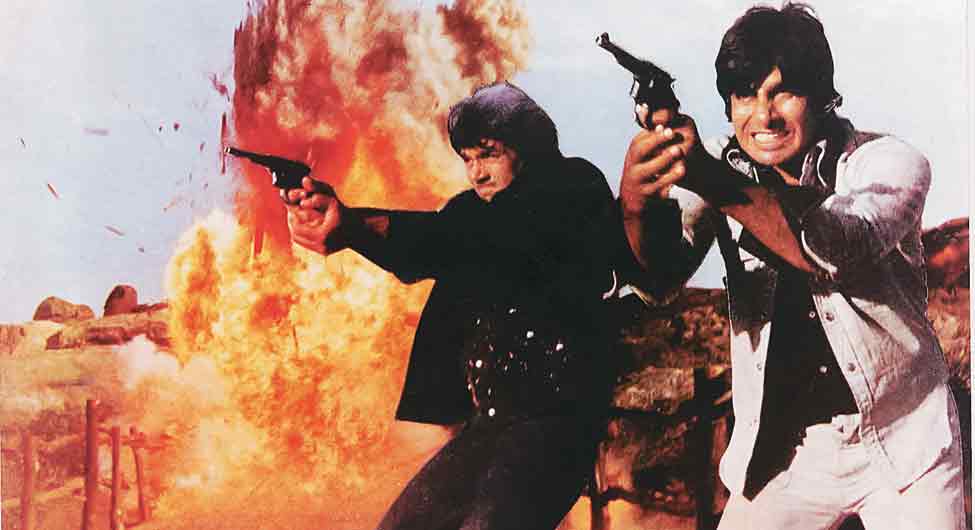
In the seventies, a lot of dacoit based films were being made. Most of them were also becoming successful at the box office. Established directors like Raj Khosla also made raw threads to capitalize on the success of Mera Gaon Mera Desh by casting Vinod Khanna and Kabir Bedi in the roles of rival dacoits. At that time, Sunil Dutt had re-established himself in the role of a dacoit in films like Pran Jaye Par Vachan Na Jaye and Heera. Even Pran had breathed new life into the role of a dacoit in Dharma.
Dharmendra’s Pratigya was also a film to save the villagers from the terror of bandits. During this period, Putlibai had also made waves. Narendra Bedi’s Khote Sikka also had an interesting story of urban youth liberating the villagers from the terror of dacoits. In such a situation, renowned producer G.P. After the huge success of Sita Aur Geeta, Sippy and his promising son Ramesh Sippy announced their next film Sholay based on the background of dacoits, which was shocking. But as soon as the film went on the floors, news of its grand production started coming.
It was said that for the first time after Waqt, Mera Naam Joker and Roti Kapda Aur Makaan, such a big multi-star film with a big budget is going to be made in 70 mm. For the first time in the film, the news of taking the help of foreign technicians for special effects was also making headlines. Actually, Ramesh Sippy wanted to present the thrill of Hollywood’s much talked about film like McKenna’s Gold to the Indian audience in a native style.
The shooting reports of the thrilling scenes of the robbers falling face down on the horses running at high speed during the train robbery in Sholay were published in film magazines, which were read by the readers with great interest. At that time, there was not much discussion about the look and style of a newcomer like Amjad Khan in the role of the main villain Gabbar Singh. Later, after the release of the film, it proved to be its USP. Through the posters, the attraction that was created was mainly centered around stars like Dharmendra, Hema Malini, Amitabh Bachchan, Jaya Bhaduri and Sanjeev Kumar.
After the imposition of Emergency in the country in June 1975, the government instructed the Censor Board to take strict action to curb obscenity, action and violence shown in films. On 12 August 1975, the Central Film Censor Board issued a certificate for the screening of Sholay, a revised 23-reel 35 mm film. This certificate was signed by the then Chairman of the Censor Board, Virendra Vyas. Despite the 70 mm print of the film being specially prepared and ordered from London, getting entangled in the customs duty, the grand premiere of the film took place on 15 August 1975 as per the pre-announced program amidst the glitter of stars at Minerva Talkies in Mumbai.
Sholay got delayed at the box office
During the release of the film on the occasion of Independence Day, an attempt was made to create hype through huge hoardings but unfortunately, the embers of Sholay were nowhere to be seen at the box office in the first week. Disappointed with the lackluster opening of the film, the distributors, sensing the mindset of the audience, strongly demanded the producer-director to change the tragic ending of the film. Ramesh Sippy himself has publicly stated many times that the entire team had gone to Bengaluru and started preparing to shoot the alternative climax. But by the next Friday, word of mouth publicity worked wonders and within no time the crowd of spectators rekindled the extinguished flame of ‘Sholay’.
There were some other innovations behind this belated and extraordinary success of Sholay. Till now, the traditional image of the horse-riding bandits wearing dhoti-kurta and wearing black tilak, which was registered in the minds of the audience, was not only destroyed by Sholay’s Gabbar Singh but also created a new model of the cunning, mischievous and dirty form of the dreaded dacoit on the silver screen. Especially his dialogue delivery was appreciated by the audience. Rising to the occasion, Polydor, competing with old gramophone record companies like HMV, released LP/EP gramophone records based on the film’s sound track for the first time. Due to this, along with the songs of Sholay, the dialogues of the film also started resonating across the country. Gabbar Singh’s “Come Thakur!” “Hey O Sambha!” “How many men were there!” “What will happen to you Kallia!” Such dialogues had become popular and had become popular among the people.
In that era of action and violence oriented films, a big budget grand film like Sholay was given a tough competition by an average religious film like Jai Santoshi Maa. Even for film business analysts, this incident was no less than a divine miracle. That year, amid the burning embers of Sholay, express films like Dharmatma, Deewaar, Sanyasi, Pratigya, and Warrant and passenger films like Julie, Geet Gaata Chal and Chupke Chupke were traveling leisurely on the silver screen, while Gulzar’s Aandhi was banned during the Emergency.
Sholay was promoted as a film using 70 mm stereophonic sound technology, but at that time most theaters in India were not in a position to screen films based on that technology. At that time neither such film projectors and lenses nor such advanced sound systems were available in theatres. Many years later, Sholay was re-released in 70 mm in select theaters.
Even before this, the producer made different efforts to attract the audience. For the first time, the audience was entertained by adding a reel of interesting jail incidents of Asrani’s jailer of the British era and for the second time by adding the Holi scenes of Jaya Bhaduri. Sholay’s record of running for five consecutive years in Mumbai’s Minerva is still remembered. The record was broken by Dilwale Dulhaniya Le Jayenge. A 3-D version of Sholay was released in January 2014 but did not receive the expected response.
Sholay is the first film which brought star fame to comedians like Asrani and Jagdeep with their characters of the British-era jailer and the carefree wooden-toed Surma Bhopali. The character of Sambha immortalized an artist like Mac Mohan forever. As a stage artist, he continued reciting Sambha’s dialogues throughout his life.
Sholay’s Ahmed also holds great importance in the career of Sachin Pilgaonkar. It’s even different for Jalal Aga, who got the opportunity to sing the film’s most popular gypsy song “Mehbooba Mehbooba…” with Helen. The characters of the true Imam Saheb and the innocent Bholi Aunty were portrayed by A.K. The effortless acting of Hangal and Leela Mishra made it memorable.
Even though today the title of staying in a cinema hall for five consecutive years has become irrelevant or the earning flags hoisted at the box office have become old and dilapidated; But the attachment of film buffs towards Sholay continues in every new generation even after five decades. Sholay is the most popular film watched repeatedly, if not in multiplexes, but through all modern communication mediums including TV, OTT; Whose attraction remains even today.
Most of the people associated with the film in the last five decades, including Sholay’s producer GP Sippy (Gopal Das Parmanand Sippy) and his son Vijay Sippy, are no longer in this world. All the playback singers who gave voice to the immortal songs of the film, including Lata Mangeshkar, Kishore Kumar and Manna Dey, composer Rahul Dev Burman and lyricist Anand Bakshi, who composed the wonderful playback music, have said goodbye to this world in the past years. Dwarka Divecha, who did the grand filming of Sholay, and chief cameraman S.M. Anwar, the film’s editor M.S. Shinde and sound recordist Mangesh Desai have also passed away. The film’s famous director Ramesh Sippy himself is now 78 years old. After Sholay, he made another big multi-star film like Shaan. It was promoted as ‘The Greatest Show on Earth’ through huge hoardings. But Shaan Ramesh Sippy and G. Did not succeed in enhancing the prestige of P. Sippy.
In the early eighties, he took the initiative to test the power of Dilip Kumar and Amitabh Bachchan in the role of father and son through Shakti. However, after that he did not get fame from films like Corruption, Akela, Zamana Deewana. Later, the serial Buniyaad, which ran for two years on Doordarshan, brought him fame again. Five years ago he directed an average film like Shimla Mirch but the audience yearned for Ramesh Sippy’s earlier style.
After social media entered the global mass communication era in the new century, for the first time people got a chance to come face to face with the climax scene of Sholay, in which Thakur takes revenge for the murder of his family members by killing Gabbar Singh. But due to the Censor Board’s rules regarding public screening of films in India, the audience was deprived of seeing this scene in the original film. In the fiftieth year of Sholay’s release, Mumbai’s Film Heritage Foundation has taken up the responsibility of preserving classic films by restoring the film with state-of-the-art 4K technology.
It took the Film Heritage Foundation more than three years to prepare this new version of the film. This latest incarnation of Sholay with the original climax without any cuts had its international premiere recently at the Ritrovato Film Festival held in Bologna, Italy on 27th June. On this occasion, the founder of the foundation, Shivendra Singh Dungarpur, was also honored with Vittorio Borini for his remarkable contribution to film preservation.
The credit for Sholay’s unprecedented success goes to its tight script, dynamic dialogues, effective acting, background music, artistic cinematography, amazing locations, skillful film editing, grand production, which added an unmatched page in the history of Indian films. This unique film has also done a unique job of dividing it into two parts like before Sholay and after Sholay.
(Vinod Nagar is a senior film scholar and cine critic)