
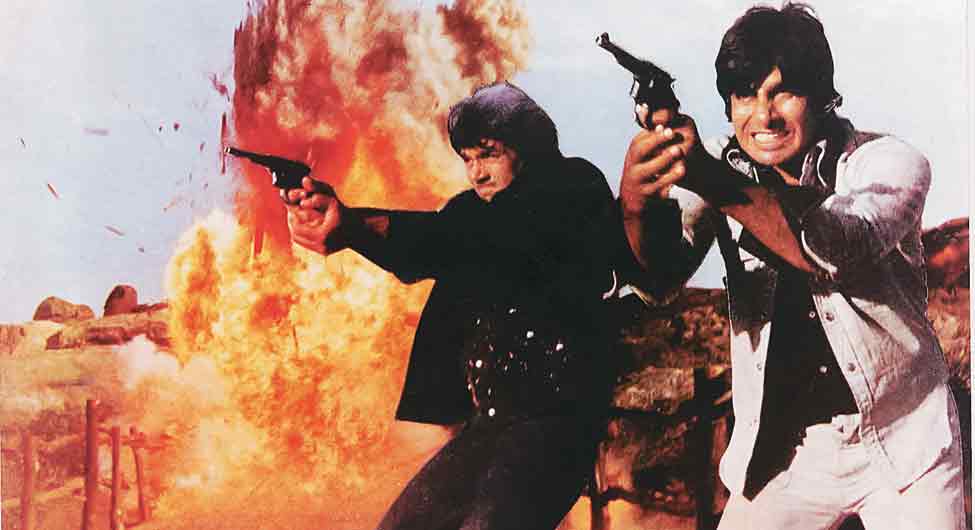
In the seventies, dacoit -based films were being made a lot. Most of them were also succeeding at the box office. Established director like Raj Khosla also made raw threads by taking Vinod Khanna and Kabir Bedi in the role of rival bandits to re -capitalize on the success of Mera Village Mera Mera Mera country. At that time, Sunil Dutt was not promised and did not promise and re -established himself in the role of a bandit in films like Heera. Even Pran had also burnt new life in the role of a bandit in Dharma.
Dharmendra’s pledge was also a film to protect the villagers from the terror of the bandits. Putlibai had also made a splash during this period. Even in the Khote coins of Narendra Bedi, there was an interesting story of urban youths who liberate the villagers from the terror of the bandits. In such a situation, the famous producer G.P. Sippy and his promising son Ramesh Sippy announced the next film Sholay with the background of the bandits after Sita and Geeta’s immense success, which was shocking. But as soon as the film went to the floor, reports of its grand construction started coming.
It was said that time, my name is going to be made in 70mm with a big budget for the first time after Joker and Roti Cloth and House. For the first time in the film, the news of the help of foreign technicians for special effects was also making headlines. In fact, Ramesh Sippy wanted to serve the thrill of the famous film like Hollywood’s Macannaz Gold in a indigenous manner for the Indian audience.
In Sholay, the shooting reports of the exciting scenes of the dacoits riding on the horses running at a high speed at the time of robbery in the train appeared in the film magazines, which was read by the readers with great fervor. At that time, there was not much discussion about the look and style of a new new artist like Amjad Khan in the role of his main villain Gabbar Singh. Later, after the release of the film, he proved to be his USP. Through the posters, the attraction that was created was mainly focused around stars like Dharmendra, Hema Malini, Amitabh Bachchan, Jaya Bhaduri and Sanjeev Kumar.
After the emergency came into force in the country in June 1975, the government instructed the censor board to take strictness to curb the vulgarity, action and violence shown in films. On 12 August 1975, the Central Film Censor Board issued a certificate for performance to the revised Sholay of 23 Reel with 35mm. The certificate was signed by Virendra Vyas, the then chairman of the censor board. Despite being trapped in the 70mm print custom duty of the film, specially prepared from London, the film took place on 15 August 1975 as per the earlier declared program, the film took a grand evil of the film amidst the dazzle of the stars.
Sholay raging late at the box office
During the release of the film on the occasion of Independence Day, an attempt was made to create a hyp through giant hoardings, but regrets, Sholay’s coals were not seen at the box office in the first week. Disappointed distributors with the faded opening of the film, sensing the mentality of the audience, strongly demanded the producer-director to change the grief of the film. Ramesh Sippy himself has publicly told that the entire team went to Bangalore and started preparing to shoot alternative climax. But by the next Friday, the mouth publicity did wonders and on seeing it, the crowd of spectators extinguished the extinguished ‘Sholay’.
There were some other innovations behind this delayed and extraordinary success of Sholay. So far, the traditional image of mounted bandits wearing dhoti-kurta in the minds of the audience was not only demolished by Gabbar Singh of Sholay, but the new venture of the dreaded dacoit, Khabti and Malin Swaroop carved the new venture on the silver screen. Especially his dialogue payment was taken by the audience on his head. On the occasion, the polydore, which was competing with the old gramophone record company like HMV on the occasion, released the LP/ EP gramophone records based on the sound track of the film for the first time. Due to this, along with the songs of Sholay across the country, the dialogues of the film started echoing. Gabbar Singh’s “Come Thakur!” “Hey o sambha!” “How many men were there!” “What will happen to you Kallia!” As such dialogues became popular and climbed on people’s tongues.
At that era of Maradar and Violence -oriented films, a grand film of big budget like Sholay was given a tremendous competition by the average religious film like Jai Santoshi Maa. Even for the film business analysts, this incident was no less than a divine miracle. That year, express films like Dharmma, Wall, Saints, Pledge, and Warrant were traveling leisurely on the silver curtain on the silver curtain, while Gulzar was banned in emergency.
Sholay was promoted as a film with a 70mm stereophonic sound technology, but most of the cinemas in India were not in a position to showcase the film based on that technology. At that time neither such film projector and lens were available nor such an advanced sound system in theaters. Many years later, Sholay was re -displayed with 70 mm in select theaters.
Even before this, the manufacturer made different efforts to attract the audience. For the first time, the audience was entertained by adding the reel of the interesting prison episodes of the British jailer of Asrani and the second time the Holi scenes of Jaya Bhaduri were entertained. Sholay’s record of running for five consecutive years in Mumbai, Mumbai, is still remembered today. The record was broken by Dil -Dar Dulhani Le Jayenge. The 3-D version of Sholay was released in January 2014 but the expected response was not received.
Sholay is the first film to give comedians such as Asrani and Jagdeep, with the stars of the stars of the British jailer and the wooden tall Surma Bhopali. Actor like Mac Mohan was immortalized by the character of Sambha forever. As a stage artist, he continued to narrate the dialogues of Sambha throughout his life.
Sholay’s Ahmed is very important in Sachin Pilgaonkar’s career. The talk of Jalal Aga is even more different, which got the opportunity to sing with the film’s most popular Gypsy song “Mehbooba Mehbooba …” Helen. The characters of the true Imam Saheb and innocent Bholi Mausi directly have A.K. Hangal and Leela Mishra’s spontaneous acting made them memorable.
Even today, the title of staying in a cinema hall for five consecutive years has now become irrelevant or the flags of earnings at the box office have become old and shabby; But the attachment to the film Rasikas towards Sholay remains in every new generation even after five decades. Sholay is not right in multiplex but is the most popular film seen repeatedly through all modern communication means including TV, OTT; Whose attraction remains even today.
In the last five decades, most of the people associated with this film, including Sholay’s producer GP Sippy (Gopal Das Parmanand Sippy) and his son Vijay Sippy, are no longer in this world. All the lateral singers, Lata Mangeshkar, Kishore Kumar and Manna Dey, who gave voice to the immortal songs of the film, have said goodbye to this Phani world in the past years. Sholay’s grand filming Dwarka Divecha and the main cameraman SM. Anwar, the film’s editor M.S. Shinde and sound recordist Mangesh Desai have also died. The film’s famous director Ramesh Sippy himself is now 78 years old. After Sholay, he made another big multi -star film like Shaan. Through a giant hoardings, it was promoted as ‘The Greatest Show on Earth’. But Shaan Ramesh Sippy and G. P. Sippy did not succeed in increasing the glory.
In the early eighties, he pioneered the power test of Dilip Kumar and Amitabh Bachchan in the role of father-son through Shakti. However, after that he did not get fame from films like corruption, alone, Jamana Deewana. Later on Doordarshan, the two -year -old serial Buniyaad again gave him fame. Five years ago, he directed the average film like Shimla Chilli but the audience craved the first Taseer of Ramesh Sippy.
After entering the global mass communication era of social media in the new century, people got an opportunity to meet Sholay’s climax scene for the first time, in which Thakur takes a revenge for the murder of his family by killing Gabbar Singh. But due to the rules of the censor board of public performance of films in India, the audience was deprived of watching this scene in the original film. The film Heritage Foundation of Mumbai has served the responsibility of conservation of classic films by restoration of the film’s state -of -the -art 4 in the fifty year of Sholay’s release.
The film Heritage Foundation took more than three years to prepare this new version of the film. The first international performance of this latest Avatar of Sholay with original climax without a cut was recently performed on 27 June at the Ritrovato Film Festival in Bolona, Italy. On this occasion, Shivendra Singh Dungarpur, the founder of the Foundation was also honored with Vitorio Borini for his remarkable contribution in film conservation.
The credit for the unprecedented success of Sholay goes to her tight screenplay, effective acting, playback music, artistic cinematography, amazing locations, skilled film editing, grand production, which added unmatched pages to the history of Indian films. This unique film has also done a unique job of dividing into two parts like Sholay and after Sholay.
(Vinod Nagar is a senior film scholar and cine critic)