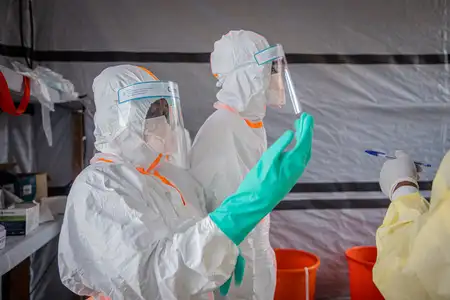
Kinshasa, July 23 (IANS). The death toll from Ebola infection in the Democratic Republic of Congo (DRC) has increased to 1,033, while the total number of infected people has reached 2,536. The country’s health officials gave this information on Thursday.
As per the latest status report, 506 patients have recovered, while 738 people are still in isolation. No new infections have been reported in health areas, so the number of affected areas nationwide still stands at 47, spread across five provinces. Of these, infection is still spreading in 46 areas.
The report said that the epidemic is still in the stage of continuous spread and the spread of the virus is very high. The fluctuations in cases reported in recent times should be interpreted with caution as delays in receiving reports and the slow process of collating data may be the reason for this.
Treatment facilities in North Kivu province remain under pressure. There, 182 patients are kept in isolation against the capacity of 141 beds.
At a press conference Wednesday in Bunia, the capital of Eastern Ituri province and the epicenter of the outbreak, Adelard Lufongola, operations manager for the national Ebola response coordination, said the number of new cases has stabilized at a level in some areas and is even showing a slight decline.
“In terms of the epidemic, it is too early to say that the infection has reached its peak,” Lufongola said.
The outbreak is caused by the Bundibugyo virus and was announced on May 15 in the eastern Ituri province of the DRC. According to the report, frequent movement of people, insecurity, small-scale mining activities and cross-border movement with Uganda and South Sudan remain the main reasons for the spread of infection.
At least 30 people were killed and more than a dozen were injured in a series of attacks in the Beni area between July 13 and 19, according to local civilian organizations, Stephane Dujarric, spokesman for the UN Secretary-General, told the daily press briefing. Due to this violence, many people have been displaced and difficulties in providing humanitarian aid to the affected areas have also increased.
Dujarric quoted the UN Office for the Coordination of Humanitarian Affairs (OCHA) as saying that at least six humanitarian organizations, including those helping in the Ebola response, have halted their movements in several places in the Beni area. The reason for this is the deteriorating security situation there.
–IANS
AY/DKP