
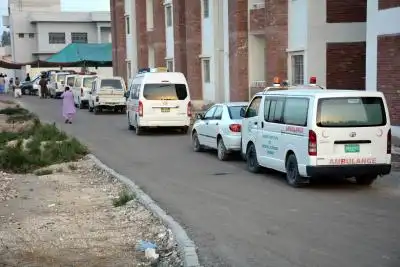
Islamabad, December 24 (IANS). About 4 thousand children are HIV positive in Sindh province of Pakistan. A European Times report made this claim recently. The story of the deteriorating system has been told in the words of statistics. Now the local media of Pakistan is also talking about the dilapidated system of government hospitals. The reason for the poor condition of the big district hospital in Hyderabad, Sindh is attributed to the negligence of the responsible officers.
According to reports, essential medicines are not available in the district hospital in Hyderabad and all the taluka hospitals of the city. There is a shortage of machines required for testing, due to which patients are not able to get even routine lab tests done at taluka-level facilities. As a result, patients are forced to turn to private hospitals and labs, where they are being charged thousands of rupees in the name of initial check-up, Pakistani newspaper ‘The Express Tribune’ reported.
The bad situation can be gauged from the fact that even the trauma center built on Hala Naka Road has not been operationalized. This has increased the burden on the district hospital of Hyderabad. This is a hospital where a large number of patients from all over Sindh come for treatment. However, the equipment in the district hospital is also damaged and the treatment facilities are also inadequate.
At present, only one MRI and one CT scan machine are operational in the district hospital of Hyderabad, while other diagnostic machines have been lying closed for months. Newspaper reports suggest that the situation is even worse in Hyderabad’s taluka hospitals, as Sindh government’s Bhittai Hospital Latifabad, Government Hospital Qasimabad, Kohsar Hospital Latifabad, Government Hospital Preetabad, and Government Hospital Hali Road and many health units lack testing facilities and essential medicines.
Earlier this month, another report has come out which presents a frightening picture of the poor system. This is about HIV. With the rapid increase in HIV cases, Pakistan has come to the second position among Asia-Pacific countries. The deepening HIV crisis in Pakistan is not only a medical emergency, it also reflects institutional corruption and the human cost of years of neglect, failure to implement basic health standards, and corruption.
Shocking statistics have shown how medical rules have been blatantly violated by repeatedly using the same syringe and carrying out blood transfusions without rules. According to a report by the European Times, health authorities have reported 3,995 registered HIV-positive children in Sindh; This figure is only for those cases for which documentation exists. According to reports, Sindh’s health minister was recently briefed about the “extremely worrying” spread of HIV infection, and that the number of cases was increasing among children.
According to statistics, more than 6,00,000 quacks are running their shops in Pakistan, out of which 40 percent are in Karachi. This figure shows the increasing rate of medical negligence in Pakistan. Due to inadequate monitoring, these fake doctors reuse syringes recklessly, practice negligence, and follow unsafe procedures, leading to the rapid spread of HIV.
The problem has been compounded by the lack of testing kits, antiretroviral drugs and trained staff in some HIV treatment centers in Pakistan. Patients often face problems as they have to move from one hospital to another in search of basic care.
The European Times reports, “Pakistan’s deepening HIV crisis is more than just a medical emergency; it is the result of institutional corruption. It reflects the human cost of years of neglect, failure to enforce basic health standards, and corruption. Nearly 4,000 HIV-positive children in Sindh, quacks and the daily use of contaminated medical equipment all add up to government neglect. This is not the story of a virus spreading silently.” This is a story of the failure of the system that allowed the virus to flourish.”
–IANS
kr/