
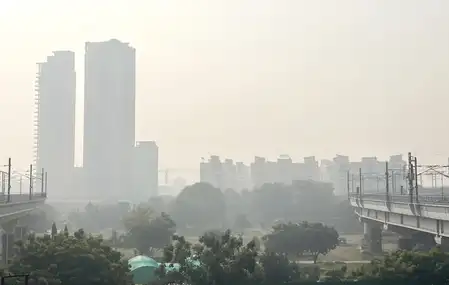
New Delhi, October 20 (IANS). The air quality index (AQI) in the national capital reached ‘very poor’ category on Monday morning. This means that the air here has become poisonous. Health experts have advised to remain alert, especially those who have any respiratory or heart related problems.
According to the Central Pollution Control Board (CPCB), the air quality index (AQI) in Delhi was recorded at 335 at 8 am on Diwali morning. This was due to people bursting crackers on the eve of the festival of lights, causing severe noise pollution and covering Delhi-NCR with smoke.
CPCB’s forecast for the coming days also indicates a similar trend, with air quality likely to deteriorate further to the “severe” category on Tuesday and Wednesday.
Dr. Harshal R., Additional Professor, Community Medical Center of AIIMS, New Delhi. “Increased exposure to air pollution has serious health effects, both short-term and long-term. Short-term effects include asthma, chronic obstructive pulmonary disease (COPD), shortness of breath and itchy eyes. Long-term exposure can lead to cardio-respiratory diseases, stroke, heart attack, dementia and mental health problems,” Salve told IANS. Are.”
The expert said that children and elderly people above 60 years of age, and people already suffering from any disease are more sensitive to the effects of air pollution.
CPCB said that the city’s daily average AQI reached 296 (‘poor’) on Sunday, then reached 300 by 6 pm and 302 by 7 pm, i.e. it reached the ‘very poor’ category.
This time the Supreme Court has allowed people to burst green crackers for a limited time, given the fear that the air quality in the national capital may worsen further.
Dr Ujjwal Parekh, senior consultant, chest medicine at a leading hospital in Delhi, told IANS, “In the last few days or a week, pollution has started increasing in Delhi, causing problems for people suffering from respiratory diseases or allergies, and it is expected to increase further if firecrackers are burnt in large quantities during the re-evaluation.”
“Therefore, this is a sensitive time for people suffering from respiratory diseases as their symptoms may increase or worsen during this period,” Parekh said.
Dr Salve stressed the need to reduce emissions by strictly banning diesel vehicles, managing dust at construction sites and controlling industrial emissions. He said that at the individual level, burning of garbage and stubble should be stopped and sustainable energy resources should be used.
The doctor also suggested avoiding early morning outdoor activities, using N95 masks when going out and eating fruits and vegetables (up to five servings a day), especially antioxidant-rich citrus fruits, to prevent the effects of air pollution on the human body.
At the same time, Dr. Parekh advised patients suffering from respiratory diseases to keep taking all their medicines regularly during the time of pollution. Also said, “Such patients should ideally stay indoors, in air-conditioned rooms, so that they are not affected or have very minimal impact of pollution during increased AQI.”
Meanwhile, in view of the deepening air quality crisis in NCR and adjoining areas, the Commission for Air Quality Management (CAQM) has immediately activated the second phase of the Graded Response Action Plan (GRAP).
The CAQM has also urged citizens to use public transport, avoid dusty construction works and avoid burning garbage.
–IANS
kr/