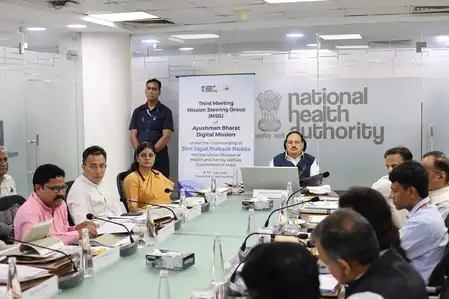
New Delhi, July 10 (IANS). Union Health and Family Welfare Minister JP. Nadda chaired the third Mission Steering Group (MSG) meeting of Ayushman Bharat Digital Mission (ABDM) on Friday. During this, he reviewed the progress of the country’s digital health ecosystem.
The meeting was attended by Tripura Chief Minister Dr Manik Saha, Madhya Pradesh Deputy Chief Minister Rajendra Shukla, Union Ministers of State Prataprao Jadhav, Anupriya Patel and Jitin Prasad, including senior representatives of NITI Aayog, National Health Authority (NHA), Ministry of AYUSH and various states and union territories.
Addressing the meeting, J.P. Nadda stressed on strengthening citizen-centric, interoperable and technology-based health services. He said that now in the next phase of the mission, special attention will have to be paid to adopting its maximum use in the entire country.
Nadda said that digital public infrastructure has become an effective medium to increase the quality, availability and transparency of health services. The key objective of ABDM is to provide every citizen with secure and consent-based access to their health records. According to him, technology can play an important role in achieving the goal of ‘universal health coverage’ provided it is inclusive, accessible and easy to use.
During the meeting, the Mission Steering Group reviewed the achievements made so far under ABDM. Officials said that Ayushman Bharat Digital Mission has emerged as one of the largest digital health ecosystems in the world. So far, more than 93.95 crore ABHA numbers have been generated across the country, while more than 105 crore health records have been digitally linked. Apart from this, 5.33 lakh health institutions and 9.85 lakh health professionals have been registered in the National Digital Health Registry.
Under the mission, 2.72 lakh health institutions have adopted ABDM enabled software. At the same time, to make OPD registration faster and easier in hospitals, about 24 crore ‘Scan and Register’ tokens have been issued. This is enabling secure and consent-based digital exchange of patients’ health records.
In the meeting, the progress made on the decisions taken after the last review meeting was also assessed. This included topics like capacity building in states, integration of digital health platforms with government schemes, increasing participation of private health service providers, and strengthening international cooperation.
The Mission Steering Group appreciated the initiatives like ‘Model District’, ‘Model Facility’ and ‘Aarogya Setu 2.0’ in the States and Union Territories. Satisfaction was also expressed on the better integration of the digital platform with major health schemes like Ayushman Bharat PM-JAY, CGHS, ESIC and Nikshay. Members believed that these initiatives were making health services faster, safer and citizen-centric.
The future strategy was also discussed in the meeting, with special emphasis on the use of new technologies like Artificial Intelligence, promoting digital health standards, strengthening interoperability and increasing coordination with states.
JP in the closing address. Nadda said that a strong digital health framework has been created under ABDM, but now the biggest priority is to ensure its widespread use. Empowering the health sector is the cornerstone of the goal of ‘Developed India 2047’ and Ayushman Bharat Digital Mission will prove to be an important pillar in this direction. He called upon the Centre, States and all concerned to work together towards providing safe, simple and digital health services to every citizen.
–IANS
SCH/ABM