
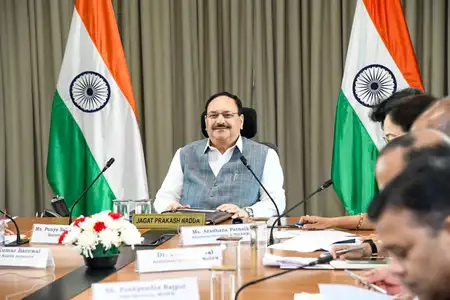
New Delhi, June 29 (IANS). Union Health and Family Welfare Minister JP Nadda will chair the 16th conference of the Central Council of Health and Family Welfare (CCHFW) in the national capital on Monday. Many important topics will be discussed in this conference organized with the aim of strengthening the health of children and reviewing major issues related to public health.
During the conference, the Union Minister will also launch the Samagra Shishu Bal Swasthya Karyakram (SSBSK). It is a comprehensive national program aimed at providing uninterrupted health services to children from birth to 36 months.
This conference will be held at Vigyan Bhawan, in which Health Ministers of States and Union Territories, MPs and senior officials of Central and State Governments will participate. Major issues related to National Health Mission (NHM), Sustainable Development Goals (SDGs), Food and Drug Reforms and allied health services will be discussed in the meeting.
According to the official statement, the launch of SSBSK is an important step forward in the government’s commitment towards ensuring comprehensive, accessible and quality healthcare services to every child in the country.
The program envisages providing a seamless system of home and community based care for children from birth to 36 months. In this, the first three years of life are considered extremely important for the child’s survival, growth, nutrition and initial development of the brain.
SSBSK will function as a holistic national program by integrating two major community based schemes namely Home-Based Newborn Care (HBNC) and Home-Based Care for Young Child (HBYC).
The integration of these two programs will ensure continuity of care for children from birth to the first three years of life. Also, child survival, nutrition, healthy growth and early childhood development will be strengthened through an integrated approach.
For the first time, a risk-stratified system will be implemented under this program for newborns and “at-risk” children. Such children will be provided additional home health services and follow-up as per their risk level.
Under the programme, “at risk” newborns will be provided home health services a maximum of nine times within the first 42 days after birth, while “at risk” children will be provided home health services a maximum of eight times till the age of 36 months.
The program will also strengthen the continuity of care through joint delivery of door-to-door services by ASHAs (ASHAs), Auxiliary Nurse Midwives (ANMs), Community Health Officers (CHOs) and Anganwadi Workers (AWWs).
Additionally, Well-Baby Sessions on every Village Health, Sanitation and Nutrition Day (VHSND) and Shishu Camps will be organized every month in Ayushman Arogya Mandirs to ensure timely identification, assessment and treatment of “at risk” children.
The program will use digital technologies such as Decision Support Systems (DSS), child tracking applications, referral systems and alert mechanisms to make monitoring, follow-up and continuity of maternal and child health services more effective.
–IANS
SAK/AS