
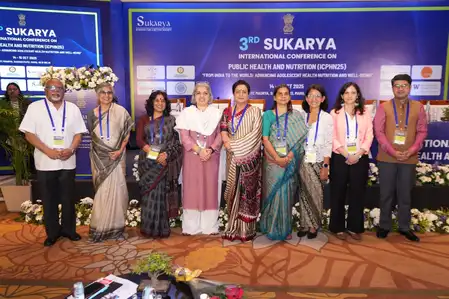
New Delhi, October 14 (IANS). Developing a culture of ‘health literacy’ and ‘self-care’ for youth can help prevent non-communicable diseases like diabetes, hypertension, obesity and cancer in India, health experts said on Tuesday.
Experts expressed their views at the 3rd International Conference on Public Health and Nutrition (ICPHN 2025) organized by non-profit organization Sukarya.
Dr. Zoya Ali Rizvi, Deputy Commissioner of Nutrition and Adolescent Health, Ministry of Health and Family Welfare, emphasized the focus of the National Mission on preventive health and behavior change.
“We are witnessing a paradigm shift. Our endeavor is not just to cure diseases, but to prevent the onset of non-communicable diseases by increasing health literacy among the youth and building a culture of self-care,” Rizvi said.
He further added, “Our aim is to reach every state and every adolescent with programs that not only suggest solutions but also enable ownership of health.”
Speaking to IANS, Meera Satpathy, Founder and President of Sukarya, said the conference focuses on “adolescent health”, which includes their physical health, mental health, nutrition, behavioral problems, etc.
Describing teenagers as “India’s biggest strength”, Satpathy stressed the need to take care of their health as early as possible.
“Adolescents and young girls have a lot of problems. When they are young, we want to take care of them. If they do not take care of their health, it becomes a burden for life. We want a good, healthy and capable India,” he told IANS.
Bonita Sharma, Co-Founder and CEO, Social Changemakers and Innovators, Kathmandu, Nepal, spoke on the need to promote balanced nutrition.
“Currently, youth in developing countries are facing the triple burden of malnutrition. They are underweight, overweight and obese. There is also the problem of anemia, also known as hidden hunger or micronutrient deficiencies,” Sharma told IANS.
“The main solution discussed so far is to use school as an entry point to lay the foundation for adolescents’ health and well-being,” he said. He also stressed the need to pay attention to the shortcomings in the implementation of policies.
“There are a lot of great policies and programmes, but when it comes to implementing them at the ground level, there are many challenges. There were also discussions on ensuring a strong monitoring mechanism,” Sharma said.
–IANS
kr/