
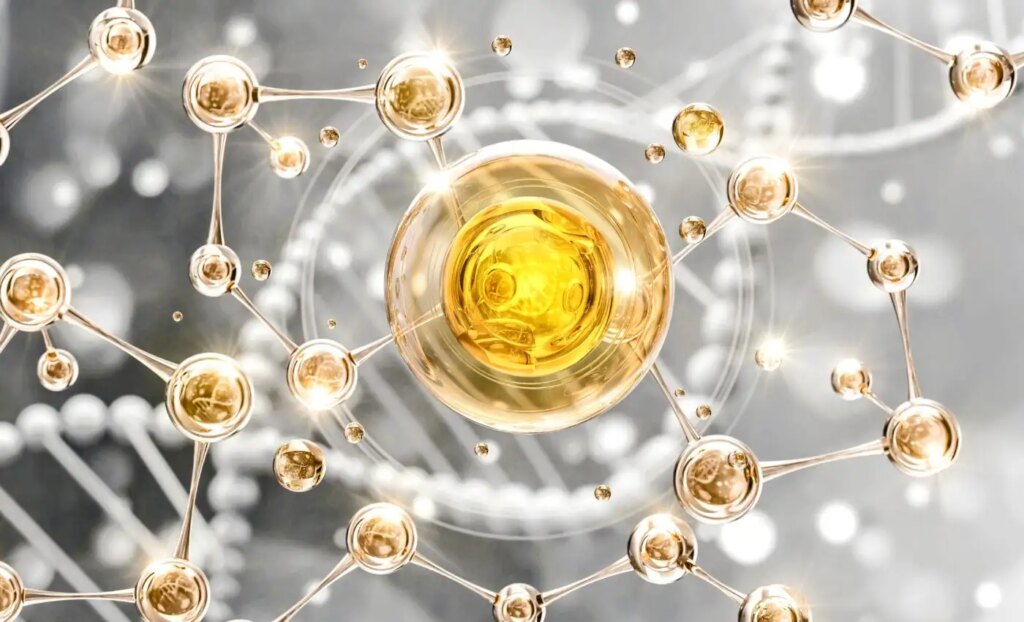
Just imagine: what would it feel like if the gold around your neck or the ring on your finger suddenly started flowing like water and behaving exactly like a person or a living cell? Although this may sound like a story from a Hollywood science fiction movie, scientists in Japan have turned it into reality. In the world of science, such discoveries often happen which surprise humanity.
Researchers at Japan’s Tohoku University have discovered “liquid gold” – the liquid state of gold – nanoparticles that behave like living organisms. The amazing thing is that these nanoparticles are so advanced that they can change their shape and structure on their own in response to heat and pressure. This scientific discovery has the potential to completely revolutionize the fields of medical science, cancer treatment, drug delivery methods and electronic gadgets in the near future. The findings of this research have been published in the *Journal of the American Chemical Society*.
How does liquid gold work?
Under the guidance of Dr. Rina Sato and Professor Kiyoshi Kani, scientists placed these extremely fine gold particles on the surface – the boundary – between air and water. To give these particles their unique properties, scientists coated them with two different types of organic molecules. According to Professor Kiyoshi Kani, this research shows how even a small change at the molecular level can fundamentally change the entire structure of a nanoparticle.
Potential use in cancer treatment
The most important aspect of this discovery is that this structural change occurs at about 40 degrees Celsius – a temperature very close to human body temperature. This suggests that in the future, it may be possible to develop drugs that can enter the body and activate (i.e. release their therapeutic agents) by sensing the specific temperature of diseased areas – such as tumors or cancer cells. This targeted approach will prevent damage to the rest of the body. Additionally, this technology can also be used in the development of flexible screens, advanced sensors, and self-healing robots. Scientists consider this a big step towards future smart materials.