
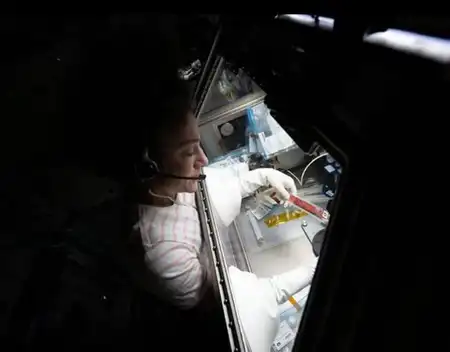
New Delhi, May 29 (IANS). Scientists on the International Space Station (ISS) are working on an experiment that can improve the treatment of cancer and serious blood-related diseases in the future. According to the information posted on the official Instagram account of ISS, research is being done on growing stem cells in space, so that better quality and more quantity of stem cells can be prepared for the treatment of patients on Earth.
The ISS is serving as an advanced testbed for new technologies and medicines that can improve life on Earth. Stem cell research is a great example of this. Scientists hope that with this research, stem cell therapy will be more effective, cheaper and easily available in the future. This can become a big ray of hope for millions of patients suffering from diseases like cancer.
This experiment can prove helpful in improving the treatment of not only cancer, blood cancer but also other serious diseases. ISS said in the post that blood stem cells can prove to be extremely beneficial for people who need to fight serious diseases or strengthen their blood system after chemotherapy. Scientists are trying to understand how stem cells develop in an environment of microgravity and whether they can maintain their capacity for a long time.
Stem cells grown on Earth lose their ability to continuously divide over time, but stem cells grown in microgravity (zero gravity) can circumvent this problem. Researchers believe that stem cells prepared in space can be of better quality and in greater quantity. This can significantly improve the treatment of patients with blood cancer, immune system diseases and life-threatening blood disorders.
The ISS posted two photos, the first of which shows NASA astronaut Jessica Meir working inside the Life Sciences Globox in the Stem Cells X-H2 experiment. Samples of stem cells grown in space will be frozen and sent to Earth, where they will be studied in detail. Whereas, in the second picture a microscopic image of hematopoietic stem cells is shown. The main objective of this experiment is to generate large numbers of high quality stem cells with the help of BioServ’s new microgravity bioreactor.
–IANS
MT/DKP