
India is celebrating its 77th Republic Day today, as the entire country comes together to celebrate the anniversary of the adoption of the Constitution and showcase its rich cultural and military heritage. Today President Draupadi Murmu presided over the grand ceremony organized at the Duty Path in New Delhi.
It is noteworthy that this year the President of the European Council Antonio Costa and the President of the European Commission Ursula von der Leyen were present as chief guests on this important occasion.
This year, the duty path stretching from Rashtrapati Bhavan to the National War Memorial was lavishly decorated to showcase India’s remarkable journey. The ceremony witnessed a unique confluence of the 150-year-old legacy of the national song Vande Mataram, the unprecedented developmental progress of the country, strong military power, vibrant cultural diversity and active participation of citizens from all walks of life.
The ceremony started at 10:30 am. It started with Prime Minister Narendra Modi’s visit to the National War Memorial, where he paid emotional tribute to the martyrs on behalf of the country.After this, the Prime Minister and other dignitaries went to the salute platform on the duty path to watch the parade.
The President of India, the President of the European Council and the President of the European Commission arrived in a traditional buggy, accompanied by the President’s Body Guard, the most senior regiment of the Indian Army.
As per tradition, the national flag was hoisted, followed by the national anthem and a 21-gun salute from the indigenously developed 105 mm Light Field Gun. This salute will be given by 1721 Ceremonial Battery of 172 Field Regiment.
Around 100 cultural artistes participated in the parade based on the theme ‘Unity in Diversity: Unity in Diversity’ which was a grand display of musical instruments and showcased the unity and rich cultural diversity of the nation. Flowers were showered by four Mi-17 1V helicopters of 129 Helicopter Unit in flag formation. Flying the national flag, this formation of helicopters was led by Group Captain Alok Ahlawat.
After this the parade started with the salute of the President. The parade was commanded by Lieutenant General Bhavneesh Kumar, General Officer Commanding, Delhi Area, a second generation Army officer. Major General Navraj Dhillon, Chief of Staff, Headquarters Delhi Area, a third generation Army officer, was the second in command at the parade.
The names of the glorious winners of the highest gallantry awards are given next. These include Param Vir Chakra winner Subedar Major (Honorary Captain) Yogendra Singh Yadav (retired) and Subedar Major Sanjay Kumar and Ashok Chakra winner Major General C.A. Pithawalia (Retd) and Col D. Sriram Kumar. The Param Vir Chakra is awarded for extraordinary gallantry, courage and self-sacrifice displayed by members of the Defense Forces in the face of the enemy, while the Ashoka Chakra is awarded for similar gallantry, courage and self-sacrifice not in the face of the enemy.
The European Union (EU) contingent included four flag bearers riding on three gypsy vehicles. They appeared to be carrying four flags: the flag of the European Union, which is the most distinctive symbol of the European Union; Military Staff Flag of the European Union; Flag of the Naval Force Atalanta of the European Union; And the flag of the EU Naval Force Aspides.
For the first time, the Indian Army’s phased battle formation format was showcased in the parade, which also included the air component. The 61st Cavalry in active combat uniform joined the reconnaissance group. This was followed by the High Mobility Reconnaissance Vehicle, India’s first indigenously built armored light special vehicle. For air support, the indigenous Dhruv advanced light helicopter and its armed version, Rudra, were deployed in the strike formation, which demonstrated battlefield tactics.
After this, the combat troops passed in front of the saluting stage along with T-90 Bhishma and main battle tank Arjun. They received air support from Apache AH-64E and Prachanda Light Combat Helicopter. Other mechanized troops include the BMP-II Infantry Combat Vehicle and the Nag Missile System (Tracked) Mk-2.
A contingent of special forces followed, including the Ajayketu All-Terrain Vehicle, the Randhawaj Rugged Terrain Tactical Transport System and the Dhavanask Light Strike Vehicle. Behind them rode the robotic dog, unmanned ground vehicle and four autonomous unmanned ground vehicles (Nigraha, Bhairav, Bhuviraksha and Krishna).
The combat support team includes India’s arsenal of new generation unmanned combat weapons, demonstrated through the Shaktiban and Divyastra. These weapons were mounted on special high mobility vehicles (HMV 6×6). Equipped with state-of-the-art technologies, these weapons demonstrate advanced surveillance capability through swarm drones, tethered drone systems and indigenously developed tactical hybrid UAV ZOLT, which are used to direct artillery fire.
Their targeting capability is strengthened by a wide range of air surveillance weapons – Harop, Mini Harpy, Peacekeeper, ATS (Extended Range), ATS (Medium Range) and Sky Striker – allowing precise engagement deep into the battlefield. These systems are capable of launching swarm drones, drones with strike ranges of more than 1,000 kilometers (for observation and attack) and aerial surveillance weapons for precision strikes on critical targets.
This was followed by the development of the Dhanush cannon system and the Amogh Advanced Towed Artillery Gun System (ATAGS).
Reflecting the spirit of self-reliant India and technological self-reliance in defense manufacturing, a powerful combination of long-range accuracy and tremendous firepower will be displayed. Through the supersonic BrahMos weapon system and the indigenous Suraksha Universal Rocket Launcher system, both of them will together demonstrate deep strike superiority.
Two strong pillars of India’s air defence, the Akash weapon system and the Abhra medium-range surface-to-air missile (MRSAM) system, will also pass by the saluting podium. This will be followed by the drone Shakti Lorry, which has been developed by the Corps of Electronics and Mechanical Engineers to enhance the operational capabilities of the Indian Army in forward areas. A glass covered integrated operations center briefly depicting the operations of Operation Sindoor will also pass through the duty path.
An excellent blend of ‘Heritage, Diversity and Development’ proved to be the magic potion during the operation. While the BrahMos missile delivered lethal strikes to the enemy, the Akash missile systems and S-400 provided a protective shield, reflecting Prime Minister Narendra Modi’s Sudarshan Chakra vision.
Snow warriors of the Indian Defense Forces will follow them. These also include the animal contingent, which includes brave soldiers, Bactrian camels, Zanskar ponies, black eagles (birds of prey), clever and alert birds; and Indian dog breeds (Mudhal Hound, Rampur Hound, Chippiparai, Kombai and Rajapalayam). All these dogs are equipped with bullet resistant vests, cameras, GPS, radio and advanced monitoring systems. The Snow Warrior team also includes a vehicle-mounted Glacier ATV.
Those marching on the duty path will include Mixed Scout Contingent, Rajput Regiment, Assam Regiment, Jammu and Kashmir Light Infantry, Artillery Regiment, 4 Bhairav Battalion Sikh Light Infantry Regiment and Combined Military Band.
The Indian Navy contingent will consist of 144 young soldiers, led by contingent chief Lieutenant Karan Nagyal, and platoon chiefs Lieutenant Pawan Kumar Gandhi, Lieutenant Preeti Kumari and Lieutenant Varun Dreveria. After this, the tableau of the Navy will be presented, which will vividly depict the theme of ‘A Strong Navy for a Strong Nation’.
The tableau will showcase a tailor-made boat from the fifth century AD (now known as INSV Kaundinya), Gurab-class ships of the Maratha Navy, and leading indigenous platforms such as aircraft carrier INS Vikrant, Project 17A Nilgiri-class stealth frigates INS Himgiri and INS Udayagiri, Kalvari-class submarine and GSAT-7R (Project Rohini) communications satellite.
This tableau also includes a depiction of the circumnavigation route traveled by Insvi Tarini during the Navik Sagar Parikrama-II expedition. Apart from Naval personnel, young cadets from the Sea Cadets Corps, an NGO imparting basic maritime skills to the youth in Mumbai, will also march with the tableau.
This tableau symbolizes the Indian Navy’s march towards victory through unitedness, self-reliance and innovation. The Indian Air Force contingent consists of four officers (one detachment commander and three additional officers) and 144 airmen. The detachment commander will be Squadron Leader Jagdish Kumar, while Squadron Leader Nikita Chaudhary, Fit Lieutenant Prakhar Chandrakar and Fit Lieutenant Dinesh will be the additional officers. In sync with the marching contingent, there will be an exciting fly past by 2 Rafale, 2 MIC-29, 2 SU-30 and 1 Jaguar in ‘Spearhead Formation’, symbolizing the Sindoor Formation.
The tableau of ex-servicemen of the three armies, the theme of which is ‘From war to nation building’, will showcase their journey from war to nation building. The façade, symbolizing Sangram, will feature a striking three-dimensional circular wall depicting the iconic war machines that shaped India’s defining war moments. There will be a symbol of Amar Jawan Jyoti at the top of the wall, which is a tribute to the brave martyrs who secured the freedom and integrity of the nation with their supreme sacrifice. The trailer portion representing nation building will highlight the continuous service of ex-servicemen towards nation building.
The joint tableau of the three Services will depict ‘Operation Sindoor: Victory through Jointness’, representing the collective strength, unity and integration of the Indian Army, Indian Navy and Indian Air Force in defense of national sovereignty. The tableau reflects India’s resolve to respond decisively through coordinated planning, joint execution and seamless coordination in all domains of war.
The visual presentation depicts precise air strikes by the Indian Air Force, quick naval maneuvers ensuring maritime supremacy and coordinated ground offensives by the Indian Army, mirroring a decisive joint military operation.
The contingent comprising women members of the Indian Coast Guard (ICG) will be led by Assistant Commandant Nishi Sharma, assisted by Assistant Commandant Apoorva Gautam Hore, Assistant Commandant Lakshita and Assistant Commandant Hardik.
Inspired by the motto of ‘Vayam Raksham: We Protect’, the contingent will showcase India’s commitment to maritime power and security, reflecting the Indian Navy’s commitment to protect its 11,098 km long coastline. DRDO will display LR-ASHM missile with launcher during the parade. This weapon system is designed to meet the coastal battery requirements of the Indian Navy.
The LR-AShM is a hypersonic glide missile capable of engaging stationary and moving targets and is designed to carry various payloads. The missile is the first of its kind equipped with indigenous avionics systems and high-accuracy sensor packages.
This hypersonic missile follows a semi-ballistic trajectory, with a speed starting at Mach 10 and averaging Mach 5.0 with multiple jumps. In the final phase, indigenously developed sensors have been provided to engage moving targets. Since the missile flies at low altitude with high speed and maneuverability, enemy ground and ship-based radars cannot detect it during most of its trajectory. The LR-ASHM is equipped with a two-stage solid propulsion rocket motor system. These propulsion systems propel the missile to the required hypersonic velocity. The vehicle separates after its first stage is completed. After the second stage is over, the vehicle glides unpowered in the atmosphere with necessary maneuvering before engaging the target.
The contingents marching on the duty path included a Central Industrial Security Force (CI) contingent led by Sub Inspector Karan Singh; Central Reserve Police Force (CI) contingent led by Assistant Commandant Simran Bala and Assistant Commandant Surabhi Ravi; Indo-Tibetan Border Police (IDO-Tibetan Border Police) contingent led by Band Master-ASI Devendra Singh; And a Delhi Police contingent led by Assistant Police Commissioner Anant Dhanraj Singh will be involved. The camel contingent of the Border Security Force will be commanded by Deputy Commandant Mahendra Pal Singh Rathore.
Mansi Vishwakarma, Senior Under Officer, Uttarakhand Directorate, who is the Commander of the SW (Girls) contingent, will lead the NCC contingent of 148 girl cadets selected from all the Directorates. Senior Under Officer Tauheed Altaf, Jammu Kashmir and Ladakh Directorate, SD (Boys) Contingent Commander, who will lead the contingent of 148 boy cadets. Under the National Service Scheme, the marching contingent of 200 volunteers will be led by Ms. Charu Singh from Jaipur, Rajasthan.
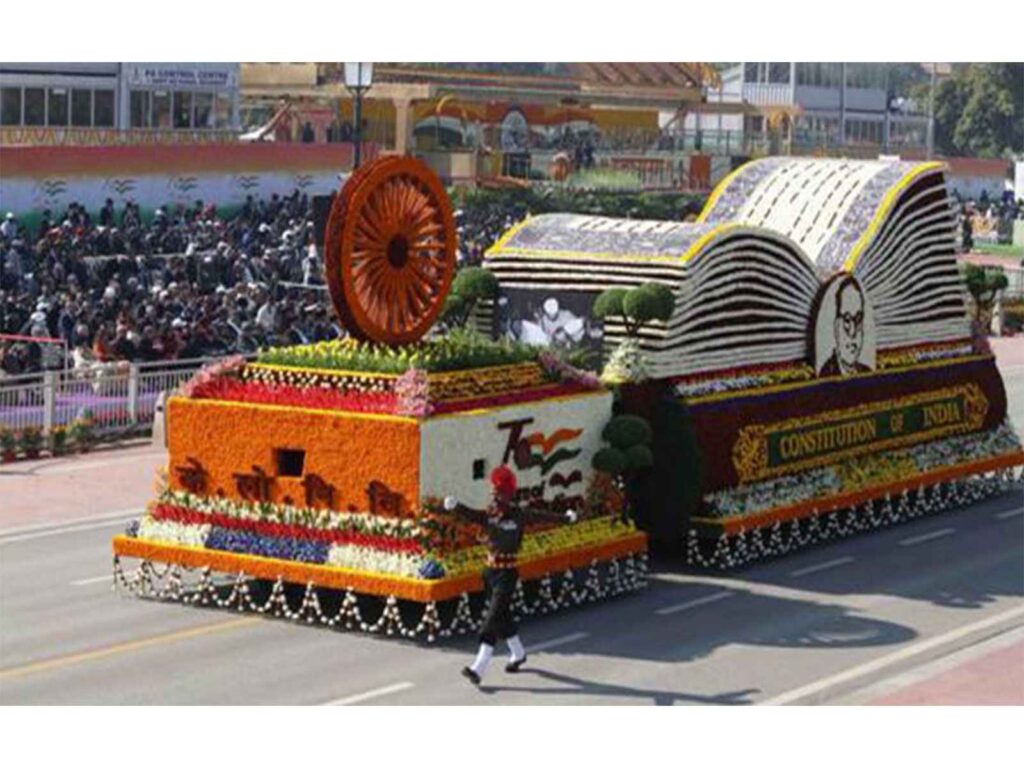
A total of 30 tableaux, including 17 from States/Union Territories and 13 from Ministries/Departments/Services, will participate in the parade based on the overarching theme of ‘Mantra of Freedom: Vande Mataram’ and ‘Mantra of Prosperity: Self-reliant India’. These tableaux will present a unique blend of 150 years of the national song Vande Mataram and the rapid progress made on the back of growing self-reliance in various sectors, steeped in the country’s rich and vibrant cultural diversity.