
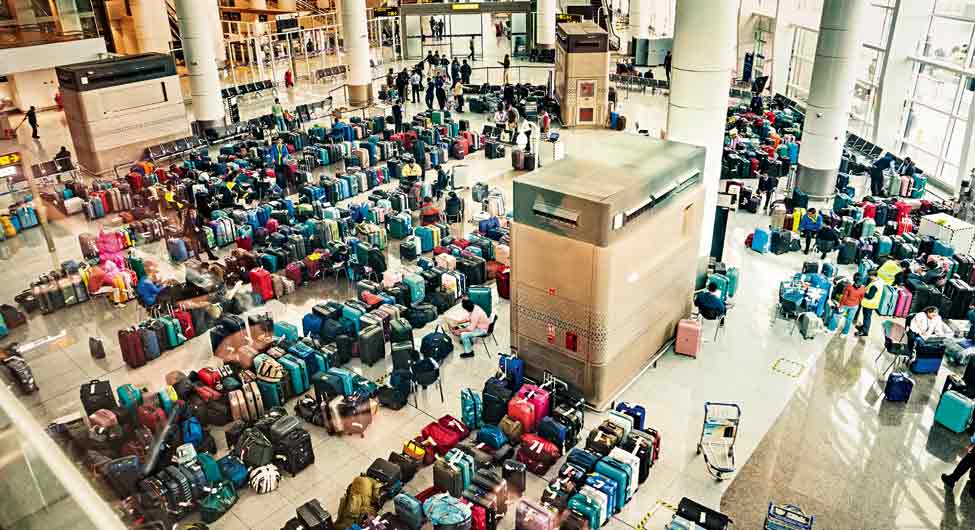
Indigo, which has almost a monopoly in the country, could be hit on the ground by a little tightening of rules, mere mismanagement and indifference or the crisis would become bigger.
The scene was exactly like that of railway stations, fortunately there was no stampede, people kept waiting at the spot for thirty-six-forty-eight hours, suffocating. There was no one to take accountability. Neither Indigo, nor the government. People just kept rubbing their hands. An elderly woman from Guwahati in the North-East waited for her husband’s body to be taken to her city for the last rites, someone missed the time to join a job, a young couple had to attend their own wedding reception through video conferencing from the airport. Chaos, chaos, jostling, running of people, screaming, thousands of bags and luggage scattered like unclaimed, cancellation of lakhs of tickets, non-receipt of money and luggage for weeks, surely all this should have been the responsibility of the entire system or the government rather than any company. All this continued unabated from late November to the first week of December, but there was no one to take responsibility. Apart from a few statements and posts on social media, nothing special came from the government or opposition leaders.
Finally, when the headlines started screaming, the government took action, but too late. She too was not free from the bitter taste of politics. When the Aviation Minister at the Centre, Ram Mohan Naidu of Telugu Desam, became active in the second week of December, the Directorate General of Civil Aviation (DGCA) also realized to give up laxity and take strict measures. Many Indigo officials were removed. DGCA officials were deployed in Indigo offices for supervision. Instructions were given for return of goods and refund. Its flights were reduced by 10 percent. However, concessions were still given. The deadline for implementing the new pilot duty rules, which ended on December 1, has been extended to mid-February next year.
Till recently or say till the end of November, DGCA was not only believing in what IndiGo was saying but was also kind, it had got permission to increase the flights by 10 percent for the winter season. According to reports, IndiGo officials, reportedly in four meetings in October-November, kept assuring the DGCA that work on additional recruitment of pilots as per the new duty rules was underway and everything would be fine. The reason was that according to the new rules, the rest period for pilots was increased to 48 hours a week instead of 36 hours and night landings were limited to two instead of six. But now it has come to light that the number of pilots of IndiGo had decreased instead of increasing, whereas in compliance with international standards, especially under pressure from the European Union, new rules were issued only in January 2024 and were to be implemented in two phases this year.
But first let’s see what happened. In the last one and a half decade (IndiGo’s first flight was Delhi-Imphal in 2006) or to be precise, within a decade, IndiGo has become the largest airline in the country with the claim of affordable, accessible flights on time. It captured about 65 percent of the market for domestic flights. It has a fleet of more than 400 aircraft and was flying about 2,300 flights a day before the current crisis. On an average, up to five lakh people have been traveling on its flights every day on more than 90 domestic and about 45 international routes.
But when December came, its wings got ruffled in the very first week, which was based on relaxation in all kinds of rules. More than 2,900 flights were canceled between December 4 and 6. More than 1,500 flights were canceled on December 5 alone. Thousands of passengers remained stranded in the lounge. When people started looking for tickets on other flights, air fares started skyrocketing. Before the current crisis, IndiGo had a market cap of $25 billion (Rs 2.3 lakh crore) and huge profits of Rs 7,258 crore in FY25. After the crisis in the first week of December, its market cap declined by 19 percent and fell by about Rs 45,000. So, what happened that left Indigo in such a bad shape? Was this a system of relaxation and arbitrarily amassing only profits, which collapsed at the slightest tightening? This accountability should not only be of IndiGo but also of all aviation circles including DGCA.
How Shiraza fell apart due to strictness
Following a series of accidents and under pressure to strictly adhere to Western and international standards, Flight Duty Time Limitation (FDTL) was created to limit working hours. Earlier there were generally similar rules, which were relaxed in the name of business convenience in the new era. For many years, Indian pilot unions have been saying that fatigue rules are a pilot’s right to life. The unions took these cases to the courts. Ultimately, after long negotiations and court intervention, DGCA decided new rules. Under the new FDTL rules, the weekly rest for pilots was increased from 36 hours to 48 hours. Night landings were reduced from six to two for each pilot. Also, no pilot can be deployed on night shift duty for more than two consecutive nights. Airlines required to submit quarterly reports on pilot fatigueYes gone.
It was decided to implement these new 22 FDTL rules in two phases this year. On July 1, 15 eased rules were implemented, including reducing the maximum daily flying time for pilots from nine hours to eight hours and the maximum number of daily landings. The second phase came into force on 1 November, with the remaining seven rules in place, including strict limits on night duty and mandatory weekly rest periods.
The new FDTL rules did not come suddenly. These rules were issued in January 2024, giving airlines about two years to prepare. Due to regulations requiring pilots to fly fewer hours per month, airlines needed to recruit more pilots to fly the same number of flights.
The new FDTL brought many complexities for IndiGo, which prides itself on working on a tight budget. Its entire economics rested on the fact that even a small reduction in the working hours of pilots required a large recruitment. Other airlines made arrangements, but Indigo could not do so. Many experts say that the owners of Indigo felt that they were so influential and influential that if they showed any reluctance, the DGCA would have to bow down.
What happened in the first few weeks before November could be called more deliberate manipulation than carelessness. As the deadline for implementing the second phase approached, DGCA started seeking preparedness reports from airlines. Apart from this, airlines also have to disclose their plans for the winter season. It has to be told how the flight arrangements will be made during foggy months. According to reports, at least four meetings were reportedly held between October and November to take stock of the preparations. Not even once did any airline including IndiGo mention the shortage of pilots. Not only this, in November Indigo formally told DGCA that it had enough crew. DGCA and government officials are now saying that they were misled. In the last week of November the system started breaking down. Cyclone Ditvah devastated Chennai and parts of the southern coast, leaving aircraft and crew stranded. From here the situation went wrong.
contrary to the law
DGCA data shows IndiGo operated 59,438 flights in November, and had around 1,200 cancellations, including 750 due to FDTL and roster related reasons. Instead of IndiGo’s planned 403 aircraft, only 344 aircraft were flying. Punctuality figures dropped from 84 percent in October to 67 percent. The system was beginning to falter. But on December 2, the number of canceled domestic flights reached 133. That day his crew management software failed.
Bad condition: Passengers looking at flight charts at Mumbai airport.
Indigo’s crew management system is made by American company Jeppesen. It optimizes all the data and prepares the roster automatically. According to insiders, IndiGo was operating with very little crew buffer, resulting in aircraft utilization for 11-12 hours a day. When the new FDTL rules reduced the number of pilots, the calculations went haywire. Experts say that one reason for the software failure was that the work of scheduling flights was being done with less pilots.
Then, from December 3, the situation worsened to such an extent that everyone started losing their temper. That day, IndiGo canceled 257 domestic flights. The number of flights canceled on 4 December increased to 611. The number of international flight cancellations reached 14. The limit was reached on 5th December. 1588 domestic and 35 international flights were cancelled. Only 706 flights could take off. CEO Peter Albers released a video, apologized and announced a ‘reboot’ of the system. When chaos spread at the airports and slogans were raised, the government also lost its sleep.
there is something else
Captain CS of Federation of Indian Pilots. Randhawa said that all this is not only because of this crisis. According to him, the system was not updated on time and staff was also not hired as per the new rules. November figures confirm this. IndiGo’s flight cancellation rate that month was 1.9 percent, which is higher than average. According to Randhawa, “Things went wrong not because rules were implemented, but because they were not implemented.” The problem came to light when there was pressure on the system.” In fact, the association filed a petition in the Delhi High Court in November that the DGCA was giving exemption and relief to the airlines in the matter of implementation of the second phase.
As soon as IndiGo landed, air fares started skyrocketing across the country. Delhi-Patna fare reached Rs 39,000, Delhi-Bangalore fare reached Rs 80,000, Delhi-Mumbai Rs 60,000, Delhi-Srinagar Rs 54,000. Finally, on December 6, the government intervened to impose a cap on fares. Due to the chaos, the Railways installed ticket counters at many airports for the convenience of the people.
Union Civil Aviation Minister K. Ram Mohan Naidu described the matter as ‘mismanagement’ in Parliament. “All the airlines had demanded changes,” he said. Exemption was given. All this has happened due to IndiGo’s mismanagement and roster manipulation.” DGCA reduced IndiGo’s flights by 10 per cent in the winter and stationed its officials at the airline’s Gurugram office for day-to-day monitoring.
inquiry at the counter
Why did the rule which was made for all airlines bring IndiGo to the ground? Because Indigo is not like other airlines. This airline has stood out in the aviation industry in the last one and a half decade. Over the last two decades, as other airlines closed down or went into one restructuring or another, IndiGo continued to expand capacity, routes and profits. The reason for its dominance was control over expenditure. While IndiGo started the winter with more than 400 aircraft, it had only 5,085 pilots to fly. Indigo’s model was developed for large scale and low cost, so it was very important to get everything running smoothly. High load factors, long duty days, tight schedules and minimal slack. When new fatigue regulations reduced pilots’ hours, there was no way for airlines to survive the blow.
It is being said bluntly in the aviation circle, IndiGo felt that the regulator would agree. To some extent, it did so and gave airlines time till February to implement the new rules. IndiGo’s board includes influential former executives, administrators and big names from the aviation sector, which increases its influence.
IndiGo Chairman Vikram Mehta apologized to every affected passenger in a video statement on 6 December. He said, “The disturbances last week did not happen intentionally, but due to many internal and unexpected external reasons. This included minor technical glitches, schedule changes for the winter, adverse weather, increased congestion in the aviation system and implementation of new regulations.” He also said that the board would ”take the help of external technical experts” and find out the root causes of the problem.
monopoly of two
There has been tremendous growth in this sector after the pandemic. The number of passengers is expected to increase from 123 million in 2022 to 161 million in 2024. But there are only two operators, who together have about 700 airplanes. Civil Aviation Minister Naidu has said that this portion is so large that five more airlines can fly comfortably. In the last 10 years, fewer new airlines have been started and more have been closed; More than a dozen airlines have shut down due to financial hiccups. The bigger blow came from Kingfisher Airlines, which went bankrupt due to huge debts; Jet Airways, once a market leader, lost its wings; And Go First also declared bankruptcy.
However, it can be said that IndiGo and Air India did not create a ‘duopoly’ by preventing market access for others. But this dominance is now coming at a cost and is troubling people.
Something went wrong: IndiGo CEO Peter Elbers (left) with the Aviation Minister.
There were serious irregularities in internal rostering and duty scheduling of flight crew within IndiGo, which created a chain reaction across the network, further aggravated by winter schedules, inclement weather
Of. Ram Mohan Naidu, Civil Aviation Minister
This crisis is the result of government policies to establish monopoly of a few houses. The most surprising thing is that the entire system has sat down and no one is ready to take responsibility.
Mallikarjun Kharge, Congress President, in a post on