
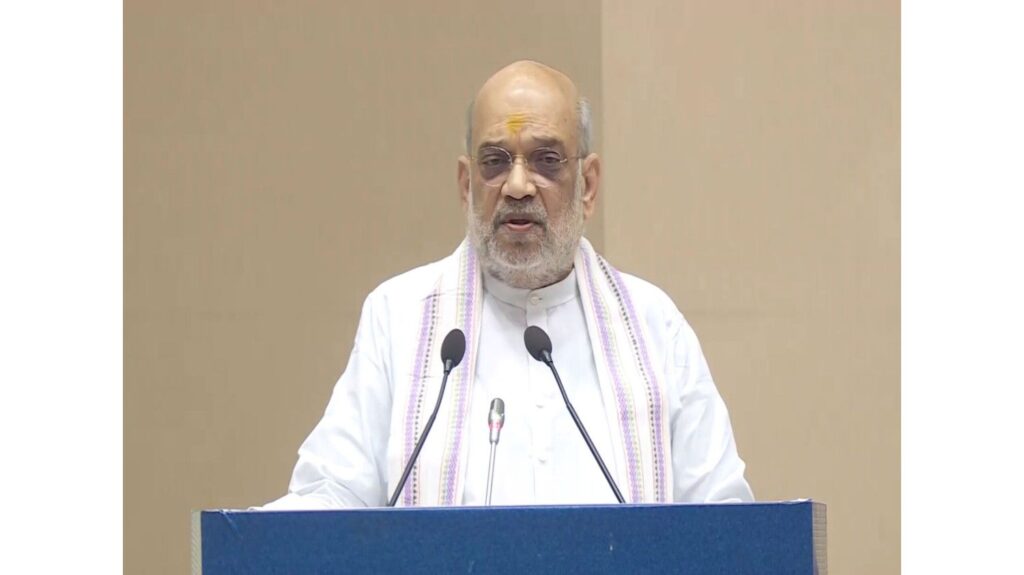
Union Home Minister Amit Shah said on Sunday that India’s fight against Naxalism could not only be won through armed operations, he stressed the need to deal with the ideology behind the movement.
Speaking on the topic of ‘Naxal -free India: The end of red terror under Modi under the leadership of Modi’ in the concluding session of India Manthan 2025 in New Delhi, Shah reiterated the government’s target of freeing India from Naxalism by March 31, 2026. He said, “This country will be freed from Naxalism by 31 March 2026. Many people believe that Naxalism will end with the end of the system of armed activities. Why did the Naxalism a problem arise and develop it? The fight against Naxalism will not end until Indian society provided this principle, legal support and financial assistance in this principle, Naxalism, until this principle, this principle, Naxalism.
He said, “We can surrender to Naxalites or our security forces can make them neutralized, but we have to make a lot of efforts on the ideological front,” he said, “The discussion in this regard is relevant and important to me too.” Shah further said, “… These leftists who are standing in the defense of Naxalites and say why they do not want to kill them? We were arresting 1,090 people, where we were able to surrender the government’s attitude.
He said, “The government’s approach is to make every effort to arrest the Naxalites and surrender them. We also give them a chance. We have also launched a good surrender policy. But when you take up arms and come down on the murder of innocent citizens of India, the security forces have no other option. The bullets should be answered with bullets … ”He said.
Highlighting the government’s comprehensive internal security achievements, Shah reminded that when Prime Minister Narendra Modi took over in 2014, India faced three major issues of internal security: Jammu and Kashmir, Northeast and Left extremism corridors.
He said, “These areas have been a source of disturbance for almost four-five decades, have killed thousands of people and are disrupting peace and stability. Also, a large part of India’s budget, which could have been used for the welfare of the poor, was imposed in dealing with the challenges of these areas. After Modi ji took charge, the government has recognized these sensitive sectors as important priority and these areas to solve the problems of these areas. Implemented long -term, superfined strategy. “
Pointing to the positive changes in the state of Jammu and Kashmir after the cancellation of Article 370, Shah said, “Work was done under a well-planned policy against Pakistan sponsored terrorism. I want to share its results … 65% in the death of security personnel and 77% in the death of citizens has decreased by 77%. Today every law is applicable there. Every law is applicable there. Panchayat elections were held in Jammu and Kashmir for the first time. The elections were selected as the election was 99.8% in the district and taluka panchayat president elections.
Underlining the ideological continuity of the Bharatiya Janata Party (BJP), Shah said that internal security has always been a main objective – from the days of the Bharatiya Jana Sangh to the BJP. He said, “Defense of internal security and the borders of the country … from the formation of the Bharatiya Jana Sangh to the Bharatiya Janata Party, has been a major part of our ideology. In a way, from the Bharatiya Jana Sangh to the Bharatiya Jan Sangh, the Bharatiya Janata Party has made three major objectives in its originals, its originals, its originals, the first, the country has three major objectives. And external security, second, cultural nationalism, and third, revival of eternal organs of Indian culture.