
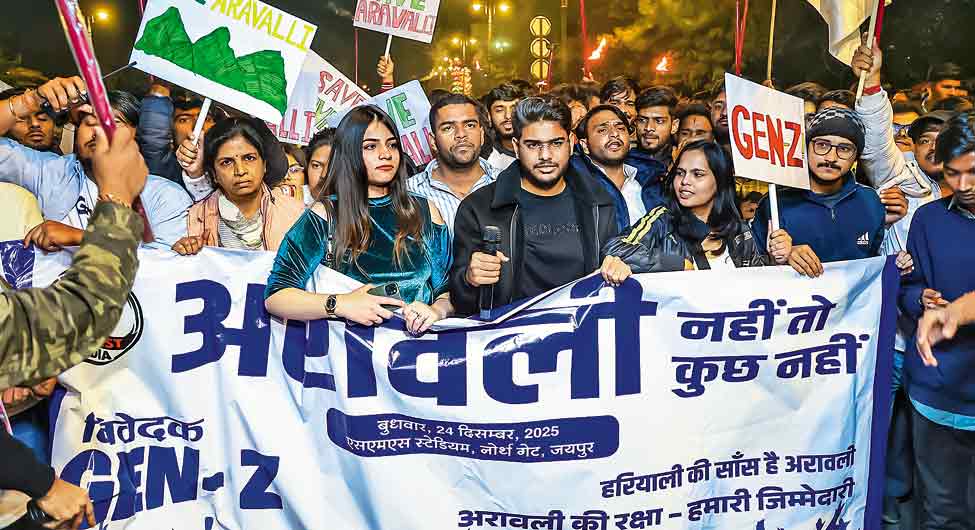
According to the Centre’s new mining policy of 2019, many questions were raised over the approval of the new definition of Aravalli hills for excessive mineral exploitation, but the Supreme Court put a stay on it.
Ultimately, the voices raised against opening the Aravalli ranges for indiscriminate industrial-commercial exploitation and environmental concerns bore fruit and for the time being it was stopped. These concerns also reached the doors of the Supreme Court. Taking suo motu cognizance, a three-member bench of Chief Justice Surya Kant, JK Maheshwari and Augustine George Masih on December 29 stayed the order, which was passed by former Chief Justice B.R. Gavai, K. Vinodchandran and N.V. Anjaria’s bench had given the order on November 20. In the first order, the Environment Ministry’s committee’s definition of considering Aravalli hills above 100 meters as safe was accepted. Now the new bench has decided to constitute a new high level committee consisting of experts in the relevant field to review all the important issues and till then the old order has been stayed.
The Chief Justice said, “We consider it necessary that the recommendations of the (previous) committee and the directions of this court be kept in abeyance till the formation of the (new) committee.” The next hearing will be on January 21.
The Aravalli hills, spread over about 700 km in five states, are the oldest mountain range in the country. These hills, which act as a shield for the climate, act as the lungs for the greenery of North India. The mountain ranges older than the Alps, Andes and Himalayan ranges came into the center of debate on November 20 after the Supreme Court accepted the recommendations of a government committee. The Environment Ministry committee considered only the 100 meter high hills as safe and recommended opening the rest for industrial-commercial exploitation. With this new definition, only 8.7 percent of the Aravalli range will come under protected limits. The remaining portion has been opened up for mining and infrastructure construction. It is believed that this will cause huge damage to the environment and climate, for which there is no compensation. The danger of changing geographical structure, human settlements and wildlife habitat is different.
Aravalli Range in Ajmer
Aravali is a long range of low and medium altitude hills, which extends through western Uttar Pradesh, Delhi, Haryana, Rajasthan and Gujarat. These chains form important climate mechanisms in those regions, including blocking the flow of dust eastward from the Thar Desert, storing natural water, maintaining space for diverse wildlife, and preventing soil erosion.
According to the committee’s recommendation, any forest or land will be considered ‘Aravalli Hills’ only if it is at least 100 meters higher than the surrounding land. The group of hills within a radius of 500 meters is classified as the ‘Aravalli Range’.
According to government data, in Rajasthan, where the Aravali range is the largest, out of 12,081 hills measured, only 1,048 hills or 8.7 percent of the Aravali are within the new legal limits. This leaves more than 90 percent of the ancient chain out of the scope of legal protection, leaving it open to mining and commercial exploitation. For decades, long stretches of the Aravalis have been protected by a legal shield from large-scale commercial activities.
In May 2024, the Union Environment Ministry, reportedly on the demand of various states, formed a committee to create a uniform definition of the Aravalli hills and mountain ranges. The panel submitted its final report in October 2025. His recommendation was accepted by the Supreme Court in November.
Many minerals including lithium, tungsten, gold and lead are found in the Aravalli range. According to a report, the central government has argued that the presence of precious and strategic minerals creates “huge potential for the future”. It is also said that there is “significant potential” for mining of important minerals such as graphite and rare earths in this range. These are resources that are considered very important for energy, high-technology manufacturing and national security.
“It is also necessary to develop a framework that is capable of utilizing the critical, strategic and nuclear minerals present in the region in a systematic, scientific and environmentally sustainable manner,” an affidavit filed by the Union Environment Ministry said.
But environmentalists and conservationists argue that opening more than 90 percent of the Aravali range for mining etc. will disturb the entire eco system and the climate crisis will become fatal. This part includes low altitude hills, dunes and rocky areas. The height of many of them is below 100 metres.
Union Environment Minister Bhupendra Yadav
The structure of the Aravalis allows rainwater to seep deeply into underground reservoirs. Congress MP Ajay Maken said in Parliament that this range makes possible groundwater recharge of about 20 lakh liters per hectare annually. If it is destroyed, there will be a rapid decline in groundwater in cities like Gurugram and Faridabad. These areas are largely dependent on Aravali. This could worsen the water shortage problem in the National Capital Region. Northern India is already one of the fastest depleting groundwater regions in the world.
The destruction of the Aravalli range will not only deepen the groundwater crisis, but will also pose a threat to the hot, dusty winds coming from the Thar Desert. These mountains act as natural shields. Because of these, hot and dusty air stops in the National Capital Region and the Ganga plains. If this shield is broken, there is a strong possibility that the levels of particulate matter, including PM10, will increase in the air pollution of nearby states and Delhi.
In the parliamentary debate, Congress MP Ranjit Ranjan compared it to landslides in Uttarakhand and indiscriminate cutting of mountains during the Char Dham road project in the Himalayas. Critics argue that ecological systems cannot be exploited indiscriminately for economic development because natural systems cannot be recreated after they are destroyed.