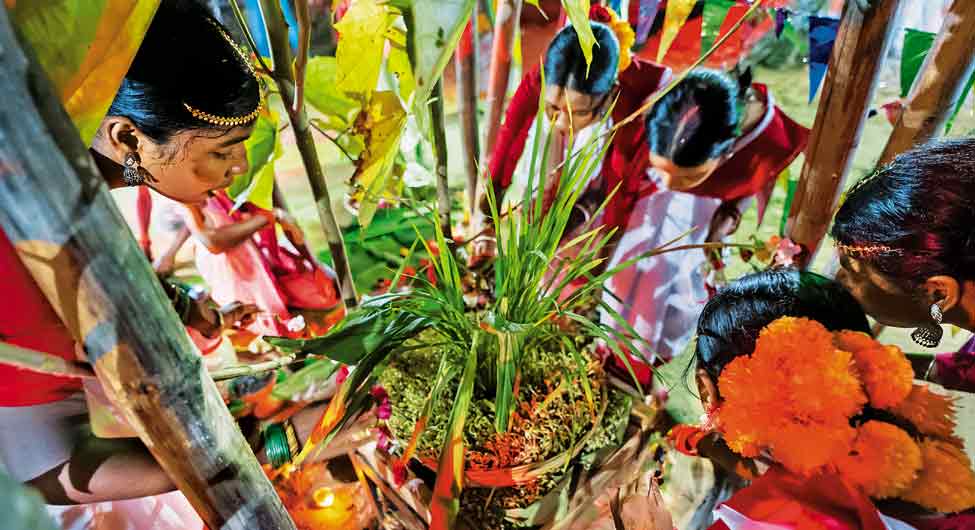
For nearly two centuries, tribals brought up in the tea gardens of Assam have been fighting for Scheduled Tribe status and rights.
Amarjeet Kerketta’s family has been living in Assam for many generations. Their ancestors were brought to Assam about 200 years ago to work in the tea gardens. Since then his family has been settled in this state from generation to generation. Like Amarjeet’s ancestors, lakhs of tribal families from Jharkhand were brought to Assam to work in tea gardens. Today their descendants are called “Tea Tribes”. But 41-year-old Amarjeet vehemently rejects this identification. Amarjeet, who belongs to the Khadiya community, objects to this word. He says, “All over India we are recognized as tribals, but here we are called tea tribes. After all, what does tea tribe mean? Khadiya, Oraon, Munda, Ho, Santhal, Gond, this is our real identity. We want to live with our identity. We deserve recognition as tribals.”
Amarjeet’s fight is not limited to just opposing the ‘Tea Tribe’ label. This struggle is also against the denial of Scheduled Tribe (ST) reservation to millions of tribals like them living in Assam, because their tribal identity is constitutionally recognized in other parts of the country.
Amarjeet lives in Dibru Darang village of Sonitpur district of Assam. He has been associated with the All Tribal Students Association of Assam (AASAA) for many years and has been actively fighting for the right to tribal reservation.
According to AASAA, more than one crore tribals and Dalits in Assam have been kept in the OBC category by the state government. About 70 lakh tribals in Assam have been identified as Tea Tribes, none of whom have received ST status so far. In West Bengal, these tribals have got the status of Scheduled Tribe, but in Assam they still have to struggle for recognition.
Jharkhand Chief Minister Hemant Soren has also raised the issue of tribals of Jharkhand origin in Assam several times. He had announced that a delegation would be sent to Assam to study their situation. In early 2025, the Jharkhand government had decided to send a team to Assam under the leadership of Scheduled Tribe and Scheduled Caste Affairs Minister Chamra Linda. This team will study the socio-economic condition of the tribals of Jharkhand origin living in Assam.
Anil Toppo, chief advisor of AASAA, is from the Oraon tribe. His ancestors came to Assam from Chhota Nagpur region of Jharkhand. Anil, 43, says he is happy that a team from the Jharkhand government is finally coming to assess his situation. He is particularly happy with the arrival of the delegation led by Chamra Linda, as he has met her earlier on this issue. Anil, who hails from Balijan village in Karbi Anglong district, holds the first Chief Minister of Assam responsible for his current situation.
Anil alleges, “After Independence, our ancestors were considered tribals here till 1950. But when Gopinath Bordoloi became the first Chief Minister of Assam, regional restrictions were imposed and we were de-scheduled. Our elected MLAs were called and asked that since you work in tea gardens, how about you are called Tea Tribe? The MLAs agreed to it.”
Both Amarjeet and Anil say that if their communities get ST status in Assam, they will become more politically powerful. In such a situation, out of 126 assembly seats in Assam, 42 to 45 seats are likely to be reserved. This can also create a possibility of becoming the Chief Minister from the tribal community. At present, only 19 seats are reserved for ST and nine seats for SC in Assam.
It is noteworthy that during the 2014 Lok Sabha elections and 2016 Assam Assembly elections, BJP had promised to give Scheduled Tribe status to tribal tea garden workers. Announcements about increasing land lease and daily wages were also made. But no concrete steps have been taken in this direction in the last ten years.
Recently the Assam government has passed a bill, under which it has been said that land ownership rights will be given to the communities living in the state for more than 200 years. The Assam Cabinet has also approved the proposal to grant ST status to six communities. After this, many tribal organizations and student groups have staged protests. They argue that this will weaken the interests of the indigenous tribal communities. Apart from this, this decision has not been implemented yet. However, many people believe that even if it is implemented, it will not fulfill the demands of millions of tribals.
Rameshwar Oraon, former chairman of the National Commission for Scheduled Tribes and former minister of Jharkhand, believes that there are many obstacles in granting ST status to the tribals in Assam. According to him, only the Assam government can send a recommendation in this regard to the Central Government.
Recognize Scheduled Tribes as per constitutional provision on a state-specific basis. This is why the existing tribal communities in Assam oppose granting Scheduled Tribe status to migrants from other areas.
The Ahom community is considered politically influential in Assam. Their estimated population is 15 to 17 lakh and they have decisive influence in about 35 assembly constituencies. Former Assam Chief Minister Tarun Gogoi belonged to this community. Ahoms are among the six groups recently approved for ST status by the Assam Cabinet.
Prabhat Das Panikka, former president of AASAA, believes that the refusal to recognize the tribals of Jharkhand, Chhattisgarh, Madhya Pradesh and Odisha in Assam as tribal reflects political intentions. Their population is much higher than the existing tribal communities. Giving them Scheduled Tribe status will bring a significant change in political power.
Panikka says, “The government called the tea garden workers tea tribes. When they left the gardens and settled in other places, they were called ex-tea tribes. This is insulting. The tea industry is only 200 years old, while the tribal history is thousands of years old. How can a hundred-year-old industry erase a thousands-year-old identity?”
Political parties, especially BJP and Congress, avoid granting ST status due to the fear that it would increase the number of reserved seats, elect more tribal MLAs and increase the chances of a tribal becoming the Chief Minister.
The tribals living in Assam for more than two hundred years are forced to live with borrowed identities. They have been deprived of their true identity. The demand for recognition of Scheduled Tribes is not just for reservation, but it is a demand for dignity, land rights and political voice.
There are many obstacles in granting Scheduled Tribe status to tribals in Assam. Only the Central Government can recommend this. State government sends recommendation to the ministry
Rameshwar Oraon, former president, National Scheduled Tribes