
Making religion a tool to win elections is against the country’s basic ideas, ideals and democracy.
If slogans of religious identity are echoed in election rallies instead of policies and promises, then understand that the foundation and promise of our Constitution, secularism is in danger. The freedom fighters and founders of our Republic knew from the bitter memories of Partition that mixing religion with politics destroys both democracy and faith. But even after seven decades, the temptation of taking recourse to religion for electoral gains continues to tempt political leaders. This may lead to short-term victory, but its long-term consequences are serious. This disintegrates the society, weakens brotherhood and hurts equality. This is the foundation on which Indian democracy rests.
This dangerous trend is clearly visible in the Bihar election campaign, where the ruling party is using religion as a weapon to mobilize voters. BJP leader Giriraj Singh’s statement a few days ago is an example of the extent to which religious division has poisoned the electoral discourse. He called those who did not vote for his party by taking government benefits as “Namak Haram”. These attempts at polarization widen social cleavages and weaken the inclusive spirit of democratic culture.
Religion provides identity, moral guidance, and continuity across generations. Karl Marx described it as “the sigh of the exploited and the oppressed, the heart of a heartless world and the soul of soulless circumstances”. For millions, religion is a refuge in times of famine and a moral compass in times of confusion.
New trend: Another community responds to I Love Muhammad in Uttar Pradesh
Political theorist Robert Doll says that religious diversity actually strengthens democratic institutions, provided it is kept separate from electoral politics. This does not mean that religion has no place in people’s lives, but rather that religion should not define citizenship or political legitimacy. Political scientists Steven Levitsky and Daniel Ziblatt have written in their study ‘How Democracy Dies’ that instrumentalizing religious identity is a sign of the decline of democracy. He recorded that leaders who attack mutual harmony and tolerance by boasting about the existence of religious communities lead to the erosion of democratic norms.
The Western model of pure separation of church and state was not adopted in India. Instead, the makers of our Constitution invented the Khanty Indian model that the polity would be based on equality of all religions, but would remain impartial in matters of faith. This attitude matches political scientist Alfred Stepan’s idea of ’double-tolerance’. This means that both democratic and religious institutions should be autonomous to work within their respective limits. This balance was not born out of principle, but out of necessity. The tragedy of partition had exposed the danger of religious mobilization. Secularism was not adopted merely as an ideal but to protect national existence. Without him the wounds of partition would have been deeper.
Articles 14, 15 and 16 of the Constitution guarantee that all are equal before the law and discrimination on the basis of religion is prohibited. The Preamble of the Constitution describes India as a “sovereign, socialist, secular, democratic republic”. The Representation of the People Act, 1951 takes it further. Its section 123 (3) prohibits candidates from seeking votes in the name of religion. There is a constitutional and legal provision that religion is a matter of personal belief and not of political mobilization.
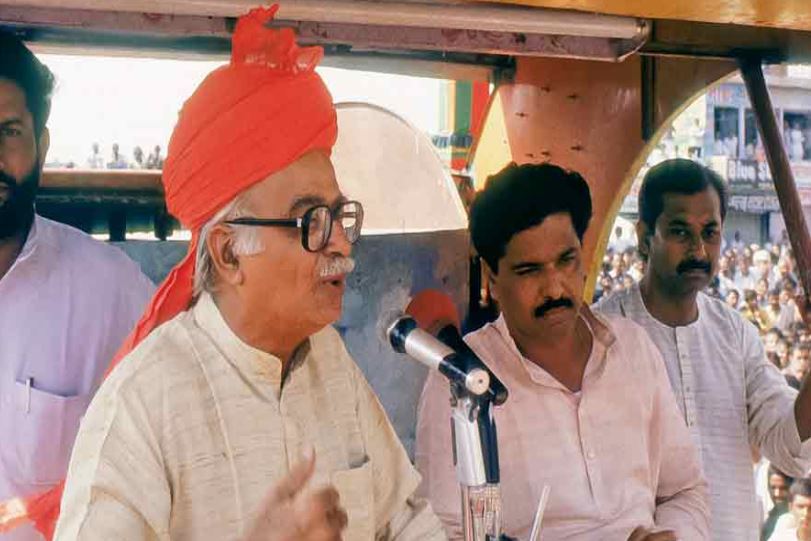
Despite this, this boundary line has become increasingly blurred. In 1989, Lal Krishna Advani’s Rath Yatra from Somnath to Ayodhya openly used religious symbols to mobilize Hindu votes. As a result, communal tensions and riots broke out across North India. After the demolition of Babri Masjid in 1992, there was overt political mobilization of religious identity.
In recent years, the 2017 Gujarat elections witnessed attempts at religious mobilization through ‘Love Jihad’ and ‘Vote Jihad’ slogans and speeches directly against minorities. In 2017 itself, during the assembly elections in Uttar Pradesh, the so-called ‘Anti-Romeo Squad’ was formed and the trumpet was raised to protect Hindu women from Muslim men. This shows how a sense of insecurity is created among religious groups and exploited for electoral gains. This would also reveal an important aspect which is usually ignored in the debate on politicization of religion. That is to describe the female body as a symbol of the respect of the community. The politicization of religion thus emphasizes the practice of gender discrimination, in which women are presented primarily as symbols of the purity of the community, rather than as independent political individuals.
If political leaders pit one community against another, a bond of trust is replaced by suspicion and resentment. As the debate turns to religious identity, questions of economic justice, health care, education and employment take a back seat. In 1923 V.D. The ‘Hindutva’ ideology that Savarkar conceptualized and later implemented through political activism is an example of how religious identity can be transformed into a political project of redefining citizenship. French political scientist Christophe Jaffarle, a keen scholar of Indian history and politics, has documented in detail how this ideology gradually moved from the cultural realm to electoral politics and is changing the basic character of Indian politics.
It is not only India that is facing this crisis. Religion is being exploited for political gains all over the world and dire consequences are emerging. Right-wing religious mobilization in America has been creating polarization in society for decades. Political scientist Thomas Frank writes in his book ‘What’s the Matter with Kansas?’ Shows how the Republican Party used religious and cultural issues to mobilize working-class voters against their own economic interests and invented a method of religious political mobilization. In West Asia, communal politics has fueled violence and ruined countries. After 2003, sectarian politics emerged in Iraq and many political factions emphasized Shia religious identity rather than Iraqi national identity. This marginalized the Sunni community and ultimately led to the rise of ISIS.
Religious polarization also makes political thinking narrow. If elections turn into a race for identity, there is no space left for debate on inclusive development, gender equality and policies related to sustainable environment. The political arena turns into a battlefield of identity instead of a marketplace of ideas. With this change the scope of citizenship also shrinks. People get divided along religious lines rather than as individuals.
A reasonable solution to the challenge of balancing deep religious and local divisions in democratic societies is found in political scientist Arend Lijphart’s idea of ’consensual democracy’. There are four basic institutional pillars of rational choice. One, a grand alliance with the participation of representatives of all important parties in the decision-making process. Second, autonomy to all bodies, so that all communities can decide for themselves matters related to their identity. Third, proportional balance in the electoral system, administrative service appointments and allocation of public resources. Fourth, minority veto rights, so that they can protect their vital interests from majority tyranny.
It is important to reiterate that secularism does not mean opposition to religion. Freedom of religion is a fundamental right enshrined in Articles 25 to 28 of the Constitution. Religion can and should continue to be the guiding force of people’s inspiration, moral values and cultural traditions. But if religion is dragged into political campaigns, it loses its spiritual power. It becomes a tool of division. The basis of politics should not be religious rituals, but constitutional morality. Only then can the pro-people nature of politics be regained and the democratic promise of equality and fraternity be truly realised.
(Rajya Sabha member of Rashtriya Janata Dal, author of the famous book ‘In Praise of Coalition Politics and Other Essays on Indian Democracy’, views are personal)