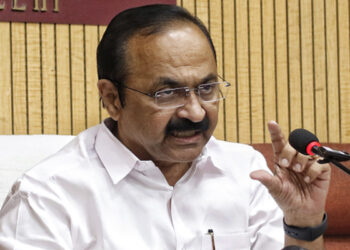
In a special Panchayat session organized during Mumbai Climate Week 2026, Panchayat representatives from six states of the country — Maharashtra, Karnataka, Kerala, Bihar, Jharkhand and Odisha — shared their on-the-ground experiences of tackling climate change. The message that emerged from the session was that effective climate solutions in India are emerging from villages and panchayats.
In the session ‘Panchayats Leading India’s Climate Charge’ organized at Jio World Convention Centre, measures like solar energy, sustainable agriculture, forestry and resource management at the Panchayat level were discussed. The event was organized under the Conference of Panchayats initiative of Asar Social Impact Advisors and Policy and Development Advisory Group.
Sharda Gaidhane, sarpanch of Bela village in Maharashtra’s Bhandara district, said her village achieved the goal of becoming the first net-zero panchayat in the state through extensive tree plantation, use of solar energy, garbage segregation and moving away from single-use plastic. For this, Bela Gram Panchayat received the Carbon Neutral Special Panchayat Award in the National Panchayat Awards in 2024.
Ramvriksh Murmu, head of Siyari village in Bokaro district of Jharkhand, said that children’s education was affected due to frequent power cuts. Following the lessons learned from the Conference of Panchayats, the Panchayat installed 72 solar street lights with the help of CSR funds. Additionally, solar energy systems were installed in schools and community buildings and solar lift irrigation pumps were installed on ponds, which reduced dependence on diesel and unstable electricity.
Jayanti Nayak, an elected representative from Odisha’s Koraput district, said the group of tribal women identified more than 10 hectares of fallow community land by documenting land use. After the approval of the Gram Sabha, it was included in the Panchayat Development Plan and 16 thousand saplings were planted, which also created local employment opportunities.
Sachith K.K., former president of Perinjanam Panchayat in Thrissur district of Kerala. Said that due to continuous community awareness campaigns, the Panchayat was transformed into a ‘Solar Village’. In eight years, 850 families became solar energy consumers, resulting in approximately 80 percent reduction in electricity expenses.
At the event, Panchayat member Surya Narayana Rao from Kolar district of Karnataka gave information about sustainable livelihoods and efforts to strengthen local governance, while Kapil Deo, a tribal leader from Harni village in Jamui district of Bihar, shared experiences related to rural development and social empowerment.
Speakers said that the role of Panchayats is important in tackling climate change, as the decisions taken at the local level directly affect the lives and livelihoods of the people. These Panchayat based efforts are laying a strong foundation towards improving the climate in India.
Addressing the session, Jagadanand, co-founder and mentor, Center for Youth and Social Development, said that the future of climate resilience lies in climate-smart panchayats, where land, water, livelihoods and people are linked together. He said that climate-smart India will start from Panchayats only.
PDAG co-founder Arindam Banerjee said the Conference of Panchayats aims to enhance the capacity of local self-governance institutions to effectively address emerging climate risks. This initiative could lead to the creation of a national local climate action platform by 2028.
Vinuta Gopal, CEO of ASER, said the panchayat representatives coming from remote areas have shown that effective action to tackle climate change is already taking shape on the ground through every tree planted, every solar panel and every village scheme. These grassroots models prove that the most sustainable solutions are those that start in communities and scale up.
It is noteworthy that Mumbai Climate Week is the first such platform in India, which is dedicated to accelerating efforts to improve the climate.