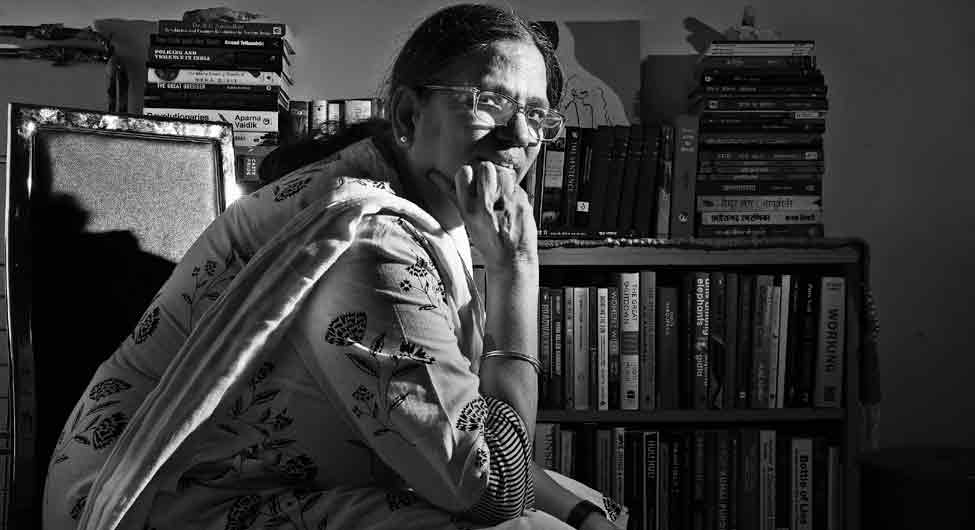
Life is difficult after jail. We are among the lucky ones who have social capital, friends, family, other activists, our organizations, our connections, our education, civil society that helps us survive.
A few weeks ago, as is being claimed, some policemen in plain clothes came to the society where I live in a friend’s rented house. The police have my mobile number, which they obviously monitor constantly. Additionally, I report to the local police station every 14 days and I go to regular court dates, at least once every 15 days, if not more. Despite this, the police did not bother to call me. When he came to my house, I was in my senior’s office in Fort (central area of Mumbai), from where I practice law in the High Court. He had no questions to ask. Both the policemen of the Kasturba Nagar police station where I report and the National Investigation Agency (NIA) officials who came on the court dates tried to say that they had no information about the policemen who had reached the society. So, clearly the motive was only to scare my neighbours, my society and my weak-hearted landlord. This is the third time this has happened in the last three years since I have been living here and five or six times since my release in December 2021. The message is clear, you are slowly trying to rebuild your broken life after being released from jail, but we will come from time to time and spoil the atmosphere, defame you, scare your landlord, your neighbours. Don’t forget, we have our eyes on you.
Life is difficult after jail. We are among the lucky ones who have social capital, friends, family, other activists, our organizations, our connections, our education, civil society that helps us survive. There are mostly women in jail, especially those who commit crimes out of passion, like murder of husband, mother-in-law or lover, etc. and are put in jail for years. The prison authorities do not take their rehabilitation seriously. Skill programmes, for example, training in beauty parlor or housekeeping (i.e. sweeping and mopping) are a joke. Hardly any efforts are made to help prisoners study the courses they enroll in; They are completely alone.
Social workers in jail are always busy with paperwork. In such a situation, women prisoners lose touch with their separated families and children. Women may be allowed to write to husbands or meet the husbands of co-accused during prison visits. But meeting a lover or a friend… Oh God, this is unthinkable!
Women often do not get financial help. Even to get bail, they have to depend on the system of legal aid, which is very limited. Then, especially for prisoners from other states, it is very difficult to get a surety. Therefore, even after the bail order, many women continue to languish in jail. Mathurabai, an old woman suffering from multiple ailments, died of Covid in Byculla jail, only because she could not pay the bail amount of Rs 15,000. He got bail more than a year ago.
So, it is not surprising that outside the jail, women prisoners get the most help from the friends they make in the jail. Friendship with different types and strangers is very important for survival in prison. These are the same friends who might ask their lawyers to fight the case of a prisoner who does not have a lawyer, lend money for bail, or provide a place for a newly released prisoner to stay until she can make arrangements for herself. Upon learning that I was a lawyer, many prisoners contacted me for advice about their cases or to “talk to their lawyers.” It is also no surprise that without any support, these women can return to the same or different world of crime, such as sex work, drug courier, petty theft etc. Such professions provide them safe haven for some time. Through these examples, proof of their criminality is accepted, but the question is what efforts have been made to give them any other practical option in jails?
As far as I am concerned, I cannot thank my socially conscious acquaintances enough. These people came forward to give bail for me. Many friends gave me shelter in their homes or in houses they owned. Senior lawyer gave me space and opportunity. I was able to do that work, in which I could once again involve myself with concentration and regain my identity and dignity. Many trade unions and workers handed over their cases to me and made arrangements for my subsistence. Thanks to all of them.
I am completely connected with Mumbai. The mills may have been closed, but this city belongs to the workers at heart. Every day, on the long journey from Borivali to Churchgate, one finds familiar hard-working faces to smile at. Otherwise, imagine what it would be like to be stranded in an unknown city without a home, without a family, without a job and without a bank balance. Some friends and many well-wishers, who have now become friends. He saved me.
But this cannot compensate for the sudden and difficult change in my life as a trade union and human rights lawyer in Chhattisgarh for more than three decades. My organization is Chhattisgarh Mukti Morcha (Major Worker Committee), where my lawyers are friends. Jamul and Dalli are my best friends in the labor colonies of Rajhara. I have brave clients from the villages of Chhattisgarh. There are many noble people whom I have met during these decades of work. I know and love Chhattisgarh, I know the forests, factories, language dialect, songs, food and drink, festivals and settlements. Even the smoke and dust and mines are familiar. Most of all, they are the workers who have loved me so much and taught me everything about life that I have. Many of them jokingly say, “Didi, you have come out of the small jail to the big jail of Mumbai.” Well, I want bail from Mumbai also.
But I don’t want to be so ungrateful. I am very relieved that my separation from my only daughter Maisha is over. Although we do not always live under the same roof. She first did her graduation from Bhilai and is now pursuing post-graduation in Clinical Psychology in Kolkata. At least we can talk to each other every day or whenever we want, see each other on video calls and talk for as long as we want. No longer does a female cop scream, “It’s been ten minutes.”
My daughter suffered a lot because of my imprisonment, especially during Covid. Trips to Pune or Mumbai were not possible often. There was all kinds of red tape in the meetings.
The letters written by him, which were full of sadness, anger and bitterness, troubled me a lot. I had to prepare myself mentally before opening his letters. There was a lot of delay. His letters remained in jail for a week, then they were censored and given to me. Similarly, my replies also used to arrive late. We were allowed to write a letter in 15 days. They also remained lying like this for a week before being posted. In fact, my words of consolation would reach the distressed girl after a month.
After my bail she is happy and feels more secure. Sometimes, when my phone is in silent mode or charging in another room, I am unable to answer his calls, then she gets very nervous. But yes, despite all this, she is very brave and is pursuing her goal of studying Psychology with full determination. This is no small matter. At this time his education is my biggest priority.
A big problem is how to survive financially. Although I love teaching and have given five-six online guest lectures to law and social work students since my release on bail, I will not get any formal teaching job. Even the best legal aid NGOs could not take me under their wing. They fear that their FCRA will be immediately cancelled.
I am lucky that I am a lawyer and there is no restriction on advocacy. However, the dilemmas facing every socially conscious lawyer remain. Those who need us the most will probably be able to pay the least. But this is a familiar and difficult path from the days of PILs.
Life continues after jail, comings and goings, cases, calls, clients, police and desires, everything. There are happy days too, when a case moves in the right direction, or when my daughter comes home or when a co-accused gets bail. But on bad days, depression suppresses you and it becomes difficult to get out of bed. On such days, I remember that song, “Aye dil hai mushkil jeena yahan, zara hatke, zara bachke, yeh hai Bombay meri jaan!”