
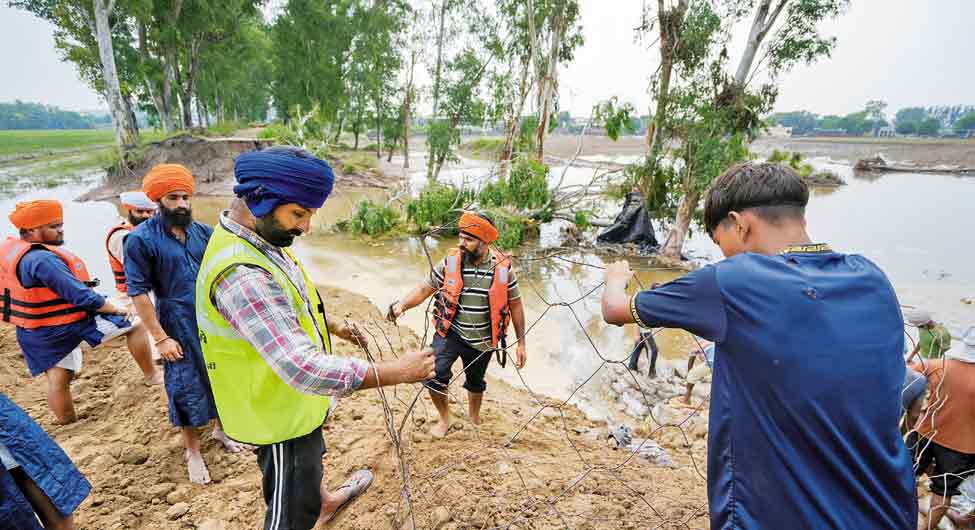
Flood ‘unpredictable natural tragedy’, not the result of wrong decisions, careless policies and loose accountability
Every year, flood problems arise in states like Bihar, Punjab, Maharashtra and Gujarat. Due to climate change, rain patterns have changed, but this is not the only reason for disasters. The condition of rivers catchment area (catchment area) is continuously deteriorating. Earlier, the rain water used to stop forest, grasslands, wetlands and ponds. The water used to get a chance to leak into the ground, then this water slowly reached the river. Now this does not happen because the health of the catchment has deteriorated. This is the reason that whatever water it rains, it goes directly into the river. The result of this is that there is a sudden flood and the loss is high.
There is also one aspect urbanization associated with it. Due to construction work in cities, ponds and puddles have ended due to cutting of trees and many other reasons. Encroachment has increased on the banks of rivers. The problem related to the dam is also not less. Silatation (soil deposition) in rivers is increasing rapidly. It has also been observed that dam management is not done in a systematic manner. In India, the dams are filled before the rain, that is, the water is stopped and released. It is not adjusted when needed. The dams in Punjab and surrounding surrounding were already filled before the rain and had to release the water as it rained. This was the right time when water should have stopped. But the lack of efficient management caused a big loss. When the water should remain, then it was released. This caused flood below.
It is true that changes in the atmosphere are also increasing the danger of floods. To a large extent this change is also responsible for floods. The glaciers are melting and excess water is coming in the rivers. Due to this, the incidence of additional flow of water is increasing. In this, we should not forget the role of disaster management. India is still not fully prepared for disaster. Lack of disaster management also causes many problems. We are master in rescue operations, but are extremely weak in prevention and management. We have clear preparations, extremely clear instructions, very lack of accurate functioning. In October 2022, a guideline was released by the National Disaster Management Authority (NDMA). If that guideline had been followed, the flood would not have come in such a serious form. Even after the flood became so serious, hardly the accountability is fixed as to why the guideline was not followed.
In October 2023 in Sikkim, a dam was swept away due to the Glacier Lake Outbst Flood (Glof). The government was being told about this danger since 2006. But no one made any difference. When the dam broke in 2023, the work of rebuilding it was started in a normal manner. It was not felt that we would have learned from our previous mistakes. If the accountability was fixed only then this incident would have become a vision. Gather information and see how many officers have taken any action on wrong management of the dam till date? No one has the answer to the question of why the early warning system was not installed to avoid glof. The biggest question is why we do not want to learn from our mistakes?
In countries like America, there is an independent assessment after an accident, so that the same mistake is not done in the future and the loss is reduced. This does not happen in India. Most of the disasters here are postponed as ‘natural’. In 2017, it was written about Bhakra Nangal Dam, in 2017 and 2020, it was said about Sardar Sarovar that the wrong management had flooded, it could be stopped. In 2023 also, Bhakra was questioned, but in 2025 there was a flood again. Whatever be the government, it remains the same.
We are also lacking. Many times we do not raise voice because we know that no one will listen. Even if some people raise their voice, they do not pay attention to them. Floods in places like Sikkim, Maharashtra, Kerala and Punjab have come due to lack of proper management of the dam.
The dam figures should be transparent. Everything should be in the middle of the public, such as the capacity of the dam, how much water can be collected in it, how much water it has to shed, if water has to be shed, then the low -lying areas have the ability to withstand how much water. Standard Operation Procedure (SOP) is the standard operation process of how much water will be released on how much rain. There should be a complete account of upstream and downstream. The department of issuing flood warnings, Central Water Commission should be given the work of an independent agency so that it can work freely from government pressure. There are also good examples of dam management. The Sardar Sarovar Dam was flooded in 2020 and 2021, but did not come in 2022. The reason was the change in the method of operation.
Heavy rains in India are often postponed as ‘cloudbukes’, but in reality there is a clear definition of what cloudbuke is and there is no arrangement to measure it. More than 100 mm of rain in an hour is often called cloudburst, but it is difficult to collect accurate data. It is difficult to raise trusted data at the district level as well. Cloudbers’ forecast is also difficult because it occurs in the form of very strong rains in a very small area. The traditional radar and satellites of the Meteorological Department are unable to catch data at such a subtle level.
Everyone knew what happened in Dharali. We also raised their voice for this. What is the problem in identifying such sensitive places? Dharali also had a similar flood around 2013. There are two new and old streams of the river. The old stream was closed for a long time, but whenever the water grows, that stream becomes active again. This is a natural process. The houses between the new and old streams were absolutely unsafe and were swept away in floods. Could it not be stopped?
We need a policy. Rivers need a way to flow and there should be no construction on that path. If it is, it should be removed in a systematic way. Ban on cutting of trees and control of mining is necessary.
The role of society in the solution of the problem is equally important. Flood security committees can be formed at the panchayat level, which should report to the cleaning of local ponds, repairing drains and encroachment. Disaster education should be made mandatory in schools and colleges so that the coming generations do not only learn relief work, but also give priority to prevention. If there is pressure from the civil society, then both transparency and accountability can come in the policies.
Finally the flood is not ‘unexpected natural tragedy’. This is the result of our wrong decisions, careless policies and loose accountability. Until we start learning from them by obeying our mistakes, every rain will continue to give us the same old lesson and new loss.
(Senior Environmentalist and Coordinator of South Asia Network on Dam, River and Peepal)