
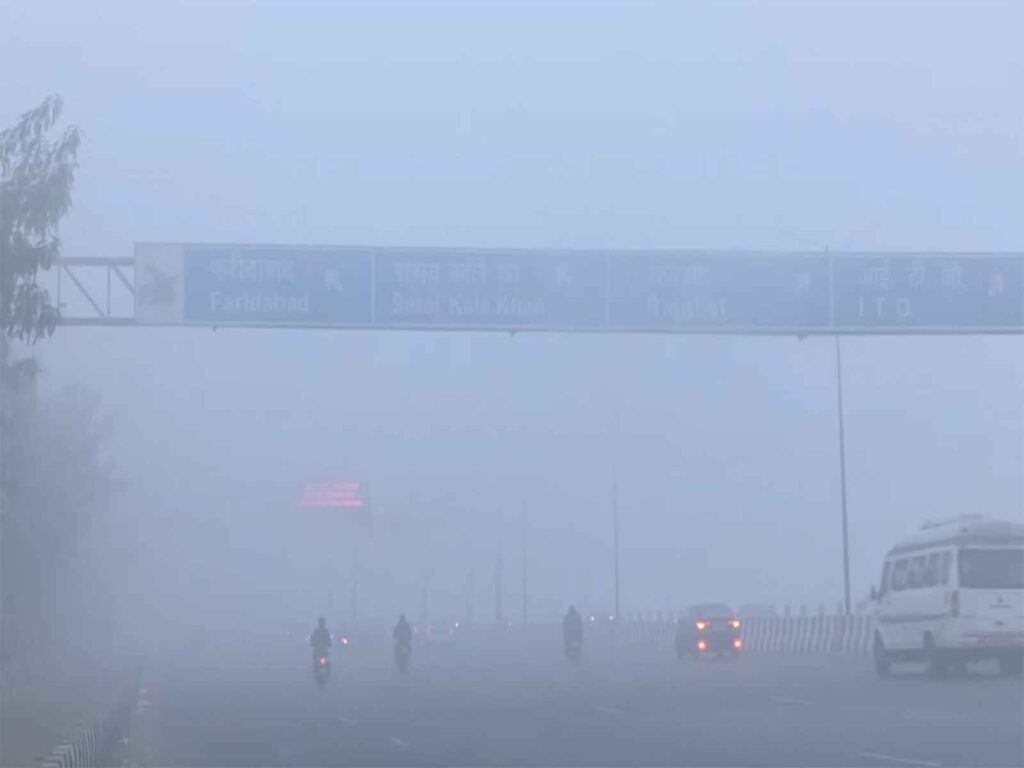
According to Central Pollution Control Board (CPCB) data, the problem of poor air quality continued in the national capital Delhi on Monday also. At around 8 am, the overall air quality index (AQI) was recorded at 452, which places it in the severe category.
This continues the trend seen on Sunday, when the AQI was 461 at around 4 pm.
A thick layer of poisonous smoke covered large parts of the city, significantly reducing visibility and causing inconvenience to residents. Anand Vihar was hit by dense smoke, where the AQI was 409, placing it in the ‘severe’ category. A thick layer of smoke also engulfed the areas around Dutva Path, Akshardham, AIIMS and Yashobhoomi.
According to CPCB data, air quality in several areas of the capital, including Aya Nagar (406), Chandni Chowk (437), RK Puram (477) and Dwarka Sector 8 (462), was recorded in the ‘severe’ category. Air quality also remained poor in Wazirpur, where the AQI stood at 500.
As per AQI classification, 0-50 is ‘good’, 51-100 ‘satisfactory’, 101-200 ‘moderate’, 201-300 ‘poor’, 301-400 ‘very poor’ and 401-500 ‘severe’.
Earlier, the Commission for Air Quality Management (CAQM) had deployed 19 teams for road inspection drive on December 12 in NCR and surrounding areas.
The campaign was conducted by the Commission as part of its ongoing monitoring and enforcement under the existing GRAP statutory framework and provisions. According to the release, a total of 136 road stretches across Delhi falling under the jurisdiction of Delhi Development Authority (DDA) were inspected.
As per the final data compiled, dust levels were found to be high on 15 road stretches, moderate dust intensity on 38, low dust intensity on 61 and negligible dust intensity on 22. Municipal waste (MSW) was found deposited on 55 road stretches and construction and demolition waste was found deposited on 53 road stretches.
The release said evidence of MSW/biomass burning was found on 6 road stretches.
The above observations clearly show the deficiencies and repeated negligence in the maintenance of the affected roads. This highlights the need for the Department of Agriculture and Agriculture to take prompt corrective action through regular and timely measures to increase operational efficiency and dust control.
It was also stated that the agency will have to ensure better compliance with solid waste/biomass burning norms on all road stretches.
The Commission observed that such incidents impact dust particulate levels in Delhi and stressed the need for strong action at the ground level including regular mechanical cleaning, timely disposal of collected dust, maintenance of road verges and central verges as well as deployment of water sprinkler/dust-control systems and targeted action for prevention of open burning incidents in all areas maintained by DDA.