
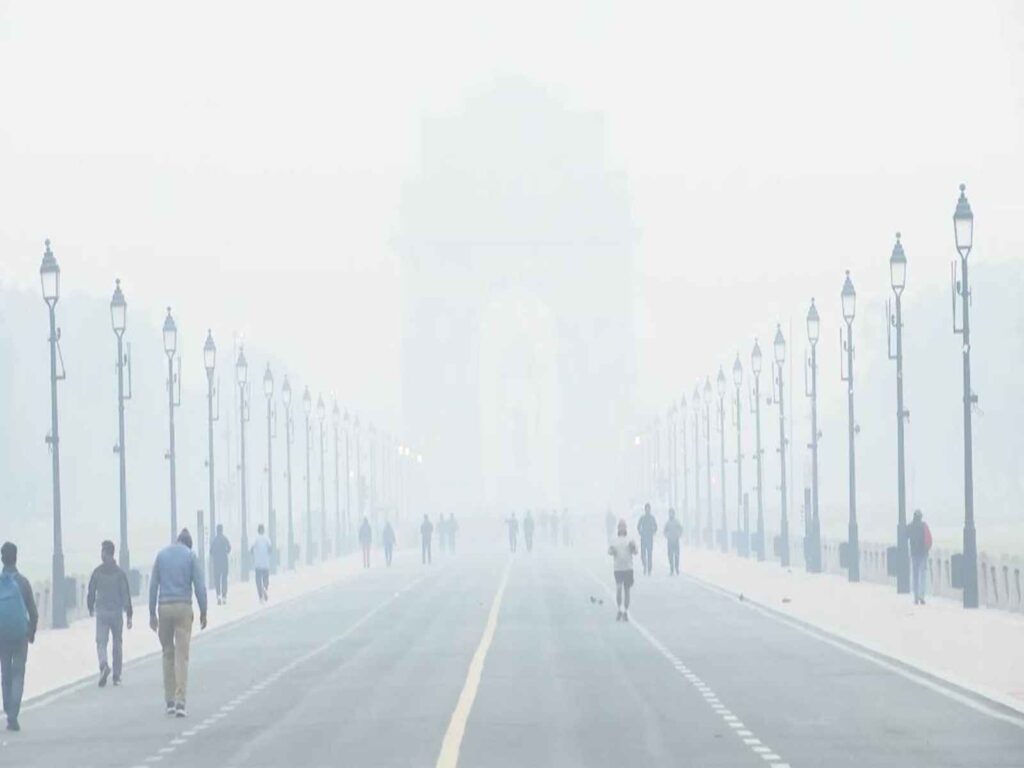
A thick layer of poisonous smog blanketed Delhi on Friday morning and there was no improvement in the air quality in the national capital. The air quality index (AQI) at 8 am on Friday was 397, which was kept in the ‘very poor’ category. The AQI at 7 am was 399, just one point below the severe category.
The air quality index in the national capital was recorded at 404 at 4 pm yesterday, which was categorized as ‘severe’ air quality.
According to Central Pollution Control Board (CPCB) data, several monitoring stations in the national capital recorded AQI above the 400 mark on Friday.
AQI 419 in Ashok Vihar, 440 in Bawana, 412 in Burari Crossing, 403 in CRRI Mathura Road, 442 in Chandni Chowk, 413 in Dwarka Sector-8, 428 in ITO, 421 in Jahangirpuri, 408 in JLN Stadium, 433 in Mundka, 402 in Najafgarh, 405 were recorded in Narela, 412 in Patparganj, 412 in Punjabi Bagh. 413, RK Puram 416, Rohini 430, Siri Fort 419, Sonia Vihar 417, Vivek Vihar 427 and Wazirpur 444.
The AQI at the monitoring station at Alipore was recorded at 396, Aya Nagar at 385, IGI Airport (T3) at 367, Lodhi Road at 302, Mandir Marg at 395, Okhla Phase-II at 398, Shadipur at 362 and Sri Aurobindo Marg at 392 – all categorized as ‘very poor’.
Only two stations reported ‘poor’ air quality, as the AQI at DTU-Delhi was 266, and IHBAS Dilshad Garden was 287.
Due to the rapid deterioration in air quality in the national capital, the Commission for Air Quality Management (CAQM) has already imposed Phase III restrictions under GRAP in the entire National Capital Region, and classified Delhi’s air in the ‘severe category’.
The Supreme Court has directed the Punjab and Haryana governments to file a status report on the steps taken to curb stubble burning. The problem of air pollution is increasing in Delhi-NCR region due to stubble burning.
“We direct the State of Punjab and Haryana to file a report as to what steps are being taken to prohibit stubble burning,” a bench comprising Chief Justice of India BR Gavai and Justice K Vinod Chandran ordered.
A lawyer in the case told the bench that the Commission for Air Quality Management (CQAM) has implemented the Graded Response Action Plan (GRAP) GRAP III, but the situation demands that GRAP-IV be implemented instead.
GRAP-III includes strict air pollution control measures for “severe” air quality, which mainly include a ban on most non-essential construction and demolition activities, a ban on certain vehicles (BS-III petrol and BS-IV diesel four-wheelers), and a shift to hybrid or online education for younger students (up to class 5).
The plan also restricts industrial activity at non-clean fuel facilities and bans non-emergency diesel generator sets.