
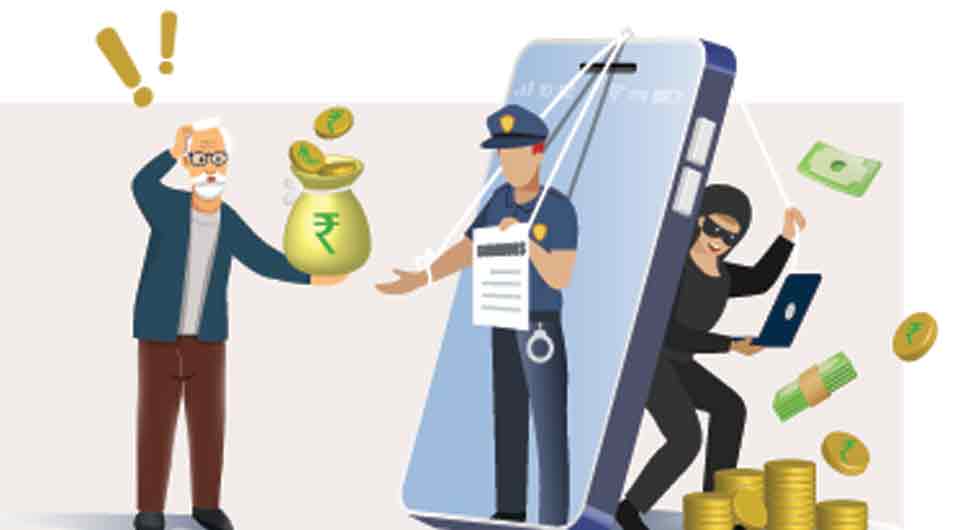
Five times more than previous years, cyber criminals defrauded people of Rs 22,842 crore in 2024, how can people save themselves apart from legal measures
QR codes at every small and big store, fintech applications that convert smartphones into wallets and billions of transactions through UPI. This is the story of digital payments in India, which is presented as a story of victory over challenges. But behind this shiny picture lies the scary truth, the rise in digital and financial frauds, which is slowly eroding people’s savings and confidence. The biggest concern for the new middle class now is not “Will my transaction get done?” but “Who is on the other side of this link, OTP or QR code?”
These figures show the reality of digital payments. According to the Reserve Bank of India (RBI), payment fraud related to digital channels increased more than five times from the previous year to an estimated Rs 14.57 billion in March 2024, while UPI transaction volumes continued to break records. Another study suggests that people lost a huge amount of Rs 22,842 crore to cyber criminals and fraudsters during the year 2024, which is much higher than previous years.
Official sources warn that if current trends continue, annual fraud losses could cross Rs 1.2 lakh crore. Interestingly, the data found that one out of every five UPI users has faced some kind of fraud. Yet more than half of victims do not file a complaint, often due to embarrassment or not knowing what to do next.
Ashwini Kumar, Founder, My Legal Expert (MLE) says, “Like the technology that makes digital transactions possible, payment frauds are also evolving rapidly. Traditional phishing emails have now given way to fake customer-care numbers, ‘KYC update’ links, remote-access apps, fake investment groups, romance scams and even deepfake audio or video imitations of trusted individuals. All these schemes have one thing in common, social engineering. Scams They rarely break into the system. The victims are often unaware of these fraud methods because they think they are talking to a legitimate organization. In that moment of mistrust, they share the OTP, accept the collect request, or install such apps, which give control of their phone to the fraudsters.
Although legal and regulatory measures are gaining momentum, it takes time for changes in fraud patterns and security measures to reach less technically savvy users. Authorities consider digital fraud a major risk and are mandating banks and payment institutions to strengthen multi-factor authentication, real-time monitoring and fraud reporting systems. Police have launched online reporting and special coordination centers for cyber crime to stop the flow of money through fake accounts and fraudulent websites. At the same time, public awareness campaigns and law enforcement agencies are urging consumers not to share sensitive information or click on unknown links or numbers.
Kumar says, “Happily, victims of fraud have several avenues of redress apart from filing complaints with the concerned banks. Complaints can be filed with the Banking Ombudsman along with cyber crime reports through designated online portals or local police stations. Though the route is longer, in cases of large sums or recurring frauds, depending on the lapse in service, one can approach consumer commissions or approach the civil court to recover the amount. Moreover, timely It is a normal process to get partial recovery or bank credit after reporting.
Fraud prevention is as challenging from a technical point of view as it is from a practical point of view. Data shows that with the increase in digital payments, lack of financial and cyber literacy among the common people is also creating an ideal environment for fraudsters.
A large number of the victims include elderly parents who are connected to UPI, some are small traders adopting cashless systems, and some are rural families completely unfamiliar with app-based banking. All of them remain unaware of the risks of online payment. For them, the easy-to-use interface may make it difficult to understand the risk. Therefore, it is important that every digital financial transaction is accompanied by continuous and robust education on the basic understanding of safe and unsafe practices.
Kumar says, “The best approach for 2025 and beyond is technology, caution in transactions and discipline in behaviour. All three must be taken care of. Consumers need to adopt some simple, important rules. Like, never share OTP or PIN with strangers, check the authenticity of phone numbers and links through official websites or apps, double check the details of the person to whom the money is being transferred before transferring money, enter a password on the phone or laptop and no matter how small the amount, report suspicious transactions immediately. Do it.”
In the meantime, regulatory authorities should continue to tighten accountability frameworks and encourage compensation in fraud cases where applicable. The trend of digital payments is permanent and so is digital crime. The key question is whether consumers feel empowered or helpless by this trend.
(Courtesy: Outlook Money)