
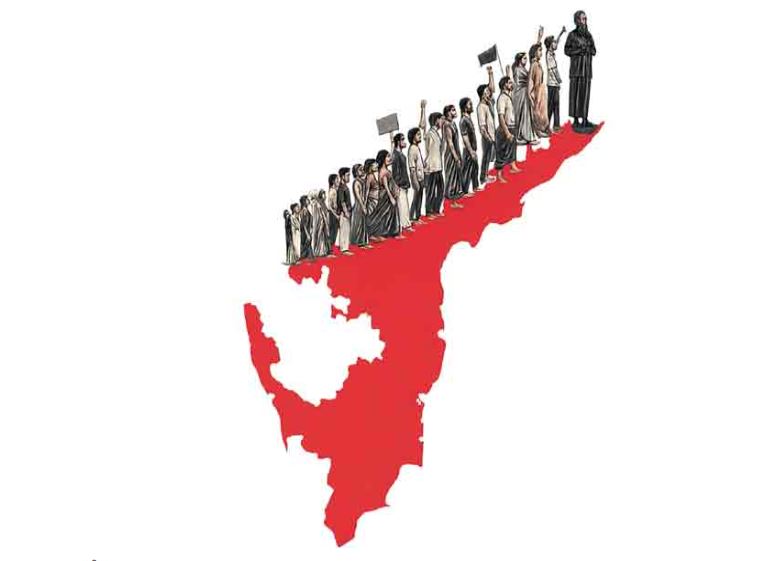
The Dravidian movement in Tamil Nadu used stage art, cinema and literature as a tool and became so embedded in the social fabric of the state that there is no other idiom of politics other than it.
Cinema in Tamil Nadu brought a modern, technology-driven new art medium in the 1930s, and from the early 1950s the leaders of the Dravidian movement used it very effectively and gained a popular following. Thattai Periyar started the ‘Self-Respect Movement’ after leaving the Congress in 1925. It later evolved into Dravidar Kazhagam (DK) and then Dravida Munnetra Kazhagam (DMK) political parties. The All India Anna Dravida Munnetra Kazhagam (AIADMK) also shares the same heritage. Now this movement has been around for almost a hundred years, and almost 60 years have passed since it first came to power. The DMK, which rules Tamil Nadu today, calls its governance the “Dravidian model”.
Let us see why this hundred years old movement is still so strong? The reason for this is his huge influence among the people. Through ideology and active programs, Dravidian philosophy has reached every section of society, from scholars to common people. In fact, in the second half of the 19th century, the consciousness of independence from British rule started emerging in India. As the movement and opposition for independence started increasing, the British started saying that “the people of India are not capable of governing the entire country themselves; they have no such historical tradition.” In response, Indian scholars developed a deeper awareness of their history. It can be said that that period was extremely fertile in every way for the making of Indian history.
Periyar started the Self-Respect Movement at the age of 46. He lived for 94 years. After founding the movement, he spent almost 50 years of his life traveling from place to place giving speeches. He is said to have addressed more than 10,000 meetings. He spoke in more than 200 meetings every year. He organized his entire life accordingly. When his wife Nagammayar died, he wrote that “a great obstacle has been removed.”
Periyar neither wanted to have a house nor to live permanently in any one place. He was always interested in traveling and meeting people. As long as Nagammayar was alive, this wish of hers could not be completely fulfilled. After his death, Periyar started living exactly the life he wanted. That means travelling, speaking in meetings, and staying in whatever city he reached, became his life.
Periyar alone was able to address so many meetings, so imagine if we add the meetings of the next generation leaders, the total number would reach lakhs. American anthropologist Bernard Batt has done special research on Dravidian political oratory and has written extensively on the subject.
The Dravidian movement systematically promoted the habit of reading extensively among the people. Whenever Periyar spoke at any meeting, very cheap pamphlets and small booklets were sold. Usually these were 10 pages or less and contained one or two articles. With time the sale of pamphlets became a part of every event of the Dravidian movement. The organization gave opportunities to many people to take responsibility. There were one or two officials in every village. Even without any official position, people were respectfully called Tondar (volunteers).
In the tradition of Tamil devotional literature, ‘Thondar’ meant ‘slave’ and ‘Thondu’ meant ‘slavery’. This is the meaning given to both the words in the Tamil dictionary prepared in the 1930s. But in the 1992 CREE-A Modern Tamil Dictionary, the meaning changed: ‘Tondar’ means ‘a person who works without remuneration in a political party or social organization’, and ‘Tondu’ means ‘any work done selflessly, without any expectation of profit, for the welfare of all.’
This economic change was brought about by the Dravidian movement. It cannot be considered merely a linguistic change. The Dravidian movement changed the word ‘Tondar’ to mean a worker associated with ideological commitment. Due to this, it became common to say that ‘He is the Tondar of the Self-Respect Movement’, ‘He is the Tondar of Periyar’, or ‘He is the Tondar of the Dravidian Movement.’ Even today, some elders are given respectful addresses like ‘Periyar Perun-Tondar’ (Great Volunteer of Periyar). Being a Tondar at the local level started being considered a matter of pride.
Not only Periyar’s family, but also the families of the Tondars of the Dravidian movement were actively involved in the movement. In March 1967 C.N. Annadurai became the Chief Minister of Tamil Nadu. In 1968 celebrations were held to mark the achievements of the first year of his rule. My wife was born in March 1968. Believing that the kingdom had flourished under Annadurai’s government, my father-in-law named his daughter “Ezhilarasu” (Beautiful/Just King). Later, when she joined school, the headmaster said that “Ezhilarasu” was a boys’ name, and she changed it to “Ezhilarasi”. This name is an indication of how deeply the Dravidian movement had reached into family life.
Here I feel the need to share a personal experience. When I was still in school in the 1970s, my father got me addicted to reading newspapers. He was a staunch supporter of Anna. When MGR left DMK and founded AIADMK, my father also joined him. At that time there was only one house in our village where newspapers came. That house belonged to a Tondar, who had taken part in the anti-Hindi movement and had dedicated his entire life to the Dravidian movement. The house was quite small, just a hut, surrounded by a hedge of dry Malangijhavai (Indian Ash tree) bushes. There was a platform for sitting under a Neem tree. There was a stack of newspapers kept on one side. All of them were DMK-supported newspapers and magazines, which contained sharp criticism of AIADMK and MGR. Still my father used to ask me to go there and study. They couldn’t read. Sometimes he would accompany me and ask me to read the headlines. On the basis of those headlines, he would start making sharp criticisms. Had more people been present there, heated debates would have ensued.
In small towns and rural centres, tea and barber shops became centers of study at that time. In many villages the Dravidian movement was also colloquially known as “Barber Party”. Padippagam (reading rooms) existed at many places. Small places where donated magazines and newspapers were often available. Anyone could go there and study. It worked almost like a small library.
Several anthologies and studies have been published in Tamil under the title ‘Dravidian Movement Journals’. Reading these reveals that in the 20th century, especially before the DMK came to power, people associated with the Dravidian movement had published hundreds of magazines.
Every leader involved in the Dravidian movement had either run a magazine or worked as an editor at some level. Textiles also played a big role in taking the Dravidian movement to the common people. Veshti (dhoti), shirt and gamchha, which were previously worn only on festivals or family events, became part of the normal daily wear. Periyar made the black shirt and black gamcha the identity of the Dravidian movement. After the establishment of DMK, the black and red bordered veshti and gamchha of the party flag became the identity of the party workers.
New words like Karaivetti (bordered vesti) entered the Tamil vocabulary. Even today Karai-Veshti remains a symbol of the party. Drama, cinema and modern literature also played an important role in the spread of the Dravidian movement. Taking inspiration from the rich ancient Tamil literature, this movement created ideas of Tamil greatness and antiquity. Besides, it also used modern literary genres to spread ideas. Annadurai wrote many novels, plays and more than a hundred short stories. The contribution of former DMK chief M. Karunanidhi was also special in this. S.S. Tennarasu and T.K. Writers like Srinivasan worked extensively on modern literature. Critics often dismissed these works as “propaganda literature”, but this cannot be denied. These compositions greatly strengthened the movement.
Whatever plays these writers wrote were widely staged. Under this pretext many theater troupes emerged. In this M.R. Radha and N.S. The performances by eminent actors like Krishnan were impressive. Many also ran their own drama companies. Bharathidasan’s play Iraniyan Allathu Inaiyatra Veeran (The Incomparable Hero) was banned by the government. M.R. Radha staged the play Keemayanam, a parody of Ramayana written by Thiruvarur Tangarasu, which was also banned. Irrespective of the ban, he continued staging it under different titles.
Understanding the immense reach and influence of cinema, members of the movement became deeply involved with it. Films with stories and dialogues written by Annadurai and Karunanidhi were released. Karunanidhi became one of the most distinguished story and dialogue writers in the 1950s. Parashakti, his first film written by Shivaji Ganesan, created a stir. K.R. Ramasamy, S.S. Actors like Rajendran and MGR strongly promoted Dravidian movement ideas in their films. Between 1950 and 1970, the film industry was deeply influenced by the Dravidian movement. The heroes were given names like Udayasuryan (rising sun) and Katiravan (sun). M.R. The film was made based on Radha’s famous play Ratna Kanir, which was full of rationalistic dialogues. A film was made on Annadurai, starring MGR. His title was Kanchi Talaivaan.
The history of how the Dravidian movement became a powerful mass movement is long and detailed. Therefore, if you want to understand it, it is most important to read the literature related to it. However, this alone is not enough, hard work is also necessary to understand it on the ground.
(Tamil writer, scholar and literary historian, views are personal)