
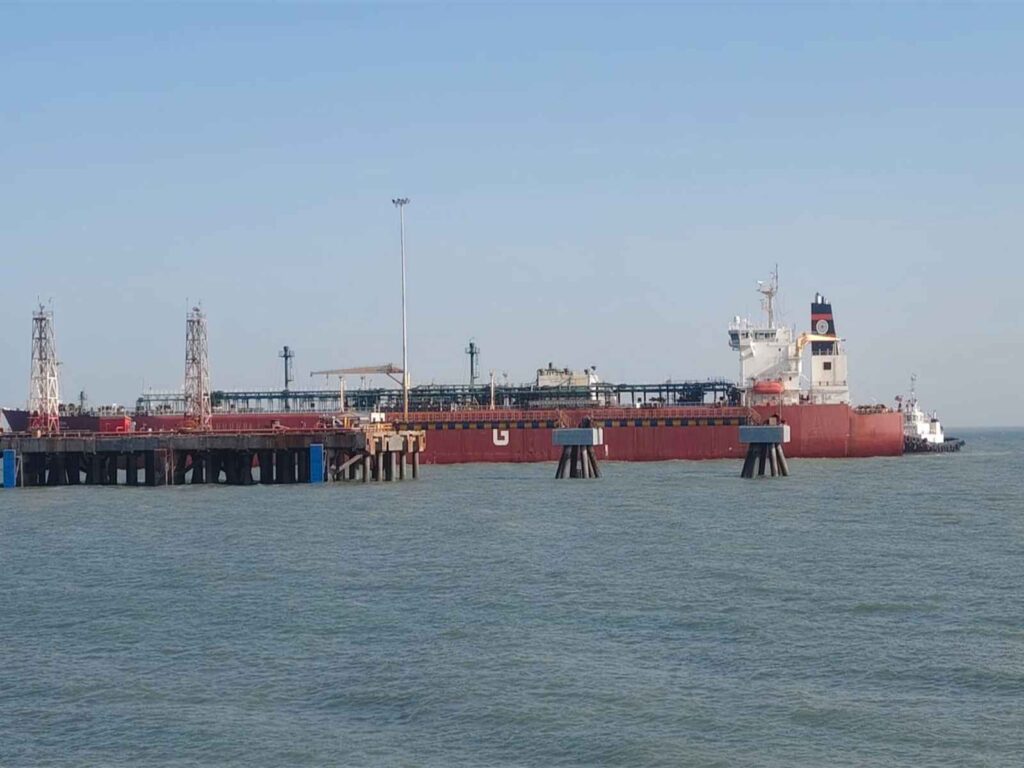
Two more Indian-flagged LPG tankers have begun their journey from the Persian Gulf and are expected to transit the war-torn Strait of Hormuz before heading towards Indian ports.
Ship tracking showed that the LPG tankers Pine Gas and Jag Vasant, which were passing close to each other on Monday afternoon, were near the waters between Iran’s Larak and Qeshm islands – presumably to clarify their identity to Iranian authorities before crossing the strait.
The two ships were among the 22 Indian-flagged vessels that were stranded in the Persian Gulf following the war in the Middle East that almost closed the Strait of Hormuz – the narrow waterway between Iran and Oman that connects the oil and gas-producing Gulf nation to the rest of the world.
Ship tracking data showed that both ships were likely to cross the strait sometime on Monday and head towards Indian ports.
Earlier, the ships MT Shivalik and MT Nanda Devi carrying about 92,712 tonnes of LPG (which is equivalent to almost a day’s cooking gas consumption of the country) had safely reached the Indian coast.
When the war broke out in West Asia after the US and Israel attacked Iran, there were originally 28 Indian-flagged ships in the Strait of Hormuz. Of these, 24 were in the western part of the strait and four in the eastern part. In the last few days, two ships each from both sides have managed to reach safe places.
LPG carrier ship Shivalik reached Mundra, Gujarat on March 16, while another LPG tanker, Nanda Devi, reached Kandla port in Gujarat the next day. Both the LPG carrier ships began their voyage on 13 March and transited the Strait of Hormuz on the morning of 14 March.
Indian flag tanker Jag Ladki laden with 80,886 tonnes of crude oil from UAE reached Mundra on March 18. Another tanker, Jag Prakash, carrying gasoline from Oman to Africa, has already safely crossed the strait and is on its way to Tanzania.
Of the 24 Indian-flagged ships remaining in the war zone, 22 are on the western side of the strait, carrying 611 sailors, while two are on the eastern side.
Of the 22 Indian-flagged ships remaining in the western part, six were LPG carriers – two of which have left for India.
Of the remaining vessels, one is a liquefied natural gas (LNG) tanker, four are crude oil tankers, one is transporting chemical products, three are container ships and two are bulk carriers. Additionally, there is one dredger, one empty and three in dry dock for routine maintenance.
In total, about 500 tanker ships are stranded in the Persian (Arabian) Gulf. These include 108 crude oil tankers, 166 oil product tankers, 104 chemical/product tankers, 52 chemical tankers and 53 other types of tankers.
Analysts say Iran may allow select ships to pass through the strait after verification. Some ships have exited the strait by briefly diverting via the Larak-Qeshm Channel.
He says this appears to be a verification process whereby Iran confirms that the ownership, cargo and vessel do not belong to the US, or to people whom Iran has allowed transit.
India imports about 88 percent of its crude oil, 50 percent of natural gas and 60 percent of LPG. Before the war began, more than half of the crude oil imported by India came from countries such as Saudi Arabia, Iraq and the United Arab Emirates, which use the strait for shipping.
About 85-95 percent of LPG and 30 percent of gas came from this strait. Although the disruption in crude oil supply has been partially compensated by alternative sources like Russia, West Africa, the US and Latin America, there has been a cut in the supply of gas and LPG to industrial and commercial users.