
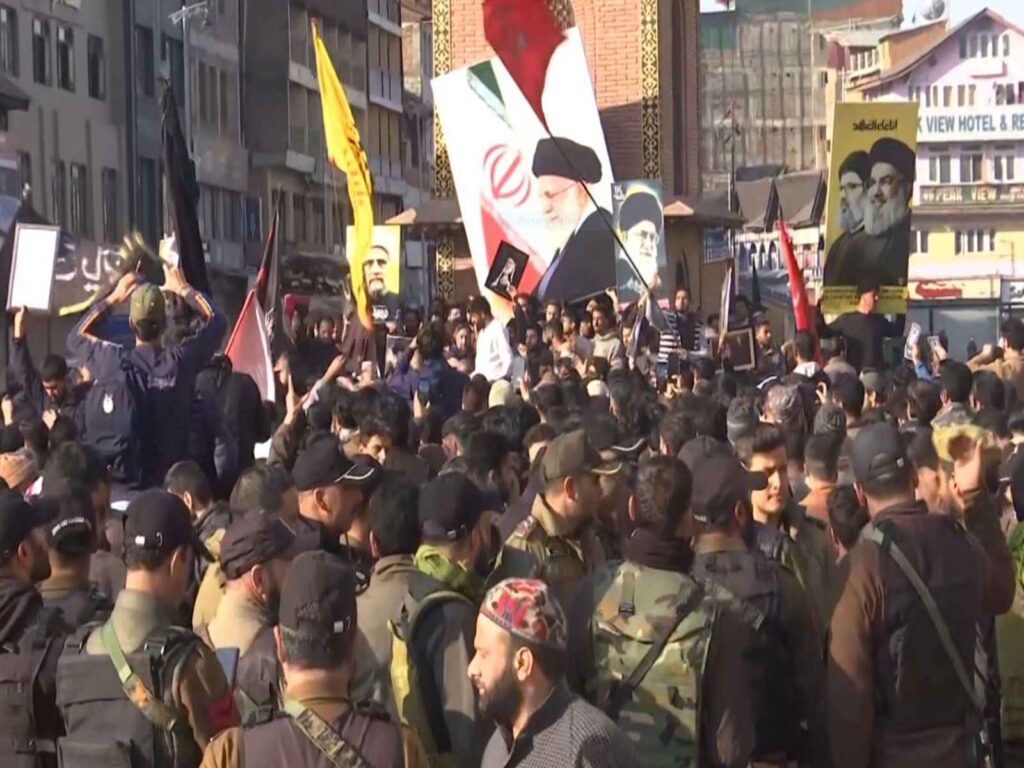
Today i.e. on Sunday, hundreds of Kashmiri Shia Muslims protested against the assassination of Iran’s supreme leader Ayatollah Ali Khamenei, who was killed in Israeli and American attacks.
Protesters chanted slogans against the US and Israel, expressed solidarity with Iran and condemned the attack. The protests remained peaceful, with participants carrying pictures of Khamenei and banners in support of Iran. Black flags, portraits of the Ayatollahs and traditional mourning songs (Nauha) were heard on the streets of Srinagar.
To the Shia Muslim community in Srinagar, Ayatollah Ali Khamenei was more than a foreign political leader; He was a Marja-e-Taqleed (source of imitation).
Iran has declared 40 days of national mourning following Khamenei’s death, leading to widespread mourning and protests across the country. In Shia Islam, the 40th day after death (Arabeen) is very important from a spiritual point of view. The incident occurred following attacks by the US and Israel on Saturday (Operation Epic Fury/Lions Roar).
The office of the country’s supreme leader has declared a period of national mourning, under which flags will fly at half-mast and public gatherings will be held to pay tribute, marking the closing of a 37-year chapter in the Islamic Republic’s history.
Ayatollah Khamenei was the successor of the revolution’s founder, Ruhollah Khomeini. Since 1989, their “story” has been one of unwavering resistance against Western influence.
Authorities have stepped up security across the country, especially in major cities such as Tehran, to prevent unrest and ensure public safety.
All eyes are on the process of selecting Khamenei’s successor, with speculation about possible candidates and their impact on Iran’s future leadership. However, holding meetings under wartime conditions is difficult, and the most important unresolved question is in whose hands lies the future of the Republic—in the hands of the clerics or in the hands of the Revolutionary Guard.
His death is being portrayed by the state media as the martyrdom of the protector, and his end not as a defeat, but as the ultimate sacrifice for the sovereignty of the nation.
Ayatollah Ali Khamenei’s official Persian account confirmed his death early Sunday and published a verse from the Quran. According to Tasnim News, Khamenei was assassinated at his workplace early on Sunday.
Earlier in the day, Iranian media Press TV reported on Sunday that the country’s supreme leader Ayatollah Khamenei was killed in Israeli-US strikes.
In a post on X, Press TV said, “Leader of the Islamic Revolution, Ayatollah Ali Khamenei, martyred in US-Israeli attacks on Iran.”
Earlier, The Times of Israel, quoting Iran’s state media, had reported that Ali Khamenei’s daughter, granddaughter, daughter-in-law and son-in-law were killed in the Israel-US strikes. The Israeli newspaper said there was no official information on Khamenei’s own fate.
Meanwhile, various reports coming from Iran suggest that people have taken to the streets to celebrate. CNN reported celebrations in several cities across Iran. According to news reports, whistles were heard on the streets of the city, people were cheering and shouting slogans like ‘Death to the Islamic Republic’ and ‘Long live the Shah’.
Earlier, US President Donald Trump took responsibility for the Ayatollah’s death and called it justice for the people of Iran.
In a post on Truth Social, Trump said, “Khamenei, one of the most brutal men in history, has been killed. This is justice not only for the people of Iran, but also for all the great Americans and the people of the many countries around the world who were killed or maimed by Khamenei and his gang of bloody goons. However, heavy and precise bombing throughout the week or so will not achieve our objective of peace in the Middle East and, indeed, the entire world. “It will continue without any interruption as long as necessary.”