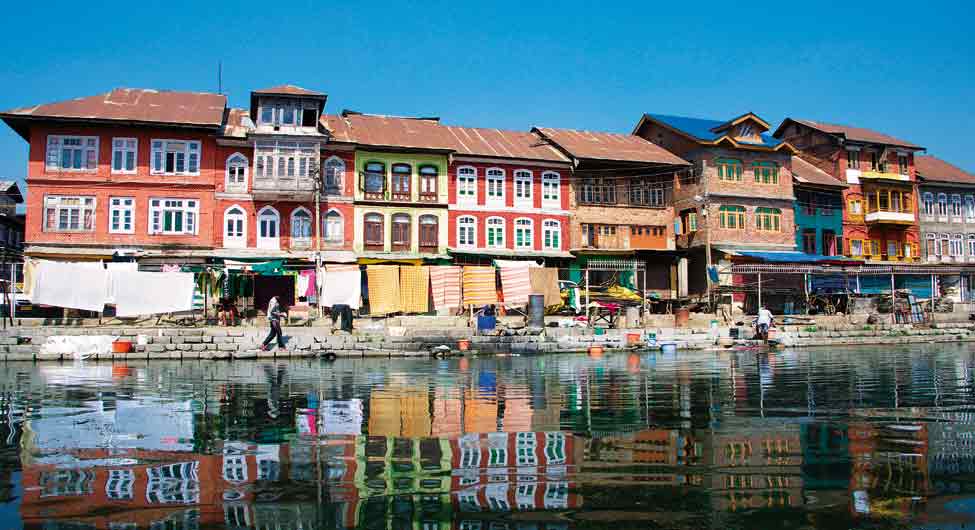
Under the Dal Lake Rehabilitation Scheme, nothing much has been achieved from Rs 416 crore, the problems are deeper, the government is not understanding anything.
When National Conference MLA Tanveer Sadiq in Jammu and Kashmir Assembly asked a question on the status of rehabilitation of people living in Dal Lake in Srinagar, the government’s answer was shocking. The Rs 416.72 crore rehabilitation scheme has seen “only 27 per cent progress” in 17 years. In this big project, approved in 2009 during the tenure of former Prime Minister Manmohan Singh, an attempt was made to relocate about nine thousand families settled on the banks of Dal Lake in the backyard of Srinagar’s Jabarwan hills. The objective was to reduce pollution, save aquatic life and stop the continuously shrinking area of the lake.
But so far only 1,808 families have been resettled in a colony in Srinagar, which was one of the worst-affected areas during the devastating 2014 floods. Some did not go to the new place on their own will, some due to lack of basic facilities, disputes over compensation and stay orders of the High Court.
Dal has been the center of history and culture of Kashmir. There has been human interference in it for centuries. This transformed the lake into floating gardens and settlements. British officer Walter R. of this lake divided into Hazratbal, Bod Dal and Nigeen valleys. Lawrence has made special mention in his book. Lawrence visited different parts of Kashmir and later wrote a book named The Valley of Kashmir, which gives complete information about the geography, history, culture and social conditions of this area.
Along with being a tourist attraction, this lake is also an essential source of livelihood, drinking water, fish and vegetables for the local people. Abbas Kashmiri, who lives in the Mir Behari area of the lake, was born in the hinterland of Dal, where seven generations have lived. He says, “We also have the revenue documents for the water in which we grow nadru (lotus stem). These documents were given to us more than 100 years ago.” People living in Dal say that they settled here as caretakers of the lake.Were.
Earlier, people used to pull out weeds with 25-30 feet long wooden sticks and completely remove the roots. In recent years, the Jammu and Kashmir Lake Conservation and Management Authority (LCMA) started using machines to cut weeds. People living in Dal believe that this has increased the growth of weeds. Local residents say, “Government machines only cut the upper layer. The roots remain there, due to which it grows faster again.
Many claim that conditions began to worsen when authorities banned farming and confiscated the boats used to remove weeds by hand. Gradually, the younger generation started moving from farming to tourism industry, transport and government jobs. Local residents say, “People don’t marry their daughters here. Outsiders still believe that the people living in Dal do not even have proper toilets.
On the condition of anonymity, a resident of Dal said that initially 98 percent of the people living in Dal did not want to move to another place, because their livelihood depended on it. Both environment and livelihood were safe. But uncertainty forced people to leave. “It was not by choice but under pressure,” he says.
failed experiment
Under the rehabilitation scheme, 7,526 kanals of land was acquired in Bemina. Each family was given a plot, Rs 1.05 lakh for construction and a lump sum compensation of Rs 3.91 lakh. But no attention was paid to basic facilities. Because of this many people returned to Dal again.
Environmental activist Raja Muzaffar calls 27 percent progress a “failure.” He says, “If only 25-30 percent rehabilitation has taken place in 17 years, it shows that proper consultation was not done. No consultation was done with experts, no correct and concrete policy was made.”
They say that the people living in Dal are being blamed but no one says anything about the rampant urbanization and construction of big hotels around Dal Lake. He says, “Urbanization causes more than 10 percent pollution in Harwan, Nishat, Shalimar, Boulevard Road.” Muzaffar says that expelling people is not the solution. “If you remove someone from his place, what will happen to him?”
In view of the stalled rehabilitation and legal difficulties, the government has now changed its stance. It was told in the Assembly that 58 interior settlements will be developed as eco-settlements under the in-situ conservation model. Under the current budget, work has started on six, including Kachari Mohalla, which is being described as a “modern village”.
According to a report by Down to Earth, in August 2024, a joint committee formed by the National Green Tribunal had reported that buffer zones were created around Dal Lake to prevent encroachment. The panel reviewed the LCMA’s sewage and solid waste infrastructure during its inspection of Dal and Nigeen lakes in October 2024. 52.40 MLD sewage is generated from 18 municipal wards.
According to data obtained by Outlook from LCMA, the Rs 212.38 crore Joint Management Program for environmental protection of Dal-Nigin Lake has been accepted in principle by the Union Environment Ministry and is still awaiting financial approval.
LCMA superintendent engineer Muzammil Rafiqui said the revised detailed project report (DPR) focuses on sewage treatment, resumption of interlinking channels and management of water capacity. “About 80 per cent of the pollution is covered by sewage treatment plants. Work on the remaining 20 per cent is underway,” he said. He also said that no new houseboats are being allowed and the floating gardens will be managed keeping the environment in mind. “Navigation systems have broken down in many areas. Channels are clogged. If drainage is not repaired, even five days of heavy rain can create a 2014-like crisis,” he said. An environmental researcher, on condition of anonymity, said that the area of Dal has reduced from about 25 square km to about 11 square km of clean water surface. He said, “Erosion of Dal alluvium has increased. “Nitrogen levels have increased due to runoff of waste and fertiliser.”
Dal is adjacent to Dachigam National Park and Salim Ali National Park, which are Himalayan wildlife sanctuaries and are famous for protecting the endangered Hangul (Kashmir deer). This raises questions on the rules of eco-sensitive zone and the guidelines of the Supreme Court, which prohibit new activity within 10 km of the protected area.
The survival and livelihood of many communities around the world depend on water. Floating villages in Borneo in Indonesia, in parts of the Philippines and Malaysia, and even on Southeast Asian urban coasts, coexist with strict waste management systems and modern sewage infrastructure.
Environmental activist Muzaffar says that instead of changing the place, such models should be studied. He says, “Ensure garbage collection. Enforce solid waste rules. If necessary, impose a fee of Rs 100 every month. But do not uproot people, because this is not the solution to the problem.”