
India AI Impact Summit 2026 held at Bharat Mandapam in New Delhi was no ordinary tech event. Inaugurated by Prime Minister Narendra Modi, the conference was attended by more than 20 heads of state, 60 ministers and 500 global AI leaders — making it the largest AI summit ever held in the Global South. Universities, startups and institutes across the country set up stalls to showcase their technological capabilities.
One of them was the stall of Galgotias University located in Greater Noida. His exhibit featured a glowing, four-legged robotic dog he named “Orion.” It was introduced in conjunction with the university’s ₹350 crore AI investment and Center of Excellence programme.
The video that changed everything
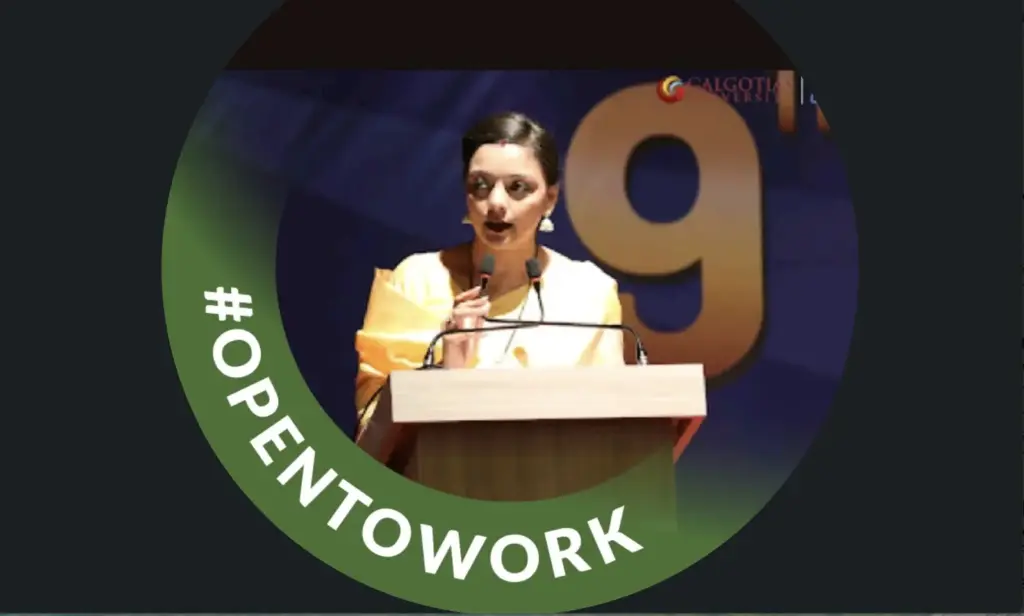
A video clip of the event quickly went viral. A woman — later identified as Neha Singh, a communications professor at the university’s School of Management — was confidently presenting Orion to the media.
He described this robot as developed by the University’s Center of Excellence and said that it is a state-of-the-art machine capable of surveillance and navigation in difficult areas.
Problem? Tech-savvy viewers immediately recognized the same robot.
“Orion” actually turns out to be a Chinese product worth ₹2.5 lakh
That robot was actually the Unitree Go2 — a commercially available model from Chinese robotics company Unitree Robotics, which is available online in India for between ₹2 lakh and ₹3 lakh. It was told that at the time of the demonstration, Chinese branding was also visible on the robot.
In short — a product that anyone could order online, given an Indian name “Orion,” was being presented as an indigenous innovation at the country’s premier AI summit.
There was a storm on social media.
Results: Stalls empty, electricity cut, public apology
The results came very quickly. Galgotias University was forced to vacate its exhibition stall at Bharat Mandapam following huge backlash on social media. MeitY additional secretary Abhishek Singh said the main problem was that the public was misled “when the whole world is watching.”
IT Secretary Krishnan made it clear that the government will not tolerate demonstrations that are presented as original inventions. “If you mislead… we don’t want any controversial organization to show something that doesn’t belong to them,” he said.
According to reports, electricity was cut off at the Galgotias Pavilion and university staff quietly vacated the stall — avoiding questions from journalists.
Professor Neha Singh: “It was misunderstood”
As the controversy escalated, Neha Singh tried to clarify. He said that he never described the robot as belonging to the university. According to her: “We never said it was ours, Indian, or Galgosian. A misunderstanding took the Internet by storm. Maybe I didn’t say what I wanted to say properly, or it was misunderstood. I am faculty of communication in the School of Management, not AI.”
However, her clarification did not satisfy critics — especially because in the viral video she clearly said that the robot was “developed” by the Center of Excellence.
LinkedIn twist: “Open to Work”
The entire episode added a dramatic ending — an “Open to Work” banner appeared on Neha Singh’s LinkedIn profile. These signals on LinkedIn are usually posted by people who are looking for a job.
His LinkedIn bio, which is still public, seems particularly ironic in the context of this entire controversy:
“I have the ability to connect, inspire, and uplift others through my command of language. With a natural command of language, expression, and influence on stage, I have spent years helping people find their voice and express themselves with clarity. I believe the right words at the right time can truly make a difference.” (https://www.linkedin.com/in/neha-singh-565b2b1ab/)
Defense of the University—And Another Controversy
Galgotias University released several statements throughout the day. In a formal apology, the university said: “One of our representatives manning the pavilion was ill-informed. She was unaware of the technical origins of the product and, in her excitement in front of the cameras, provided factually incorrect information even though she was not authorized to speak to the media.”
Earlier in another statement, the university had described the backlash as a “propaganda campaign” against itself. The statement read: “We Galgosians — faculty and students — are deeply offended by the ongoing propaganda campaign against our university.”
But the controversy did not stop here. Netizens also identified a drone displayed at Galgotias’ stall as the Striker V3 ARF — a commercially available product from South Korean company Helsel Group, designed for drone sports. Questions were also raised on the claims that it was “made by hand”.
What did the government say?
MeitY additional secretary Abhishek Singh clarified that the government does not intend to stifle innovation, but the representation should not be misleading. He said the controversy “should not overshadow the hard work of people who have actually done something.”
The big question: innovation versus imitation
The incident has sparked a major national debate — over how educational institutions conduct themselves at major events. Critics say the line between using a globally available tool for education and presenting it as an indigenous innovation is not only ethical — but also a question of national credibility.
Proponents of Galgotias argue that universities around the world use commercially available hardware to train students. The dispute, according to him, was not caused by deliberate deception but by poor communication.
But at an event — meant to showcase India’s AI ambitions to the world — the scene was disastrous.
One more thing: IndiaAI Expo has been extended by a day to 21st February due to the overwhelming response — although it will be closed on 19th February for VVIP audit.
The gist is this: Orion was not born in Greater Noida. It was made in China, bought for around ₹2.5 lakh, and sparked the most talked-about controversy at India’s biggest AI summit. Whether it was a failure of communication or something else — this incident serves as a stark reminder: In this age of viral videos and instant fact-checking, the right words — and the right attribution — really do make a difference.