
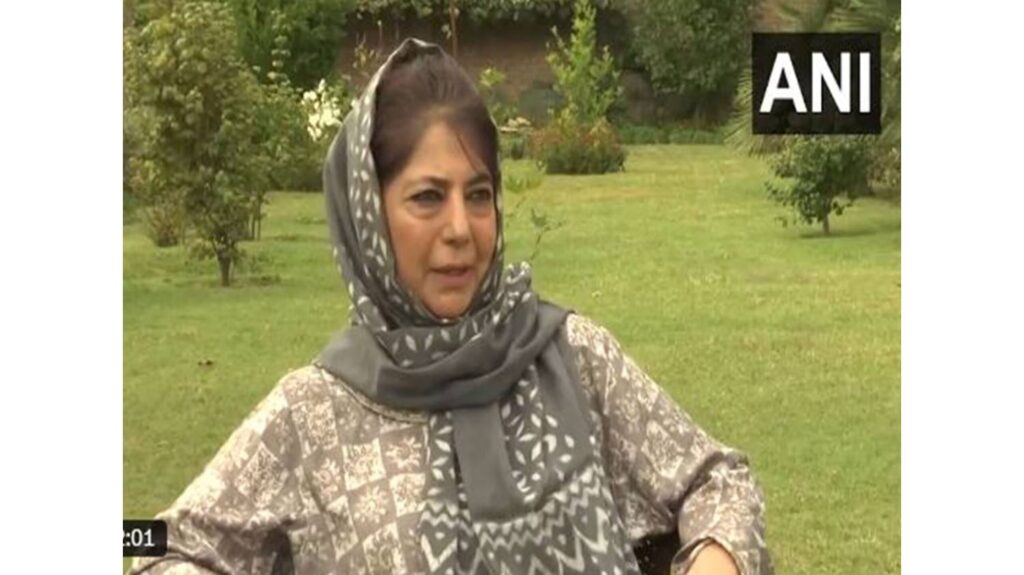
Former Chief Minister of Jammu and Kashmir and PDP chief Mehbooba Mufti on Thursday expressed concern over the recent violent protests in Leh. Talking to the ANI, he blamed the fear in the Ladakhis for this unrest, that his land and culture is in danger. He emphasized that the government should remove these fears through concrete action and not through hollow promises.
He condemned the allegations against Sonam Wangchuk and called it a strategy to hide the failures of the government and warned that converting Ladakh into a “open jail” would have serious consequences. He urged the Center to remove the fears of Ladakh residents through meaningful action rather than “jumlas”.
Talking to ANI, he said, “Ladakh is afraid that his land will be taken away from him and the culture there will change. The government will have to overcome the action, not from action.
The unrest began after a 14 -day hunger strike by climate activist Sonam Wangchuk, who had been protesting peacefully for these demands for five years, even he had traveled barefoot from Leh to Delhi.
The disturbance in Leh stems from the state status and long -standing demands to include in the sixth schedule. The people of Jammu and Kashmir are also making similar demands for the state status since the cancellation of Article 370 in 2019.
In Leh, officials have imposed restrictions under Section 163 of the Indian Civil Protection Code, 2023. According to an order from the District Magistrate, there is a ban on the gathering of five or more persons in the district; No procession, rally or march will be taken out in Leh without pre -written permission.
It is well known that the Government of India is actively interacting with the top bodies Leh and Kargil Democratic Alliance on these issues. He had several meetings with the high-powered committee (HPC) and the sub-committee through formal means and many informal meetings with the leaders.
The next meeting of the high -powered committee has been scheduled on 6 October. Meetings are also proposed on 25 and 26 September with Ladakh leaders. On the other hand, Ladakh Ladakh Lt. Governor Kavinder Gupta chaired a high -level security review meeting on Thursday, which assessed the situation after the protests seeking state status and sixth schedule status, which turned out to be violent and clashed with the police.
On the other hand, Ladakh Ladakh Ladakh’s Ladakhist headed a high -level security review meeting on Thursday to assess the situation after protests demanding state status and sixth schedule status. The protests turned violent and clashed with the police.
He emphasized the need for strict vigilance, strong inter-agency coordination and active measures to ensure peace, security and public system in the entire Union Territory. Ladakakh’s Lieutenant Governor’s Office shared in a post on X, “Lieutenant Governor Kavinder Gupta presided over a high level security review meeting to assess the emerging situation in Ladakh, in which a high-level security review meeting was enhanced, in which peace, security and public arrangements in the state to protect the public system. The need for uninterrupted inter-agency coordination and active measures was emphasized.
Ladakh’s Lt. Governor’s Office shared in a post on X, “Lieutenant Governor Kavinder Gupta chaired a high-level security review meeting to assess the emerging situation in Ladakh, stressing on the need for the need for seamless inter-agency coordination and active measures.”
Mustafa demanded an inquiry into the case, saying, “Till now all our protests and conversations with the government have been very peaceful and we want to continue it. We are a border area and we have been fighting enemies like Pakistan and China for the last 70 years. Whoever has fired on people should be held accountable for ruthless murder.”
The people of Ladakh are demanding to include the Union Territory in the sixth schedule of the Constitution. The sixth schedule of the Constitution includes Article 244 (2) and 275 (1), including “provisions related to administration of tribal regions of Assam, Meghalaya, Tripura and Mizoram states.”