
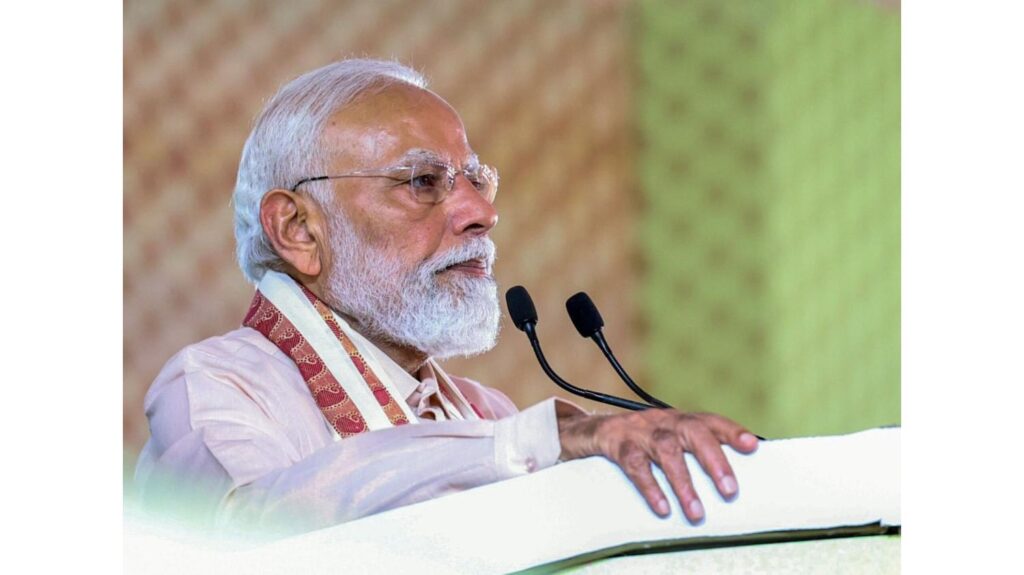
Prime Minister Narendra Modi on Thursday outlined a twin approach to energy security: boosting domestic infrastructure for wider access and promoting self-reliance to reduce import dependence. Addressing the gathering at the NXT conference held at the Bharat Mandapam on Thursday, the Prime Minister said, “First, we create infrastructure to increase energy access in the country. Second, we do not have to be completely dependent on foreign sources for energy. For this we emphasized self-reliance in the energy sector. Is…”
He also criticized the opposition for “pursuing its agenda” amid the LPG shortage issue and assured that continuous efforts were being made to “remove bottlenecks in the supply chain”.
Addressing the gathering at the NXT conference held at Bharat Mandapam on Thursday, the Prime Minister said that the opposition is trying to create panic among the public, which is causing loss to the country. He further said that although the war has affected the country, the government is making continuous efforts to deal with the crisis.
The Prime Minister said, “There is a lot of discussion these days about LPG. Some people are trying to serve their own interests by spreading panic. I do not want to make political comments on them at this time. But I would definitely say that by doing this they are exposing themselves to the public and causing huge loss to the entire country. No country is untouched by this global crisis arising out of war. Everyone is affected by this crisis to a greater or lesser extent. India is also making every possible effort to deal with this crisis. We are making efforts at various levels. Recently I have discussed this issue with top leaders of many countries across the world. Continuous efforts are also being made to remove the bottlenecks in the supply chain.
Prime Minister Modi also highlighted the efforts made by the BJP government to increase the capacity of petrol, diesel and LPG resources in the country. He said that before 2014, the country had minimal reserves of petroleum, which have increased to more than 50 lakh tonnes at present. Similarly, he said the number of LPG connections and LNG terminals has doubled in the country since 2014.
The Prime Minister said, “We have made significant progress in capacity building in the petroleum and diesel sector. Before 2014, India’s strategic petroleum reserves—crude oil stored for use in times of crisis—were very low. Today we have established strategic petroleum reserves of more than 50 lakh tonnes.”
He further said, “Till 2014, there were only 14 crore LPG connections in the country. Today the number is more than double—33 crore domestic LPG connections. In 2014, there were only 4 LNG terminals in the country. Today their number has also doubled.” While reassuring the public, the Prime Minister referred to the rise in fertilizer prices during the escalation of the Russia-Ukraine crisis. He stressed on the efforts taken by the Central Government to minimize its impact on farmers and citizens, including keeping the price of a bag of urea stable at Rs 300, while globally it is priced at Rs 3000.
The Government of India has always made every effort to ensure that the burden of the consequences of war does not fall on Indian citizens. Fertilizer prices skyrocketed as the Russia-Ukraine crisis escalated. Despite this, we provided a bag of urea to our farmers for Rs 300, which used to cost Rs 3,000 in the international market. This time too, we will make every effort to ensure that the war has minimal impact on the lives of our farmers and citizens,” the Prime Minister said.
He also requested the state governments to “stop black marketing and spread of rumours” and assured strict action against those involved in such activities.
“At this critical time, I also request the state governments from this platform: It is extremely important to stop black marketing and spread of rumours. Therefore, careful monitoring of the situation is necessary. Strict action should be taken against those indulging in black marketing,” the Prime Minister said.