
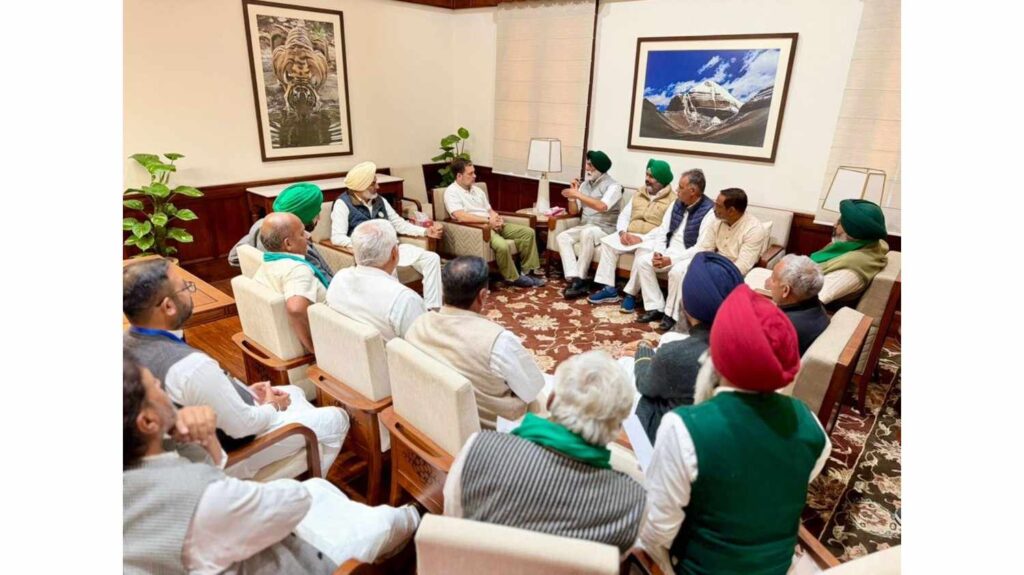
Rahul Gandhi on Friday hosted a diverse delegation representing 17 major farmer unions from across India for an intensive meeting at his Parliament office to discuss the India-US interim trade agreement. This information was shared by Sukhpal Singh, MLA from Bholath, former opposition leader of Punjab and president of All India Kisan Congress on X.
Khaira posted on
Farmer leaders expressed concern that the agreement would harm Indian farmers, especially those growing corn, soybeans, cotton, fruits and nuts. He called for a nationwide movement to protest the agreement and protect the rights and income of farmers.
Khaira posted, “Rahul Gandhi met leaders of farmer unions from across the country at Parliament House today.” Farmer leaders expressed opposition to the US-India trade deal, warning that it poses a serious threat to the livelihoods of farmers growing maize, soybean, cotton, fruits and dry fruits.
Khaira posted, “In the discussion, Rahul ji and union leaders stressed the urgent need for a nationwide mass movement to oppose this agreement and protect the rights, income and future of farmers and agricultural laborers across India.”
Sukhpal S. in the 17-member delegation. Prominent leaders like Khaira (MLA Bholath), advocate Ashok Balhara, PT John and Tejveer Singh were included. Their united stand shows that “KMM – India” (Kisan Mazdoor Morcha) is getting ready to face its biggest challenge since the farm law protests of 2020-21.
The India-US interim trade agreement focuses on reducing tariff barriers, while also attempting to maintain a balance between India’s domestic agricultural sensitivities and US demand for market access.
America has agreed to reduce the reciprocal duty on Indian goods from 50% to 18%. This will benefit Indian exports in the sectors of textiles, leather, footwear and pharmaceuticals. India has expressed “willingness” (non-binding) to buy US energy (LNG/crude oil), aircraft (Boeing), technology and coking coal worth $500 billion over the next five years.
The US will provide duty-free access to India’s agricultural products such as spices, tea, coffee, mangoes, grapes and cashew nuts, potentially boosting Indian agricultural exports, which were projected to reach $4.45 billion in 2024-25.
The US has agreed to remove the previously imposed 25% punitive duty on Indian goods (linked to India’s purchases of oil from Russia), provided India maintains its commitment to the new trade balance.
However, the government claims that 90-95% of Indian agricultural products have been kept out of this agreement to protect the interests of farmers. The government (through the commerce and agriculture ministries) has adopted a “no compromise” stance on domestic agricultural interests to avoid political opposition.
The government claims that 90–95% of sensitive agricultural areas are protected. No duty concessions have been given on wheat, rice, maize or millet; Milk, ghee, butter, cheese and chicken products are fully protected. The government has clearly banned the import of genetically modified (GM) products. Onion and sugarcane have been kept out of this agreement.
To compromise, India provided limited access to select American products. Duties on intermediate products such as coconut oil, castor oil and modified starch will be phased out over 10 years to give domestic industries time to adjust. Limited quantities of almonds, walnuts and pistachios can be imported at reduced duty.
Duties on dried distillers grains (DDG) and red sorghum (used for animal feed), as well as premium wines and spirits, were reduced. Meanwhile, Rahul Gandhi on Thursday assured farmers of his support, saying, “Whether an FIR is filed, a case is registered or a privilege motion is brought – I will fight for the farmers.”
He accused the government of being anti-farmer and selling the country through this deal.