
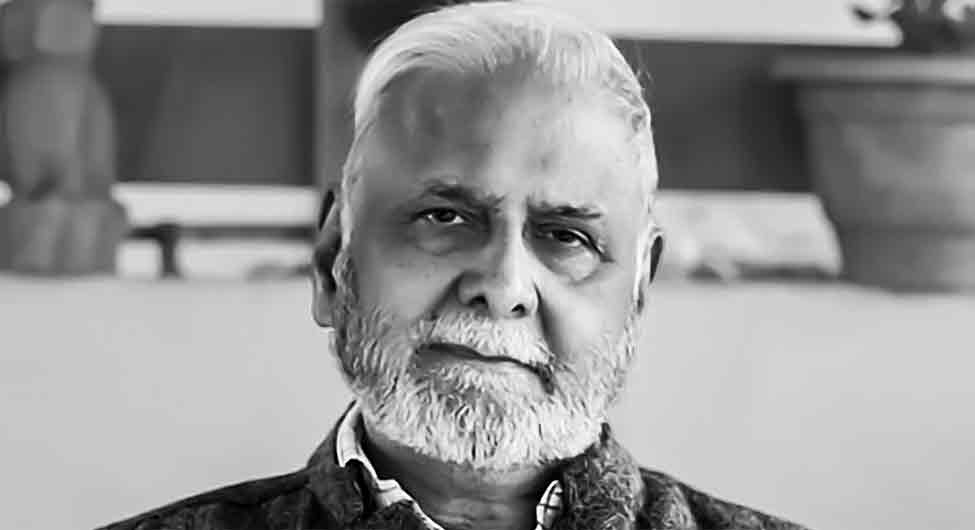
Jagdeep is not left untouched, the news does not pass silently, it travels with us, trembling. There is a difference between the death of a man and the death of passion, isn’t it? Jagdeep Chhokar’s death is one such death of passion. He whole-heartedly thought of and implemented measures to preserve and improve the democratic electoral system.
Kaka Hathrasi had written many humorous poems regarding the deformity of name and work. But even he would not have thought that two persons with the same name could be in distorted roles. I would never have thought of such a comparison, but in the style of missing ladies, the day former Vice President Jagdeep Dhankhar appeared after 53 days, Jagdeep left without a trace. Then it occurred to me that there is a huge difference between two people with the same name. Even while leaving, Jagdeep Chhokar recorded his statement against the spineless thirst for power.
Jagdeep Chhokar was not a court man. Chhokar Saheb, who was once a professor at IIM, Ahmedabad, after his retirement from there, joined with some Sahamna people and formed an organization named Association for Democratic Reform or ADR and remained with it. Free and fair elections have their place in a parliamentary democracy. A place that cannot be changed, cannot be stolen, cannot be taken away, nor can it be left in someone’s pocket. If anything like this happens, it is possible that the system of democracy may survive but its spirit dies. This is the basic thing. (It is due to his and ADR’s efforts that candidates in the elections give information about their assets and cases; every candidate and party is forced to give account of election expenses. It is only through ADR that we know how many people have criminal cases in our Parliament and Assemblies. It is ADR that challenged the particularly intensive scrutiny of Bihar).
When parliamentary democracy had just arrived in the country, even Gandhi, who had a kind of dislike for the parliamentary system, understood this role of elections and was also cautious about it. He kept saying in different words that strong monitoring of elections would be necessary, because this is where the betrayal of democracy can begin. Therefore, the night before he was shot, he wrote the last document of his life so that Congress could consider it. Along with many other things, it was also recorded that the work of adding, deleting and deleting names in the voter list should be decentralized and should be done by public servants at the village level. He never liked the idea of raising a huge white elephant like the Election Commission. Gandhi was actually shot because he was constantly trying to take the country towards dangerous options.
After independence and after Gandhi, if anyone paid the most attention and worked towards the promotion of democracy, it was Jayaprakash Narayan. The country secretly considered him an alternative to Jawaharlal. But after the election defeat, such efforts were also considered the cry of the defeated opposition. After independence, it was Jaiprakash who formed the committee for electoral reforms. This was also a new experiment in the context of democracy that not only government but also civil committees and inquiry commissions should be formed. Even when we were slaves, on Gandhi’s initiative a citizens’ committee was formed to investigate the Jallianwala Bagh massacre, of which Gandhi was also a member. Jayaprakash constituted many such commissions, both on administrative reforms and on education system. Later, he made the question of democracy so important that he created a whole movement and philosophy of total revolution.
This kind of thing happened to Chhokar Saheb on many occasions. It is foolish and also fruitless to think that the electoral system should remain centralized and the government should not misuse it. He argued with me a couple of times and then ended the conversation by saying that I do not have the ability to say anything new and I am just trying to patch what is going on.
This tailoring is also of great importance. As challenging as the task of building parliamentary democracy is, the task of keeping it democratic is equally challenging. Power needs as much democracy as is necessary to ensure smooth functioning of its power. Those who want democracy cannot digest anything less than a developing democracy. There is a need to keep expanding the sky of democracy, because that which does not develop in favor of the citizen is not democracy. Jagdeep Chhokar was a soldier of such developing democracy. They are no more. Is there democracy? Will there be democracy? Wherever Chhokar Saheb has gone after handing over this question and challenge to us, we will find him fighting for democracy there too.