
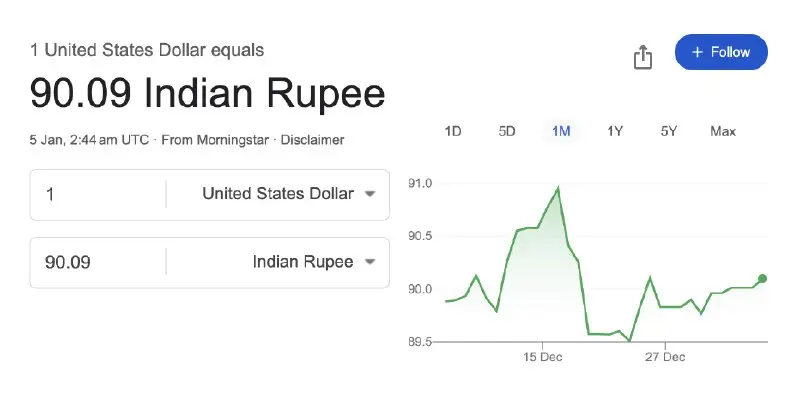
After the US military intervention in Venezuela, geopolitical tension is at its peak at the global level, the direct impact of which is now visible on the Indian currency market. Due to this new crisis, the movement of the Indian rupee may deteriorate this week. Market experts and analysts estimate that the rupee may further weaken against the dollar and fall to the level of 90.50 to 91. Investors are rushing towards safe investments in view of global uncertainty, due to which the dollar is strengthening.
Huge turmoil in global markets due to Venezuela crisis, strong increase in demand for dollars due to increasing uncertainty among investors.
The impact of increasing tension on the global stage is being clearly felt on the Indian currency market. There is an atmosphere of nervousness among international investors after the recent US military action in Venezuela. In this period of uncertainty, investors are withdrawing money from risky markets and investing it in safe currencies like dollar, due to which the demand for dollar has increased and the rupee has come under pressure. Rupee has been in a weak trend since last few trading sessions and has become highly sensitive to global volatility.
Risk on currencies of emerging markets increases due to fear of fluctuations in crude oil prices, India may also be affected
Venezuela is a major oil exporter, so the instability there is likely to have a direct impact on crude oil prices. Experts say that although India imports less than 1 percent of its oil needs from Venezuela, global tensions and fear of retaliation could affect the entire oil market. Whenever crude oil prices rise or geopolitical tensions increase, it is considered negative for currencies of emerging markets like India. This is the reason why the rupee seems to be getting a double blow.
All eyes are on the next step of the Reserve Bank, the dollar-rupee swap to be held on January 13 will be very important.
According to market experts, the role of the Reserve Bank of India (RBI) has now become very important to manage the rupee. Although RBI has taken some steps to support the rupee, the market’s eyes are now fixed on the date of January 13. On this day the Reserve Bank is going to do a big dollar-rupee swap of $10 billion. Analysts believe that unless this major step is taken, the rupee may slip into the range of 90.50 to 91 per dollar. It will be interesting to see at what level the central bank intervenes in the market.
The burden on the common man’s pocket may increase: With imports becoming expensive, there is a fear of petrol-diesel and inflation increasing.
The impact of this fall of rupee will not be limited only to the stock market or currency market, but it can have a direct impact on the pockets of the common man. Due to weakening of rupee against dollar, there is every possibility of imports becoming expensive in the country. India imports most of its crude oil needs, so the rupee’s weakness may put pressure on petrol and diesel prices. Apart from this, due to the cost of imported goods, an increase in the inflation rate can also be seen in the country. Also, in this environment of uncertainty, huge fluctuations can be seen in the stock market.