
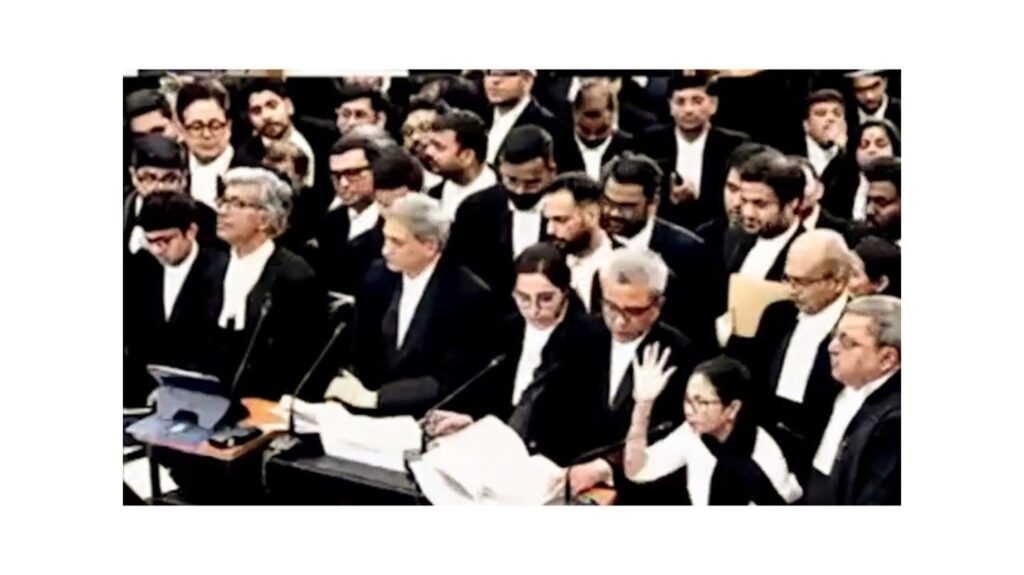
The Supreme Court on Monday extended by a week the deadline for publication of the final voter list under the Special Intensive Revision (SIR) exercise of the Election Commission of India (ECI) in West Bengal, while also issuing a show cause notice to the West Bengal Director General of Police (DGP) over allegations of violence during the revision process.
The final voter list, which was earlier scheduled to be published on February 14, will now be released after the extended deadline. A bench headed by Chief Justice of India Surya Kant said the extension was necessary as the Electoral Registration Officers (EROs) and Assistant Electoral Registration Officers (AEROs) needed additional time to scrutinize the documents and take appropriate decisions.
The Court also took serious cognizance of the allegations of violence during the SIR process and issued a show cause notice to the West Bengal Director General of Police (DGP) directing him to explain the steps taken to maintain law and order in the state.
“In order to streamline the ongoing SIR process and address the apprehensions raised by various stakeholders, we deem it appropriate to issue certain additional directions (keeping in mind that OMIT had issued certain directions in the previous hearing as well),” it said.
The court directed the West Bengal government to submit the list of 8,505 officers to be deputed by the state by 5 pm on Tuesday. The Court provided discretion to the Election Commission to replace EROs and AEROs and utilize the services of these officers as and when required.
“Out of these officers, the ECI, after a brief scrutiny of their bio-data, may shortlist personnel equal to the number of micro-supervisors already serving and provide them with brief training in EROS, AEROS and assistance to micro-supervisors,” the Court said.
The Court clarified that these officers would only assist in the process and “the final decision rests solely with EROS.” Citing allegations made in the counter affidavit of the Election Commission that despite complaints, no action was taken against persons burning Form-7 (objection forms) and other materials, the Court issued a show cause notice to the DGP. The court said that it will take a final decision on the scope of powers of the Election Commission in this regard only after receiving the reply from the police chief.
During the hearing, senior advocate Shyam Diwan, appearing for Chief Minister Mamata Banerjee, said that out of 7.08 crore voters included in the draft list, mapping of 6.75 crore has been done, while mapping of 32 lakh has not been done. He further said that even among the voters whose mapping has been done, about 1.36 crore names have been kept in the logical discrepancy list due to “minor spelling and dialect variations like Dutta-Datta and Roy-Ray”.
Diwan also told the court that the state has deployed over 8,500 Group-B officers and assured that “they can report to EROS immediately.” Senior advocate Abhishek Singhvi, appearing for the West Bengal government, argued that the state government had offered assistance, but the Election Commission instead appointed “micro observers from outside Bengal” who were unfamiliar with the language and administrative system of the state. He claimed that the Election Commission had never before “sought deputation of Group-B officers” and trained state officers were inappropriately sidelined.
Diwan also argued that the modus operandi of micro-observers could lead to mass deletion of voters’ names. Responding to this, the Chief Justice said that the purpose of micro-observers is only to assist EROS and AEROS and not to take independent decisions.
After hearing all parties, the Supreme Court issued the above directions. The Supreme Court was hearing a batch of petitions filed by various petitioners, including Chief Minister Mamata Banerjee, alleging irregularities in the SIR exercise conducted by the Election Commission in West Bengal. Banerjee has alleged that voters’ names were put in the logical discrepancy list due to minor dialectal spelling differences and objection notices were issued without any reason.
Earlier, Banerjee herself appeared before the Court and said that the State was being selectively targeted by the Election Commission to remove voters instead of including them or rectifying the errors. After hearing their arguments, the Court had sought a response from the Election Commission.